
 Posted by
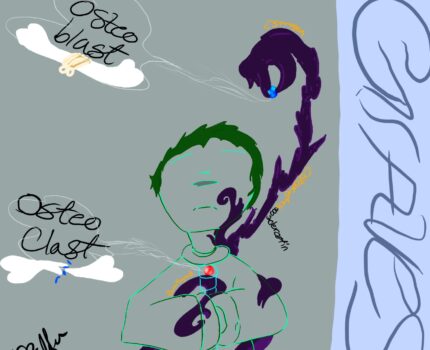
Graves disease negatively affects the hormones that regulate bone development.
Bones within the body support weight, stabilize, protect, and store minerals for the body. This organ extends throughout the body providing form. Bone development and regeneration is done through osteoblast and osteoclast cells. How much these cells are active are regulated by hormones such as estrogen and parathyroid hormone. A condition such as graves disease disrupts the release of these hormones leading to issues with bone development and lead to the development of additional conditions concerning the bone.
Bones form through bone remodeling. The process consists of osteocytes, estrogen, and parathyroid hormone regulating osteoblasts and osteoclasts. The first phase is when osteocytes, which release the hormone sclerostin. A cell that is regulated by the hormone estrogen. This enables the activity of osteoclasts to reabsorb bone material and degrading the matrix proteins. These proteins consisting of matricellular proteins (Alford & Hankenson, 2006). After that the next phase would be that pre-osteoblasts become osteoblasts. These cells are attracted to the degraded matrix and repair the bone by synthesizing matrix compounds to form bone (Dunja Mudri, 2022). The hormones regulate this process through how much of the hormones is being released. Graves disease affects this process negatively.
Graves disease is a condition where the thyroid hormones is overstimulated leading to hyperthyroidism. This is where the thyroid hormone is overactive (Dunja Mudri, 2022). Hyperthyroidism has in trails been associated with lower levels of estrogen, a hormone that regulates osteoblasts as well as being involved in regulating osteocytes (Kjaergaard et al., 2021). As opposed to this an increase in parathyroid hormone, which regulates osteoclasts has been observed. This leads to an increased period of osteoclast activity and decreased osteoblast activity (Mikosch, 2005). The osteoblasts not being able to repair how much the osteoclasts reabsorb affects the structure of the bone.
The period of time for the osteoclast activity is typically one fourth that of the length of which osteoblasts are active. When graves disease affects the release of hormones osteoclast are active for almost the same length of time as the osteoblasts (Dunja Mudri, 2022). With less time for repair the bones become at risk of becoming more brittle, having an higher risk of break or fracture, and even loss of bones mass. Graves disease also puts one at higher risk of developing a secondary condition called osteoporosis. Osteoporosis is a disease that causes the bones to become more weak and brittle due to irregularities in hormone regulation.
Bones are an important organ that we rely on to keep out body stable and mobile as well as protected. Osteoblasts and osteoclasts are the cells that handle both the breakdown and repair of the bone. These cells in turn are regulated by the hormones estrogen as well as the parathyroid. A condition such as graves disease can negatively impact the amount of hormones being released in turn changing the activity of the cells involved in the formation of bone. This change in cell behavior may lead to degrading bone health as well as the development of secondary conditions such as osteoporosis.
Works Cited
Dunja Mudri. (2022). Impact of Graves’ Disease and Antithyroid Drug Therapy on Bone Mineral Density – Pathophysiological Mechanisms and Clinical Relevance. Acta Clinica Croatica. https://doi.org/10.20471/acc.2022.61.03.15
Mikosch, P. (2005). Effects of thyroid disorders on the bone. Wiener Medizinische Wochenschrift (1946), 155(19-20), 444–453. https://doi.org/10.1007/s10354-005-0222-0
Kjaergaard, A. D., Marouli, E., Papadopoulou, A., Deloukas, P., Kuś, A., Sterenborg, R., Teumer, A., Burgess, S., Åsvold, B. O., Chasman, D. I., Medici, M., & Ellervik, C. (2021). Thyroid function, sex hormones and sexual function: a Mendelian randomization study. European Journal of Epidemiology, 36(3), 335–344. https://doi.org/10.1007/s10654-021-00721-z
Alford, A. I., & Hankenson, K. D. (2006). Matricellular proteins: Extracellular modulators of bone development, remodeling, and regeneration. Bone, 38(6), 749–757. https://doi.org/10.1016/j.bone.2005.11.017
STEAM Abstract: Paige Snuffer – Graves disease and your bones
This STEAM project includes an artistic representation of how graves disease causes harm to the bones of the body. Estrogen is shown removing osteoblasts from the body, leaving osteoclasts behind. In graves disease, reduced osteoblast activity along with prolonged osteoclast activity reduce the body’s ability to repair the bone, affecting the structure of the bone. Osteocytes are also depicted in the painting releasing the hormone sclerostin. In the body this would enable osteoclasts to reabsorb bone material, further exacerbating the situation.
Bones are important to the body and give the body shape, provide support, stabilize, protect, and store minerals for the body. Bone development and regeneration is accomplished through osteoclast and osteoblast activity. This activity is regulated by the hormone estrogen and the parathyroid hormone. Graves disease disrupts these hormones causing issues with bone development.
When one is diagnosed with graves disease, thyroid hormones are overstimulated causing hyperthyroidism. Hyperthyroidism has been linked in trials to lower levels of estrogen, which regulates osteoblasts and osteocytes. In addition, an increase in parathyroid hormone has been shown leading to an increased period of osteoclast activity. With less osteoblast activity and more osteoclast activity, the bone cannot be repaired enough to offset the resorption. Graves disease also increases risk of osteoporosis which can further weaken bones.
Living with graves disease has serious negative affects on the health and wellness of our bones which can have a detrimental effect on one’s quality of life and overall health. The normal regulation of osteoblast and osteoclast activity by estrogen, osteocytes, and the parathyroid hormone is crucial to maintaining healthy bones.