
 Posted by
Hypertrophy is the process of muscle growth. Research on the particular triggers and mechanisms for hypertrophy have evolved over the years, and are still not fully understood. However, the research has at least given us a good estimate on different stimuli required to stimulate muscular hypertrophy, as well as the underlying mechanisms that cause hypertrophy following exposure to said stimuli.
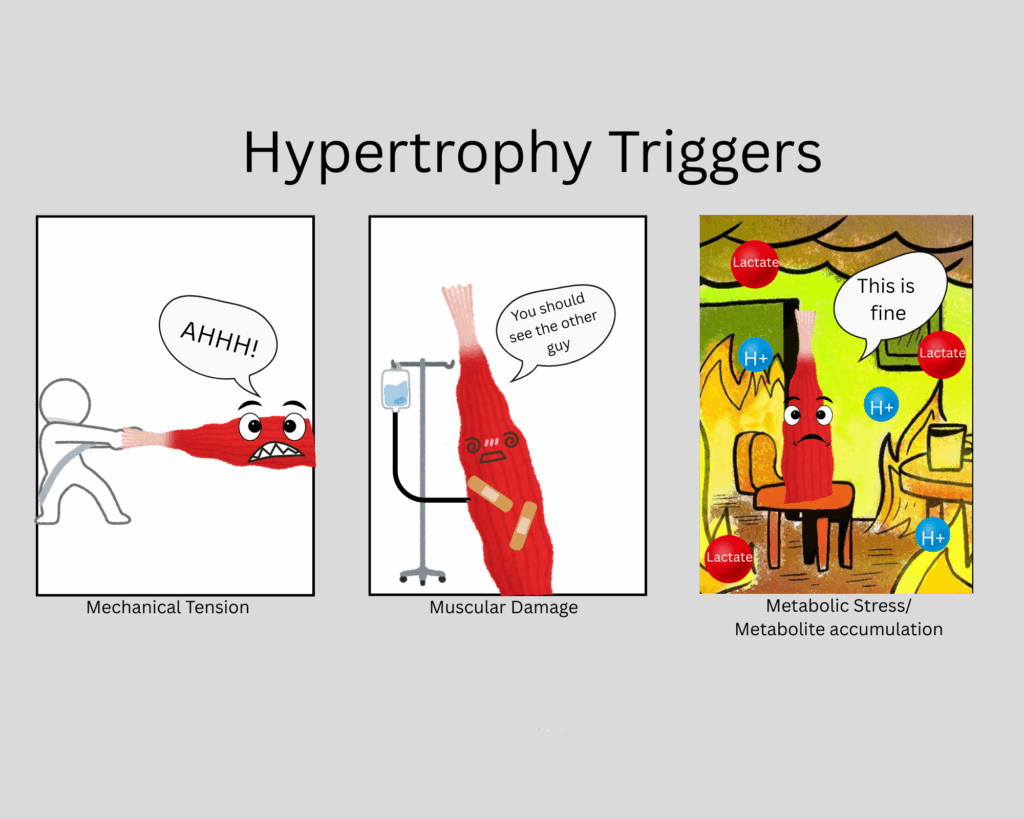
The main triggers required for hypertrophy, as we currently understand it, are mechanical tension, muscular damage, and metabolic stress in the form of metabolite accumulation. Mechanical tension is caused by a muscle producing force across a joint by pulling on the skeletal attachment point, being stretched, or both. (Schoenfeld, 2013). Mechanical tension is induced during resistance training, when cross-bridge formation and produces force during concentric, eccentric and isometric contractions. Passive tension, caused by static stretching, can also cause hypertrophy, but the intensity and duration of pure stretch-mediated hypertrophy shown in animal models does not seem to be practical in humans (Antonio & Gonyea, 1993). Muscular damage, in the scope of hypertrophy, is microscopic damage done to the muscle fibers during exercise or strenuous activities. It is particularly prevalent during eccentric contractions, and is hypothesized to be one of the triggers for delayed onset muscle soreness (DOMS) (Delayed Onset Muscle Soreness, n.d.). The last hypertrophy signal is metabolic stress, or metabolite accumulation. This is what is thought to cause the burning sensation during strenuous bouts of exertion in a working muscle. Common metabolites include phosphate metabolites, a byproduct of ATP utilization, and hydrogen ions, which change the pH of the blood. Accumulation occurs when production of these byproducts exceeds the body’s ability to clear them (Schott et al., 1995). Some combination of these three factors is considered to be crucial for eliciting muscle growth.
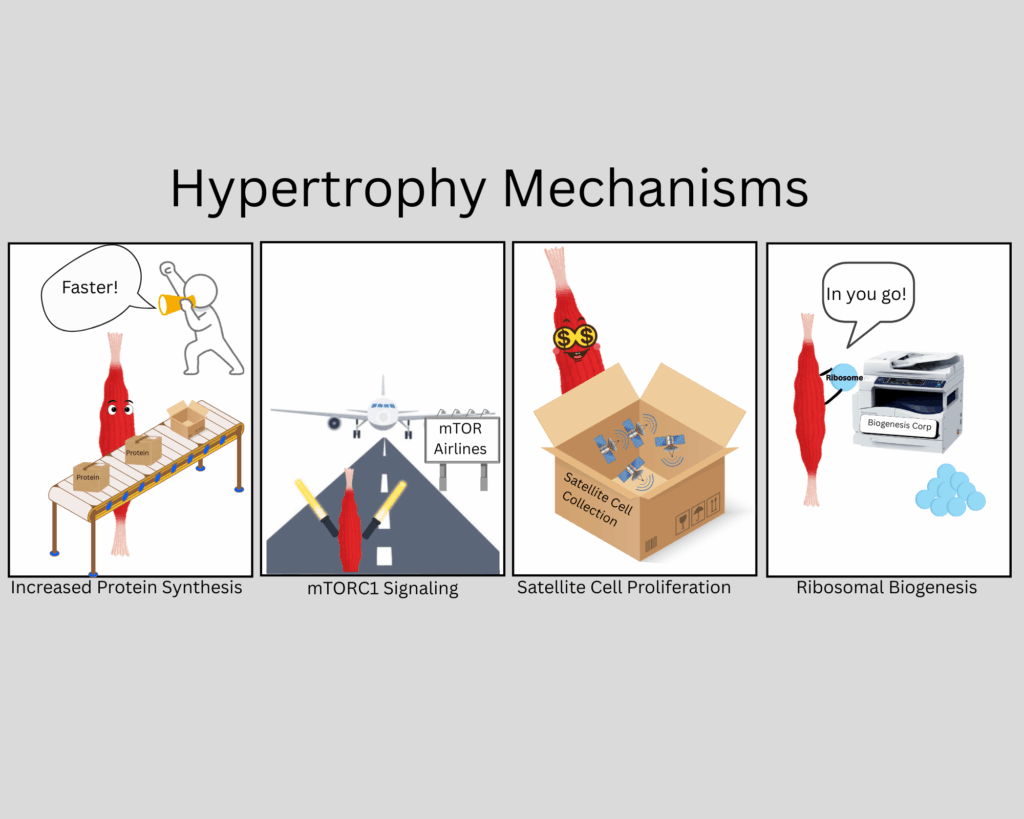
It is important to note that the aforementioned triggers for hypertrophy do not directly cause muscle growth, but trigger a variety of downstream effects which cause the body to build muscle. While there are others, the effects I have chosen to highlight are increased muscle protein synthesis, mTOR signaling, satellite cell proliferation, and ribosomal biogenesis. Muscle protein synthesis can be simplified to one statement: muscles have to create more protein (a process called anabolism) than they break down (catabolism) in order to grow. Unlike some cells in the body, muscle cells are not often replaced, so they must be able to repair themselves via muscle protein synthesis. If synthesis is greater than breakdown, we grow muscle (Schoenfeld, 2010). Next is mTOR signaling, which is actually an upstream effect causing muscle protein synthesis. mTOR stands for mammalian target of rapamysin, and can be activated via mechanical tension. It is a protein kinase that regulates cell growth. If activated, is triggers a cascade of different effects that end up increasing muscle protein synthesis (Schoenfeld, 2013). Our next mechanism is satellite cell proliferation. Satellite cells are stem cells that can donate themselves to muscle fibers when the integrity of the fiber is disrupted. They can help add nuclei to the muscle fiber, which, under a concept called “myonuclear domain theory”, can allow the muscle to grow larger than it would have with its original number of nuclei. Interestingly, this is also considered to be the mechanism surrounding “muscle memory”, the phenomenon where a previously trained person will regain size and strength much quicker than untrained counterparts following periods of detraining (Snijders et al., 2020). Our last mechanism of hypertrophy is ribosomal biogenesis, the creation of new ribosomes. This is actually a process tied closely in with the mTOR pathway and muscle protein synthesis – mTOR stimulates ribosomal biogenesis. Ribosomes chain amino acids together into more proteins, therefore, more ribosomes equals greater ability to synthesize new proteins. (Figueiredo & McCarthy, 2019).
References:
The project I am analyzing is titled “Mechanisms and Triggers for Muscle Hypertrophy”, and focuses on the process of growing muscle. The project is by Dan Glinko. Hypertrophy is the process of muscle growth. In order for this to happen, hypertrophy requires a trigger. The three main triggers of this are mechanical tension, muscle damage, and metabolic stress. Muscular tension is the pulling or stretching of a muscle on the skeleton. This helps induce muscle growth. Muscle damage is the damage of muscle fibers, typically caused by exercise. This can result in muscle soreness, and also results in muscle growth. Metabolic stress causes the burning sensation in the muscles during exercise, resulting in muscle growth over time. But lets look at how the muscles actually grow when presented with these triggers. The types of stimuli described above cause increased muscle protein synthesis, mTOR signaling, satellite cell proliferation, and ribosomal biogenesis. All of these are important parts of growing a muscle. Protein synthesis causes muscle growth when more protein is created than destroyed. In other words, anabolism must exceed catabolism. Secondly, mTOR signaling regulates cell growth, and plays a part in protein synthesis. Next, satellite cell proliferation helps add nuclei to the muscle cells, which results in muscle growth. FInally, ribosomal biogenesis is the creation of new ribosomes, which helps turn amino acids into more protein. All of these processes must take place in order for a muscle to grow. See Dan’s comic strip artwork for a visual representation of muscular tension, muscle damage, metabolic stress, protein synthesis, mTOR signaling, satellite cell proliferation, and ribosomal biogenesis.