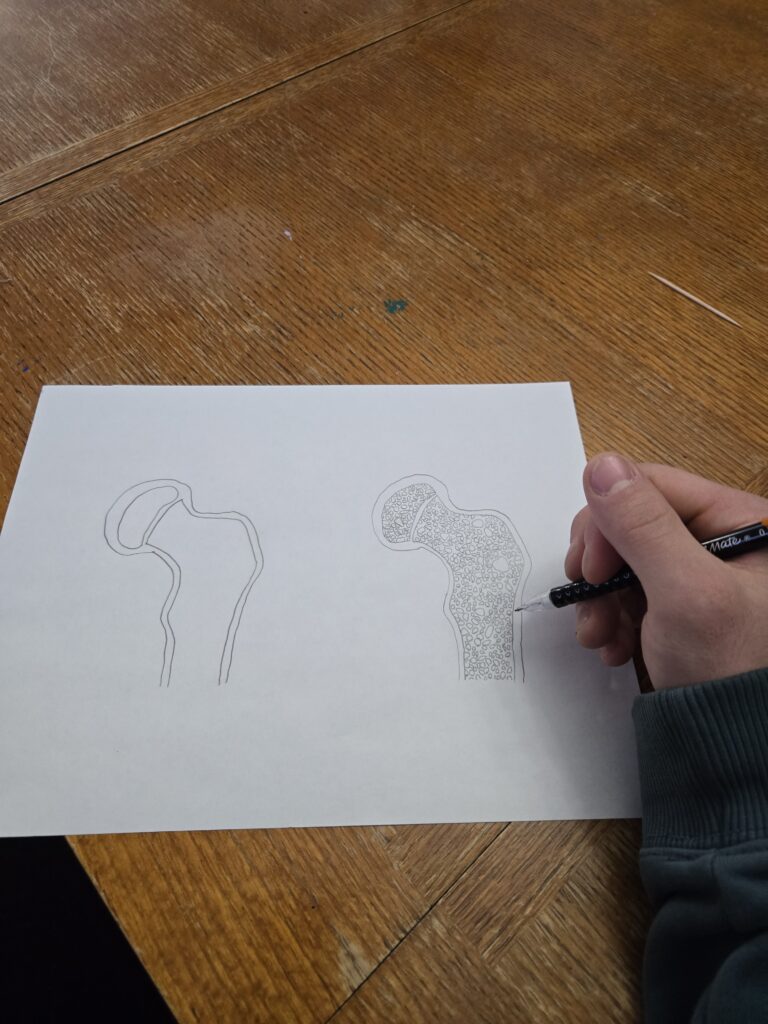
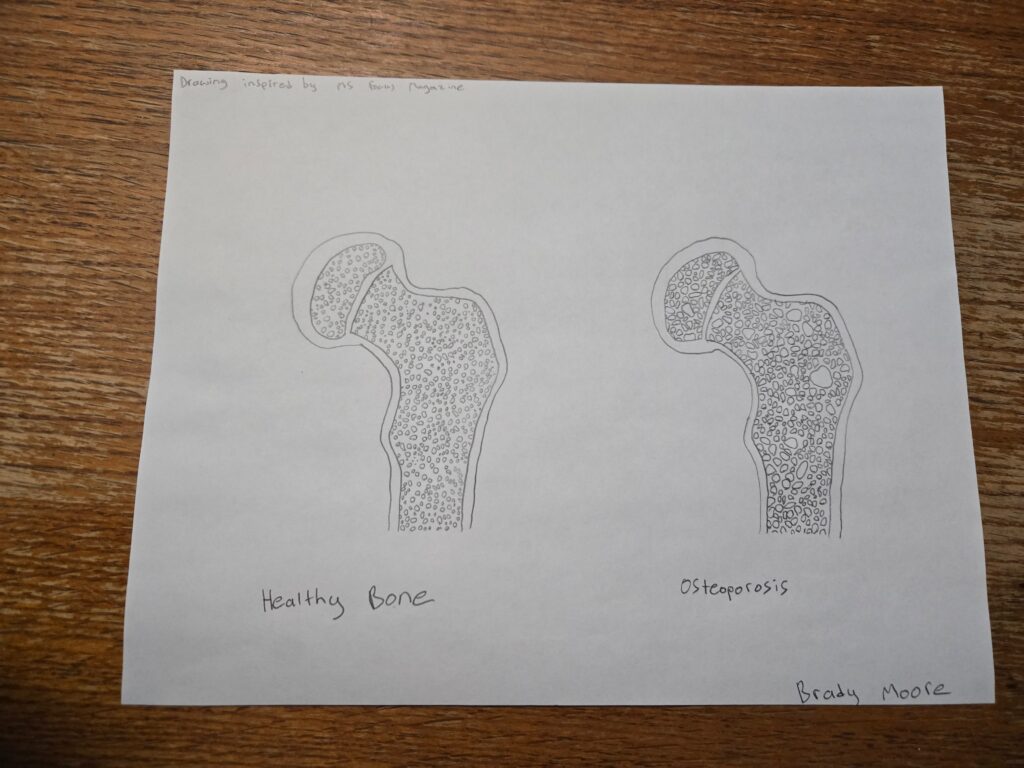
For Brady’s STEAM project he studied osteoporosis and its effects on bone. For the art portion of his project he drew what healthy bone looks like compared to what bone with osteoporosis looks like. Osteoporosis is a chronic skeletal disease that causes one’s bones to slowly weaken and lose mass. This causes the bones to become more brittle making them easier to break or fracture. Osteoporosis progresses silently and without symptoms that are noticeable until a break or fracture occurs. This has led it to being a global health concern, especially as populations age.
Osteoporosis occurs when osteoclast activity that causes bone resorption happens faster than osteoblast activity that causes bone formation. Over time this leads to a loss in bone mass and weakens them. Other molecular pathways that can contribute to this bone mass loss are RANKL/RANK pathway that promotes osteoclast activity, proteases like cathepsin K enzymes that breakdown collagen in the bone matrix, and Wnt signaling inhibitors like sclerostin and Dickkopf-1 that interfere with osteoblast activity. There are some therapeutic advances in osteoporosis including Antiresorptive treatments such as denosumab and odanacatib. Denosumab helps inhibit RANKL and lower osteoclast activity, while odanacatib helps inhibit cathepsin K which helps reduce the degradation of the bone matrix.
The best way to catch osteoporosis early on is through screening and risk assessment. Dual-energy X-ray absorptiometry (DXA) is the best type of screening for osteoporosis but access is limited, therefore questionnaire-based screening tools have been developed to be a more accessible type of screening. The Fracture Risk Assessment Tool (FRAX) model is the most widely used type of screening tool as it is accessible and available in places with limited resources.
 Posted by

STEAM Abstract
Osteoporosis By Brady Moore
For Brady’s STEAM project he studied osteoporosis and its effects on bone. For the art portion of his project he drew what healthy bone looks like compared to what bone with osteoporosis looks like. Osteoporosis is a chronic skeletal disease that causes one’s bones to slowly weaken and lose mass. This causes the bones to become more brittle making them easier to break or fracture. Osteoporosis progresses silently and without symptoms that are noticeable until a break or fracture occurs. This has led it to being a global health concern, especially as populations age.
Osteoporosis occurs when osteoclast activity that causes bone resorption happens faster than osteoblast activity that causes bone formation. Over time this leads to a loss in bone mass and weakens them. Other molecular pathways that can contribute to this bone mass loss are RANKL/RANK pathway that promotes osteoclast activity, proteases like cathepsin K enzymes that breakdown collagen in the bone matrix, and Wnt signaling inhibitors like sclerostin and Dickkopf-1 that interfere with osteoblast activity. There are some therapeutic advances in osteoporosis including Antiresorptive treatments such as denosumab and odanacatib. Denosumab helps inhibit RANKL and lower osteoclast activity, while odanacatib helps inhibit cathepsin K which helps reduce the degradation of the bone matrix.
The best way to catch osteoporosis early on is through screening and risk assessment. Dual-energy X-ray absorptiometry (DXA) is the best type of screening for osteoporosis but access is limited, therefore questionnaire-based screening tools have been developed to be a more accessible type of screening. The Fracture Risk Assessment Tool (FRAX) model is the most widely used type of screening tool as it is accessible and available in places with limited resources.