 Posted by
Breastfeeding plays a critical role in shaping a baby’s early life microbiome, by transferring beneficial microbes and bioactive compounds from mother to infant. These microbes are essential for the development of the infant’s gut microbes, immune system, oral microbiome, and overall health. The research done shows that a mothers breast milk exposes the baby to a variety of different bacterias, both good and bad, which in turn improves the infant’s microbiome development.
Breast milk is full of nutrients and different bacterias that are helpful to a baby. Two components present are, lactoferrin and glycerol monolaurate (Sawale et.al. 2025). Lactoferrin is a glycoprotein transferrin member. It is a non-heme-iron binding protein, meaning it’s a protein that contains iron but no heme and works to regulate iron and homeostasis in the body. Lactoferrin is a part of the innate immune system. In the article titled, Antimicrobial effect of lactoferrin and glycerol monolaurate on selected bacteria associated with newborn infections, authors Manoj Sawale et.al. wrote,, “It has two mechanisms of action against the bacteria: bacteriostatic (nitrogen dependent) and bactericidal (nitrogen independent)” (2025). The first mechanism, bacteriostatic, restricts bacteria from using nitrogen for growth or reproduction by hiding away any immediate iron. The second mechanism, bactericidal, suppresses diseased bacterias by interacting with lipopolysaccharide of gram-negative bacteria. The second component found in breast milk is glycerol monolaurate (GML). Authors Manoj Sawale et.al. wrote, “GML, also known as monolaurin, is a fatty acid monoester formed by glycerol and lauric acid” (2025). GML has been thoroughly researched and it’s known to have antimicrobial and anti inflammatory properties. Both lactoferrin and glycerol monolaurates help improve and build a baby’s immune system.
These components of breast milk are passed through into the infant via natural passive humoral immunity (Larson, Immune System, 60). Each mothers breast milk has its own unique microbiome with a plethora of different bacterias. Stated in the article titled, Breast Milk, a Source of Beneficial Microbes and Associated Benefits for Infant Health, “Breast milk plays a vital role in inoculating the infant gut with bacteria after birth” (Lyon et.al. 2020). The varieties of bacteria diffused from the mother into her child promotes a baby’s gut colonization. Human milk oligosaccharides (HMOs) are glycans that are heavily present in breast milk. Babies cannot digest HMOs but utilize them with Bifidobacterium. The bifidobacterium breaks down the HMOs, leaving no room for bad bacteria which in turn allows the gut to colonize and create a strong intestinal microbiome.
Overall breastfeeding infants is the prime option. It simply fills the baby with necessary nutrients such as water, fats, carbohydrates and proteins as well as supplying them with a diverse amount of bacterias. The diversity then helps build a babies immune system, gut and oral microbiome, and strengthen their overall health.
Works Cited
Agnieszka Dombrowska-Pali, Wiktorczyk-Kapischke, N., Agnieszka Chrustek, Dorota Olszewska-Słonina, Gospodarek-Komkowska, E., & Socha, M. W. (2024). Human Milk Microbiome—A Review of Scientific Reports. Nutrients, 16(10), 1420–1420. https://doi.org/10.3390/nu16101420
Arishi, R. A., Gridneva, Z., Perrella, S. L., Cheema, A. S., Lai, C. T., Payne, M. S., Geddes, D. T., & Stinson, L. F. (2025). Breastfeeding patterns and total volume of human milk consumed influence the development of the infant oral microbiome. Journal of Oral Microbiology, 17(1), 1–9. https://doi.org/10.1080/20002297.2025.2469892
Lyons, K. E., Ryan, C. A., Dempsey, E. M., Ross, R. P., & Stanton, C. (2020). Breast Milk, a Source of Beneficial Microbes and Associated Benefits for Infant Health. Nutrients, 12(4), 1039. https://doi.org/10.3390/nu12041039
Sawale, M., Singh, A., Gutierrez, V., Bala, S., Murguia-Peniche, T., Ozadali, F., Benyathiar, P., & Mishra, D. (2024). Antimicrobial effect of lactoferrin and glycerol monolaurate on selected bacteria associated with newborn infections. Food Control, 168(110882). https://doi.org/10.1016/j.foodcont.2024.110882
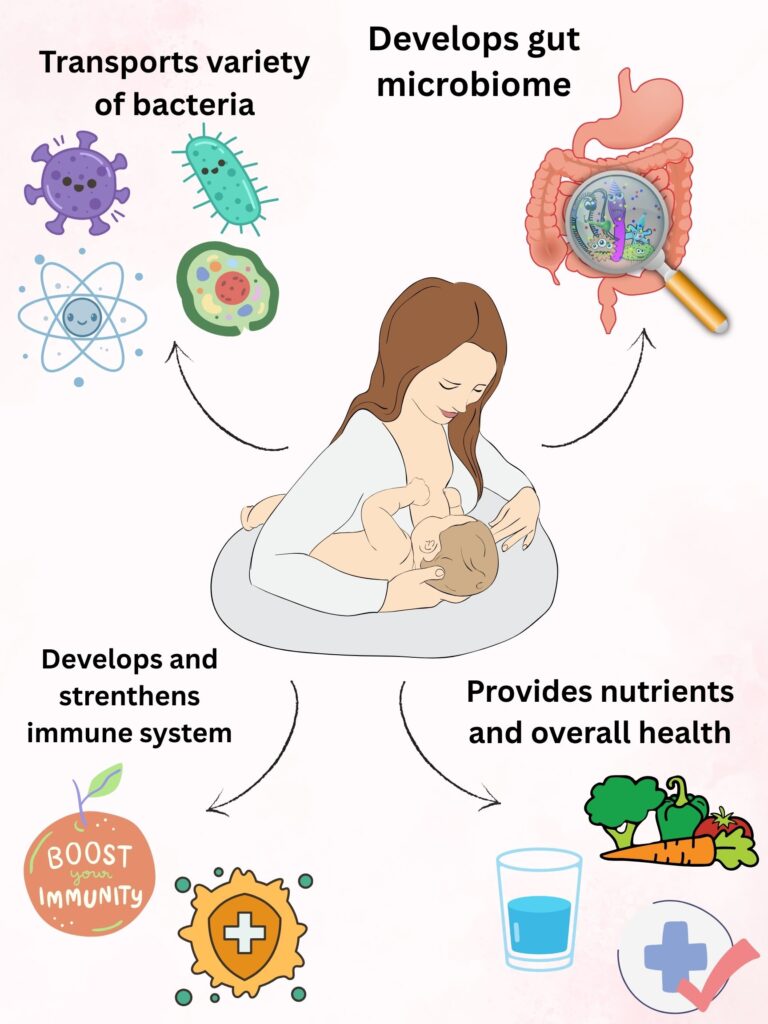
Breast-feeding plays a very important role in a baby’s life, especially in their micro biome and immune defense development. This project explains how breastmilk is beneficial to the development of a baby oral and gut Microbiome as well as their immune system. Research shows that breastmilk contains a diverse range of microorganisms that when fed to a baby helps colonize and support a babies Microbiome, which would need more help in the beginning because of how young they are. Some key components of breastmilk are. Lactoferrin and glycerol monolaurate, which both have antimicrobial and anti-inflammatory properties. Lactoferrin is an iron-binding glycoprotein that helps to limit bacteria growth by isolating iron to help disrupt bad bacteria. glycerol monolaurate on the other hand is a fatty acid that helps enhance antimicrobial activity and helps with inflammation. Breastmilk also provides a passive humoral immunity to the baby by containing a multitude of unique, micro biomes that get passed to the infant during early development, which helps colonize the bacteria in the baby’s gut. Human milk also contains bacteria such as. Bifidobacterium which is indigestible by the baby, but can still help with their gut colonization and keeping away the bad bacteria. This project highlights the importance of breastmilk in the early development of babies to help not only protect them from illness, but also grow their immunity and their ability to fight off illnesses later in life. The art project was very well done and it clearly shows that breastmilk provides nutrients transports bacteria develops the gut Microbiome and helps develop strengths in the immune system, all while being, cute, and colorful