
 Posted by
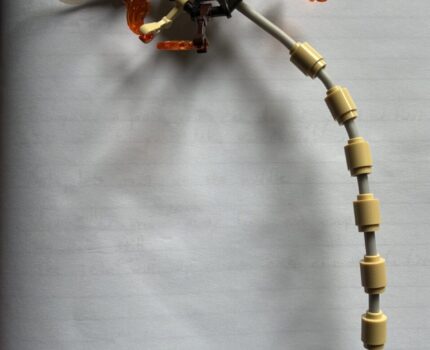
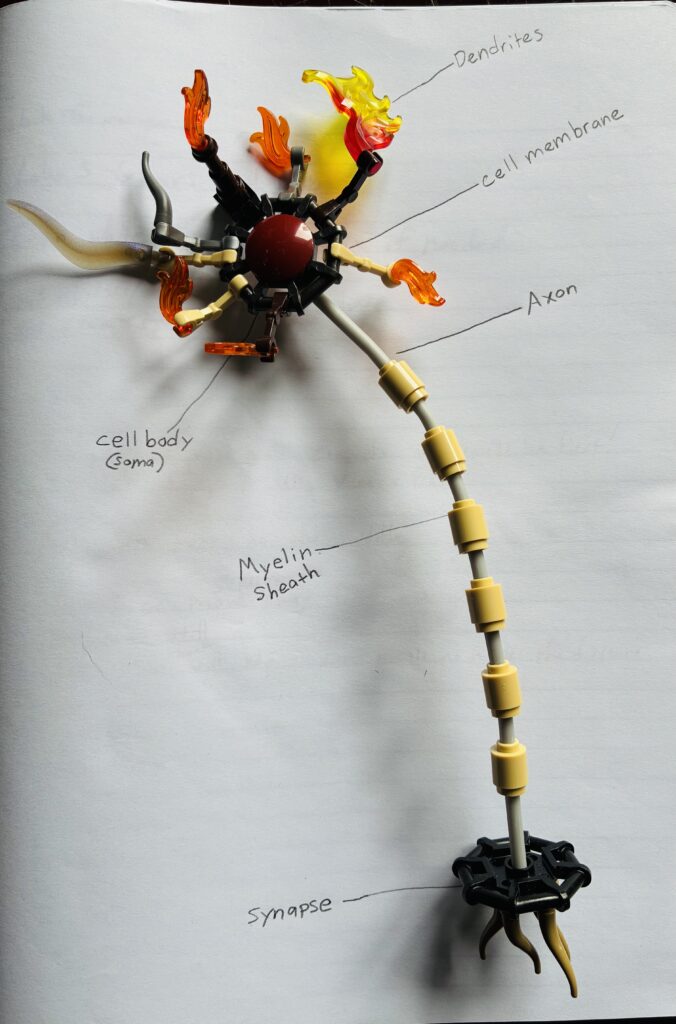
From the objective list in units 1-7, I choose to “explain how neurons carry electrical charge”, for my STEAM project. My neuron model is constructed with LEGO’s. The long axon is a single fiber that is attached to the neuron cell body where the nucleus can be seen in the middle of said cell body and on the opposite end of the axon arm represents the synapse.
The Neuron cell body is represented by a web shaped piece that houses the cell membrane in the middle. The cell body of a neuron includes mostly the cytoplasm, organelles and nucleus (Betts et al., 2022, p. 459); and has Dendrites extending and reaching out. Usually these are highly branching. The dendrites receive information from other neurons and communicate that information to the cell body (Betts et al., 2022, p. 459). The axon is the long grey plastic LEGO connecting rod. The LEGO bricks that are attached to the Axon arm are representing the Myelin sheath. The Myelin is an insulating layer. There are sections in between each myelin sheath, this is to represent the node of Ranvier. The distance between each myelin sheath has to do with how the electrical signals travel down the axon (Betts et al., 2022, p. 459).
Nervous tissue is capable of sending and receiving electrochemical signals that provide the body with information (Borah et al., 2024). When a neuron is sufficiently stimulated, it generates an action potential that propagates down the axon towards the synapse (Betts et al., 2022, p. 150). Electrical potential exists inside and outside cells. This influences cellular functions through neurons (Borah et al., 2024). Resting potential is when a steady flow of information is being passed over the nerve membrane, this turns to action potential once the information is transmitted from one place to another…from negative to positive (Borah et al., 2024). “For a typical nerve cell, the resting potential of the interior cell it is -70mV and the membrane starts to depolarize when the interior potential is down to -55mV, leading to opening of Na+ channels” Borah et al., 2024, tells us, and once the channels are open the interior potential starts to rise or energize their electrical charge (Borah et al., 2024).
Neurons have polarity, information flows in one direction. It flows from through a neuron from the dendrites, across the cell body, and down the axon (Betts et al., 2022, p. 459). Picture a battery with the positive side lit up, and the energy moving down to the negative end. This is when the membrane begins to repolarize back to its resting potential as it opens the K+ channels (repair paper). Neurons generate information through electrochemical impulses (Betts et al., 2022). Understanding how neurons carry electrical charge matters when we are looking at nerve regeneration and repair. Nerve regeneration has the ability to be enhanced with electric stimulation while fostering the correct environment (Borah et al., 2024). When a neuron is sufficiently stimulated, it generates an action potential that propagates down the axon towards the synapse (Betts et al., 2022, p. 150). Betts et al. 2022, p.151 state that “Inflammation is standard and the initial response of the body to injury”. Cellular and biochemical therapies are used for peripheral nerve injuries that incorporate axon and myelin regeneration (Grosu-Bularda et al., 2025). Grosu-Bularda et al., 2025 states the peripheral nervous system is “responsible for transmitting motor, sensory, and autonomic signals between the central nervous system and the rest of the body”.
Citation
Betts, J. G., Desaix. P., Johnson, E., Johnson, J. E., Korol, D., Poe, B., Weise, J., Womble, M.D., & Young, K. A. (2022). Anatomy and Physiology. Open Stax, Rice University.
Borah, R., Diez Clarke, D., Upadhyay, J., & Monaghan, M. G. (2024). From innovation to Clinic: Emerging strategies harnessing electrically conductive polymers to enhance electrically stimulated peripheral nerve repair. Materials Today Bio, 30, 101415. https://doi.org/10.1016/j.mtbio.2024.101415
Grosu-Bularda, A., Vancea, C. V., Hodea, F. V., Cretu, A., Bordeanu-Diaconescu, E. M., Dumitru, C. S., Ratoiu, V. A., Teodoreanu, R. N., Lascar, I., & Hariga, C. S. (2025). Optimizing Peripheral Nerve Regeneration: Surgical Techniques, Biomolecular and Regenerative Strategies—A Narrative Review. International Journal of Molecular Sciences, 26(8), 3895. https://doi.org/10.3390/ijms26083895