
 Posted by
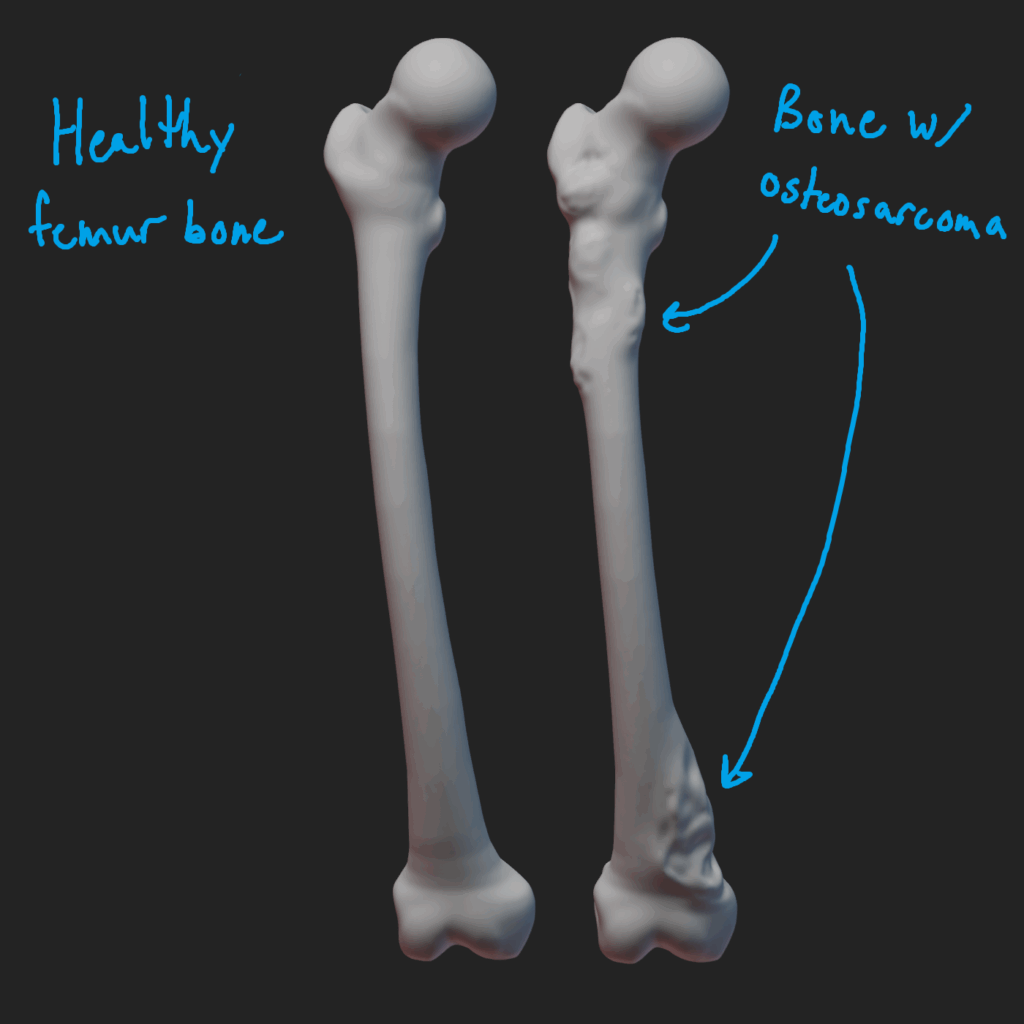
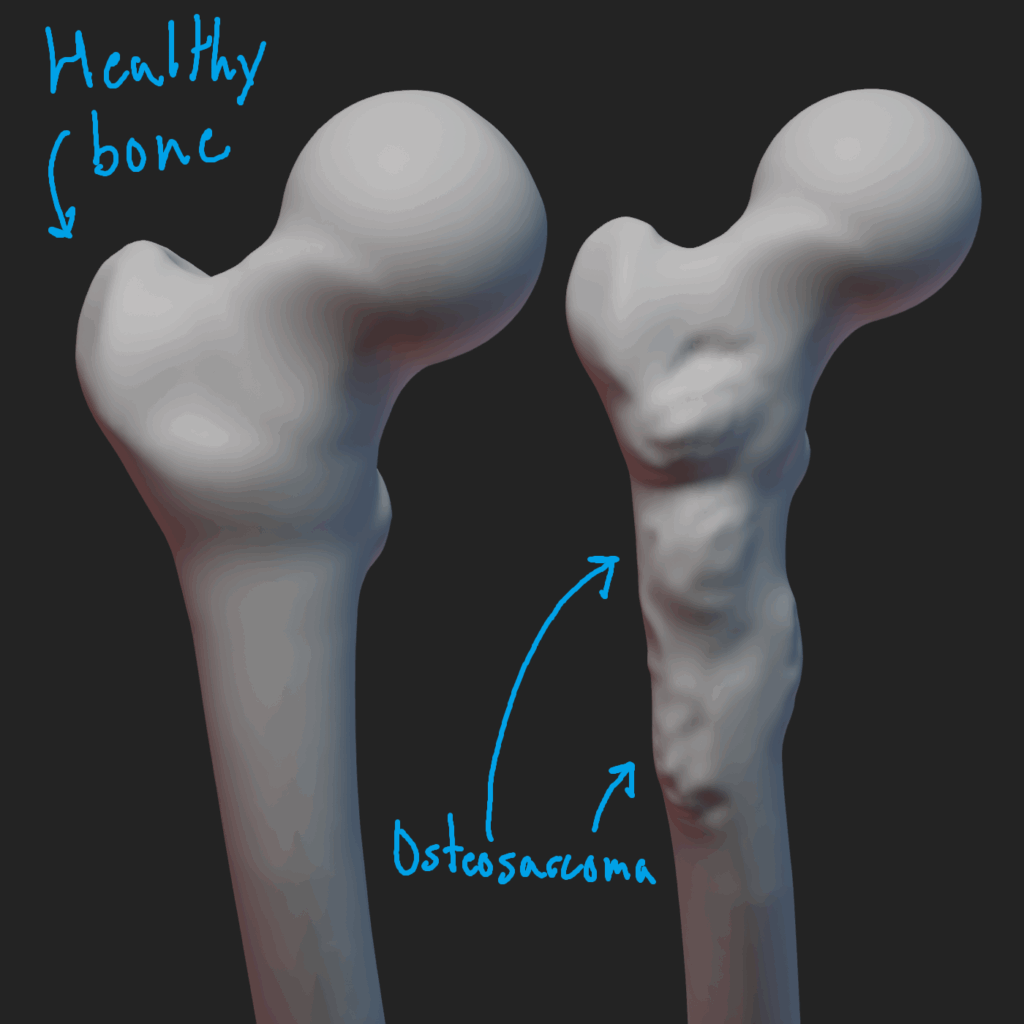
Osteosarcoma (OS) is a highly malignant tumor that occurs within bone tissue (Hu et al., 2022). OS develops from cancerous osteoblast cells, which form new bone. Affected bone tissue isn’t as strong as healthy bone tissue (Johns Hopkins Medicine, 2019).
OS is more common in children and adolescents than in adults, as children and adolescents experience rapid bone growth, especially during puberty (de Azevedo et al., 2019). 30% of OS cases can be fatal, but can increase if the cancer spreads to surrounding tissues (Cleveland Clinic, 2021). Approximately 80% of all cases occur within the metaphysis of long bones, where the shaft of the bone flares towards the ends (Misaghi et al., 2018). Approximately 70% of tumors contain abnormalities within the cancer cells’ chromosomes that would otherwise typically suppress the tumors (Hu et al., 2022). It is unknown if it is inherited or acquired after birth. Tumors can form within or protrude from the bone, causing complications with mobility and pain.
There are different types of OS. The most common type of OS is “Conventional osteosarcoma”, making up 80% of all OS cases (Misaghi et al., 2018). This is the type that most often affects adolescents. Conventional OS is typically high-grade, which means it grows and spreads much faster than its counterpart, low-grade. There are types of low-grade OS that may not affect the person until their 40s. Diagnosis is, however, more difficult to diagnose as it may resemble fibrous dysplasia. Fortunately, recovery from low-grade OS is much better (Misaghi et al., 2018). Unfortunately, low-grade, however, make up a small percentage of all OS cases.
Symptoms of OS can sometimes vary based on location, but typically they include: pain in the bone/joint that gets worse with time, limping, decreased mobility, and even breakage of the bone with no apparent cause (Cleveland Clinic, 2021). Currently, chemotherapy and surgical removal are the only treatments for OS. Surgery involving limb salvage is the most common treatment. This is where the affected region of bone is removed and replaced with implants made of metals such as titanium. Amputation of the entire limb is a less common route that is becoming less prominent. Misaghi et al. reported, along with other studies, that limb reconstruction not only improves the quality of life of a patient but also has an equal or slightly greater survival rate than amputations.
References:
Hu, Z., Wen, S., Huo, Z., Wang, Q., Zhao, J., Wang, Z., Chen, Y., Zhang, L., Zhou, F.,
Guo, Z., Liu, H., & Zhou, S. (2022). Current Status and Prospects of Targeted Therapy for Osteosarcoma. Cells, 11(21), 3507. https://doi.org/10.3390/cells11213507
Misaghi, A., Goldin, A., Awad, M., & Kulidjian, A. A. (2018). Osteosarcoma: a comprehensive review. SICOT-J, 4(12), 12. https://doi.org/10.1051/sicotj/2017028
de Azevedo, J., Fernandes, T., Fernandes, J., de Azevedo, J., Lanza, D., Bezerra, C., Andrade, V., de Arajo, J., & Fernandes, J. (2019). Biology and pathogenesis of human osteosarcoma (Review). Oncology Letters, 19(2). https://doi.org/10.3892/ol.2019.11229
Johns Hopkins Medicine. (2019). Osteosarcoma. Johns Hopkins Medicine Health Library. https://www.hopkinsmedicine.org/health/conditions-and-diseases/sarcoma/osteosarcoma
Cleveland Clinic. (2021, February 24). Osteosarcoma Symptoms & Treatments | Cleveland Clinic. Cleveland Clinic. https://my.clevelandclinic.org/health/diseases/15041-osteosarcoma
This project focuses on osteosarcoma (OS), a highly malignant bone cancer that primarily affects children and adolescents during periods of rapid bone growth. One of the things I learned is that OS develops from cancerous osteoblasts—the cells responsible for building new bone—which explains why the affected bone is weaker and more likely to fracture. I didn’t realize that OS tends to form in the metaphysis of long bones and that 70% of cases involve chromosomal abnormalities that would normally help suppress tumors.
What stood out to me was the breakdown of different OS types, especially the contrast between high-grade conventional OS, which spreads quickly and usually affects teens, and low-grade OS, which progresses more slowly and is more common in older adults. I also didn’t know that low-grade cases are harder to diagnose because they resemble other bone disorders like fibrous dysplasia.
The section on treatment was really informative. I had always associated cancer surgery with amputation, but this project explained how limb salvage procedures are becoming more common, using titanium implants to replace the affected bone. It was encouraging to learn that these reconstructions can improve quality of life and even match or exceed survival rates of full amputation.
Overall, this project helped me better understand not only the biological basis of osteosarcoma, but also how it impacts real patients, especially young people. It’s a reminder of how important early detection and advanced surgical options are in improving outcomes.