 Posted by
The course objective for my STEAM project is to explore the process of bone remodeling and the cellular components involved in this process, with an emphasis on the reputation of osteoclasts and their role in bole remodeling. I want to explain my understanding of osteaclasts as being more than just cells of bone resorption, but also as being active participants in bone regeneration and even orchestrators of signaling for bone repair (Xiang et al., 2024).
While traditionally portrayed as the “destructive” force in bone physiology, recent research has revealed that osteoclasts actually play a more complex and collaborative role with osteoblasts and osteocytes. I aim to communicate this newfound view through an art piece which deeply reflects not only the lessons learned in class, but outside information which was retrieved from peer-reviewed articles, as well by creating a hand drawn, short and charming comic. This project will illustrate how bone is constantly broken down and rebuilt through a balance of cellular activity, while highlighting the misunderstood contribution of osteoclasts in keeping bones healthy, adaptable, and strong.
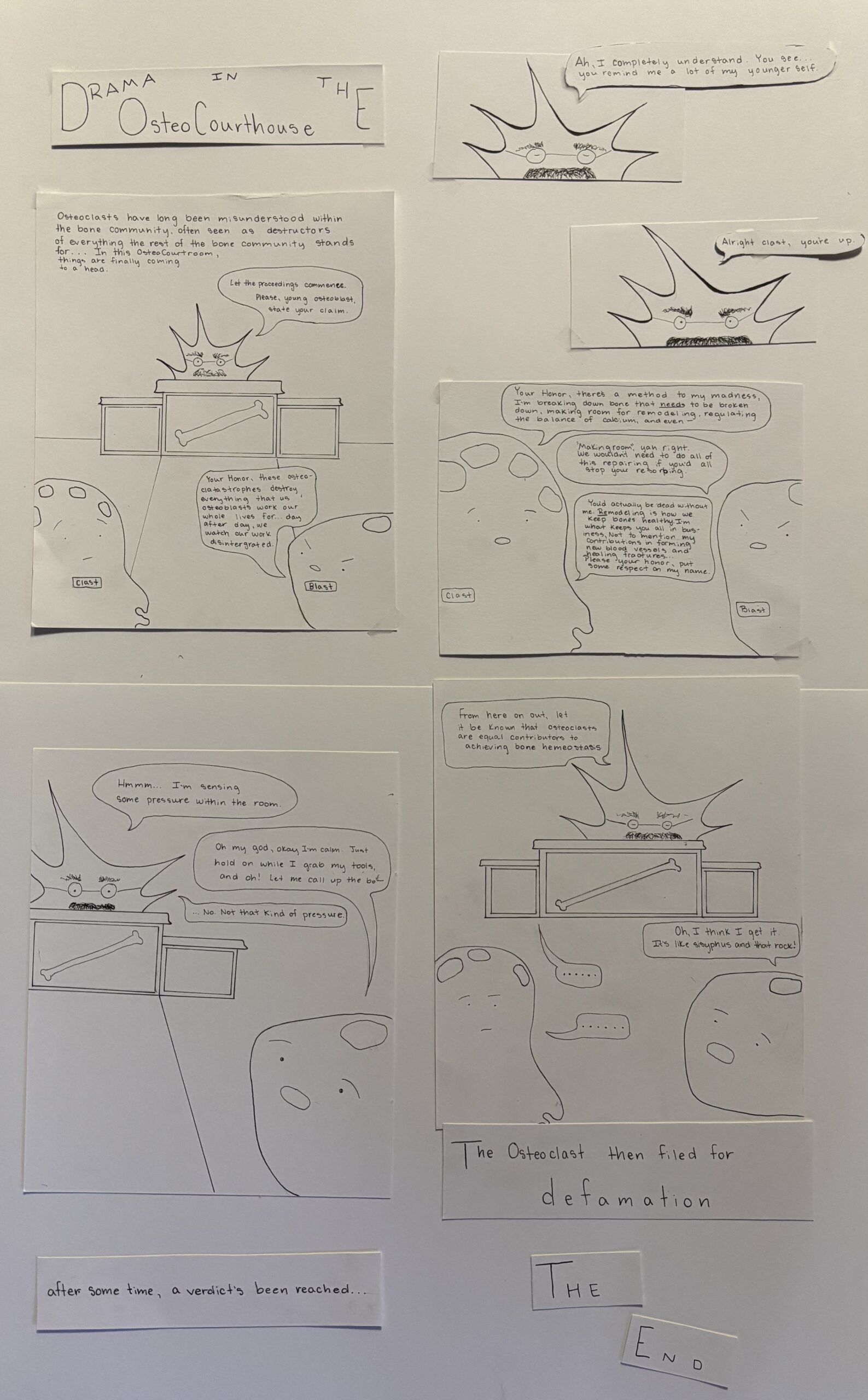
My comic enters the scene of a fictional conflict: osteoblasts (the builders) currently accuse osteoclasts (the “destroyers”) of being the “bad boys” of the town in the osteocourthouse. Afterall, the osteoclasts do indeed have this sort of reputation, but as the story unfolds, it’s revealed that osteoclasts aren’t just bone-destroyers, but rather quite essential for bone health, healing, and even building. In this comic, I hope to expand our current understanding of the role of osteoclasts as students, yet still align our view with how we were previously taught in class. They are not to be seen as villains or destroyers, but rather as essential contributors in the process of building bone.
Before enjoying the comic, it’s important to understand the science behind it; Bone cells exist within a matrix of collagen fibers and mineralized calcium salts. Osteoblasts are the cells which are most active in bone formation and osteoid secretion (a matrix made up of 90% collagen). This secretion later mineralizes with hydroxyapatite crystals, which is what gives bone its compressive and tensile strength. Once these osteoblasts become surrounded by this calcified matrix, they mature (ossify) into osteocytes. These osteocytes can be seen as the key regulators of bone homeostasis by passing information between osteoblasts and osteoclasts. (Bellido, 2013).
Osteoclasts, the misunderstood characters in this story, are large, multinucleated cells derived from hematopoietic stem cells in the bone marrow, and monocytes, a type of white blood cell. Osteoclasts are responsible for bone resorption, the process of breaking down bone tissue and releasing its minerals back into the blood stream. While the textbook describes their origin and role in bone remodeling as the demolition crew, new research reveals that osteoclasts also play an important role in the regeneration process of maintaining hemostasis as well.
Research presented by Xiang et al. (2024) notes how osteoclasts actively contribute to angiogenesis (blood vessel formation), osteoblast recruitment signaling, and bone regeneration, especially during the healing of bone fractures. In the article, it also highlighted that osteoclasts develop through a fusion process that involves different types of precursor (not yet fully mature) cells, which makes them highly diverse and adaptable.
By turning these new concepts into a dramatic comic, it allows students like I, who are entering the world of science, to easily grasp the complexities in the relationships of osteoblasts, osteocytes, and osteoclasts, and highlighting how they work together rather than against each other. This STEAM project creatively communicates the scientific truth that bone remodeling is more than back and forth of rebuilding and resorbing, but rather a complex team effort. Osteoclasts, long misunderstood, are finally getting the redemption they deserve, not just in my comic, but in the science world too.
Bellido, T. (2013). Osteocytes and Their Role in Bone Remodeling. Actualizaciones En Osteología, 9(1), 56–64.
Xiang, Q., Li, L., Ji, W., Gawlitta, D., Walboomers, X. F., & van den Beucken, J. J. J. P. (2024). Beyond resorption: Osteoclasts as drivers of Bone Formation. Cell Regeneration, 13(1). https://doi.org/10.1186/s13619-024-00205-x
This STEAM project focuses on explaining how bones are constantly rebuilt and repaired by different types of specialized cells. One of the main goals is to help people understand that a certain type of bone cell called the osteoclast—often seen as the “bad guy” that breaks down bone—is actually much more helpful than previously thought. Traditionally, osteoclasts were only known for their job of breaking down old or damaged bone. But new research shows that they also help with healing, forming new blood vessels, and even signaling to other cells to start building bone again.
To communicate this idea in a fun and accessible way, the project includes a hand-drawn comic. In the story, osteoclasts are on trial in the “osteocourthouse” for being seen as destructive. But throughout the comic, it’s revealed that these cells are actually critical for keeping bones strong and healthy. The comic aims to change the way we think about these misunderstood cells by showing how they work alongside osteoblasts (the builders) and osteocytes (the coordinators) in a well-balanced team.
Before diving into the comic though, readers are introduced to some basic science: bones are made from a combination of proteins like collagen and minerals like calcium, which gives them strength. The different bone cells each play a role in maintaining this structure. By blending science and art, this project helps students (and others) better understand that bone health relies on teamwork between all three types of cells, and that osteoclasts are not villains—they’re essential team players in the ongoing cycle of bone remodeling and repair.