For this project I chose to combine the aesthetic structure of a cooking recipe with the form and function of a sodium potassium pump, which is a universal method of active transport found throughout the body, but for the focus of this piece will be put in context of synaptic electro-signalling. Neuronal cells need a method to create a charge to transmit a signal, so charged ions, potassium and sodium (electrolytes) are utilized by these cells to create a disparity in charge between the inside of the cell (the cytoplasm) and the outside (the extracellular area) which is known as the membrane potential.
This isn’t as easy as it sounds. Concentrations across a membrane will naturally reach equilibrium, and in order to create a low entropy (ordered) system you need an input of energy. Now we have our protein, the sodium potassium pump, which sits in the membrane and acts to move sodium ions into the cytoplasm, and potassium ions into the extracellular area. This sets the stage for the climax of the cycle, the action potential. This is the moment when the sodium ions that have been quickly shoveled out of the cell rush back into the cytoplasm, causing an electrical impulse which travels down the axon and passes on the signal to the next neuron. But how does this vital protein function to “clean house” and set things back into place in order to achieve action potential once again?
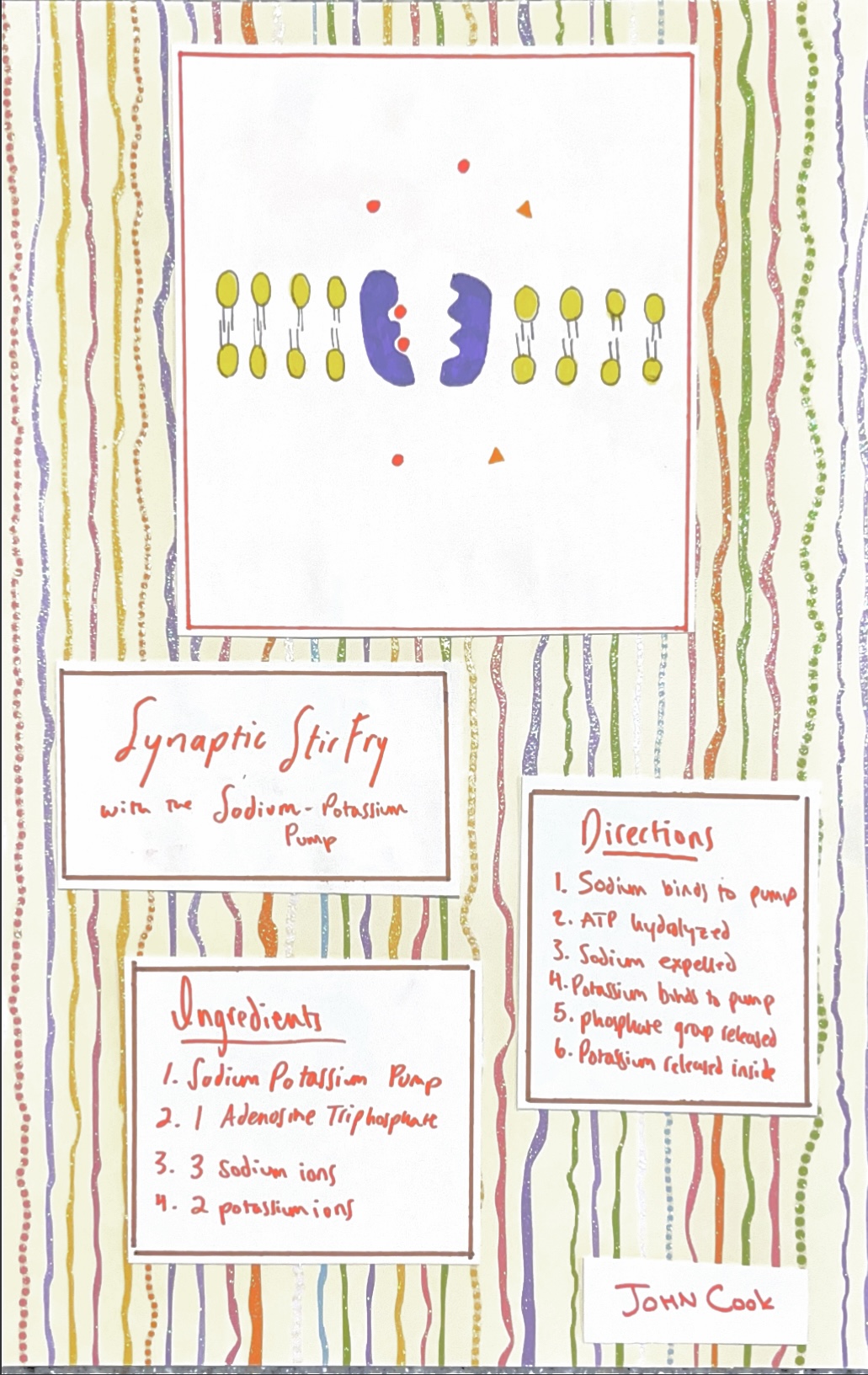
In its most basic unit, you need your ingredients: the sodium potassium pump, obviously, and 1 ATP molecule, 3 sodium ions, and 2 potassium ions. The pump is the agent which facilitates this sequence, the adenosine triphosphate serves as the fuel to move ions against the concentration gradient, and your ions for establishing a charged resting membrane potential. The “directions” by which this happens is as follows.
Three sodium ions bind to the intracellular portion of the pump, which directs the hydrolysis of ATP (splitting off of one of the phosphate groups of ATP with a water molecule to release energy) and changes the configuration of the protein. The pump then spits out the three sodium ions outside of the cell. Next, two potassium ions bind to the exterior of the pump and the phosphate is released. Upon release of phosphate, the pump returns to its original configuration, and releases the two potassium ions into the cell. Now you have what is in essence a battery, with a net negative charge within the cell, and a neuron that’s ready to transmit a signal. Because of these proteins, you get to enjoy pizza, listen to music, and experience your life as you know it.
 Posted by

For this project I chose to combine the aesthetic structure of a cooking recipe with the form and function of a sodium potassium pump, which is a universal method of active transport found throughout the body, but for the focus of this piece will be put in context of synaptic electro-signalling. Neuronal cells need a method to create a charge to transmit a signal, so charged ions, potassium and sodium (electrolytes) are utilized by these cells to create a disparity in charge between the inside of the cell (the cytoplasm) and the outside (the extracellular area) which is known as the membrane potential.
This isn’t as easy as it sounds. Concentrations across a membrane will naturally reach equilibrium, and in order to create a low entropy (ordered) system you need an input of energy. Now we have our protein, the sodium potassium pump, which sits in the membrane and acts to move sodium ions into the cytoplasm, and potassium ions into the extracellular area. This sets the stage for the climax of the cycle, the action potential. This is the moment when the sodium ions that have been quickly shoveled out of the cell rush back into the cytoplasm, causing an electrical impulse which travels down the axon and passes on the signal to the next neuron. But how does this vital protein function to “clean house” and set things back into place in order to achieve action potential once again?
In its most basic unit, you need your ingredients: the sodium potassium pump, obviously, and 1 ATP molecule, 3 sodium ions, and 2 potassium ions. The pump is the agent which facilitates this sequence, the adenosine triphosphate serves as the fuel to move ions against the concentration gradient, and your ions for establishing a charged resting membrane potential. The “directions” by which this happens is as follows.
Three sodium ions bind to the intracellular portion of the pump, which directs the hydrolysis of ATP (splitting off of one of the phosphate groups of ATP with a water molecule to release energy) and changes the configuration of the protein. The pump then spits out the three sodium ions outside of the cell. Next, two potassium ions bind to the exterior of the pump and the phosphate is released. Upon release of phosphate, the pump returns to its original configuration, and releases the two potassium ions into the cell. Now you have what is in essence a battery, with a net negative charge within the cell, and a neuron that’s ready to transmit a signal. Because of these proteins, you get to enjoy pizza, listen to music, and experience your life as you know it.