
 Posted by
Objective: Relate the molecular structure of water to its material properties.
Water’s molecular properties play a large role in mosquito attraction. Water is a universal solvent, meaning that it has polarity due to its structure. Oxygen is much more electronegative than hydrogen, meaning that oxygen has a stronger pull on the shared electrons in the O-H bonds. This creates a charge separation between the molecules, making water a universal solvent that can surround and break up other charged/polar molecules. Being a universal solvent, water can dissolve many ionic compounds and compounds with hydrogen bonding capability. Sweat is more than just water on our skin–sweat is a combination of salts, amino acids, urea, ammonia, and lactic acid that is dissolved in water and transported as sweat on our skin. This sweat is vaporized into the air as our body temperature rises, cooling off our skin and bringing our body temperature back down–this cooling mechanism effectively regulates our body temperature.
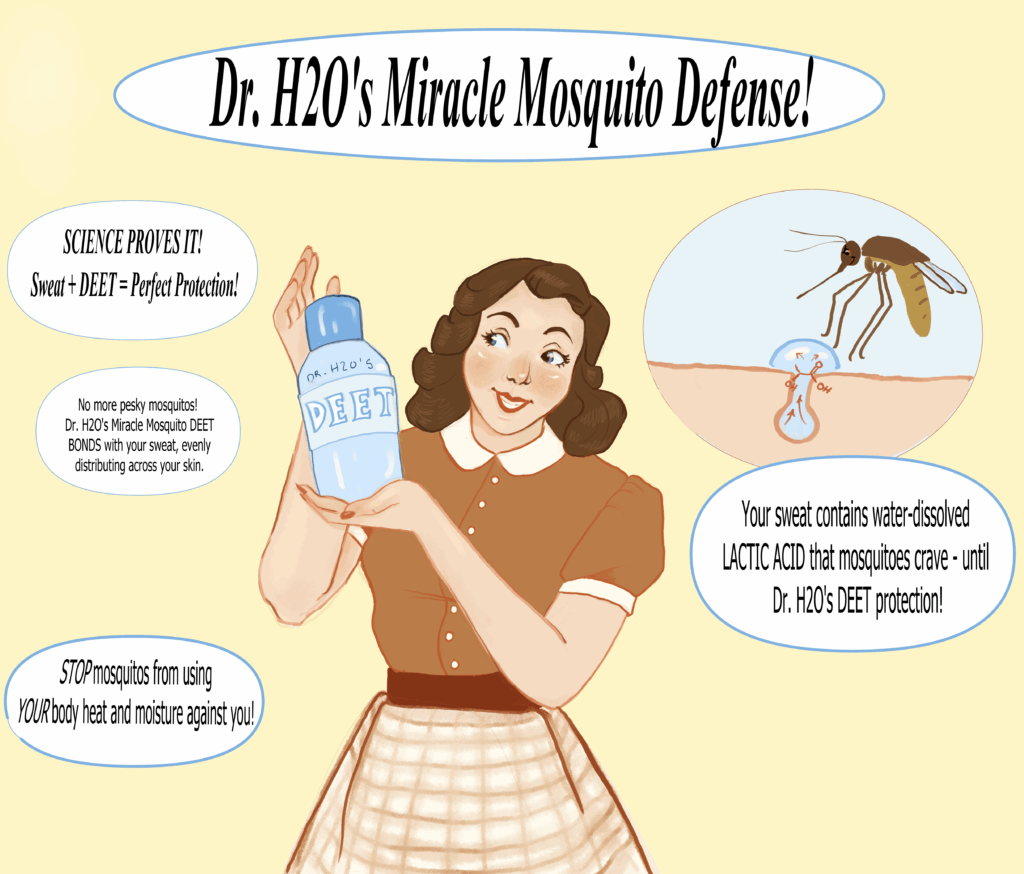
However, mosquitos are very attracted to two things: lactic acid, and humidity. The water in our sweat transports lactic acid to the surface, attracting mosquitos to us. In high heat, the water evaporates from our skin and creates a subtle humidity around our bodies. We can see here that the properties of water as a universal solvent and as having a specific high-heat capacity contribute to the ways that mosquitoes become attracted to our skin. DEET likely creates a barrier that disrupts the mosquitoes’ odorant detection of lactic acid on our skin, and by dissolving with skin moisture, it is evenly distributed across the skin.
In order to communicate the properties of water and DEET and how mosquitoes interact with them, I created a vintage-style advertisement for “Dr. H2O’s Miracle Mosquito Repellent.” The advertisement features a woman displaying the DEET product, with speech bubbles around describing the effects of the product. The advertisement also has an image of a mosquito being attracted to a drop of sweat coming from an eccrine gland, with lactic acid being exported into it. Next to this image is a speech bubble that describes “Your sweat contains water-dissolved LACTIC ACID that mosquitoes crave – until Dr. H2O’s DEET protection!”
As someone who seems to always get the most mosquito bites on camping trips, I was determined to uncover why this was. I never believed the myth that I had “sweet blood…” and it turns out that I was right! I really enjoyed making this project, and I hope that it educates others on the way in which water, being universally soluble and having a high specific heat capacity, can affect the way that outside forces interact with our bodies.
Coutinho-Abreu, I. V., Riffell, J. A., & Akbari, O. S. (2022). Human attractive cues and mosquito host-seeking behavior. Trends in Parasitology, 38(3), 246–264. https://doi.org/10.1016/j.pt.2021.09.012
Dean, I., & Siva-Jothy, M. T. (2011). Human fine body hair enhances ectoparasite detection. Biology Letters, 8(3), 358–361. https://doi.org/10.1098/rsbl.2011.0987
United States Department of Agriculture. (n.d.). How attractive are you? to mosquitoes, that is. AgResearch Mag. https://agresearchmag.ars.usda.gov/2000/feb/mosq