
 Posted by
For my STEAM project, I chose to focus on how cigarette smoking affects bone health and overall bone density. Throughout this unit, we learned that bone is a very active tissue that is constantly remodeling. Osteoblasts build bone, osteoclasts break bone down, osteocytes monitor stress inside the bone, and osteogenic cells serve as stem cells for new bone growth. Because smoking interferes with these processes, it connects directly to the two course objectives I selected: identifying the four cells that comprise bone tissue and identifying the seven functions of bone. Focusing on these objectives helped me understand why smoking has such a strong impact on the skeletal system.
The four bone cells work together to keep bones healthy. Osteoblasts form new bone matrix, osteoclasts resorb old bone, osteocytes detect stress and communicate with the other cells, and osteogenic cells produce new cells that can become osteoblasts. This balance is essential for maintaining strong bones, proper mineral levels, and normal bone repair. Smoking disrupts this balance by damaging osteoblasts and increasing the activity of osteoclasts. Research clearly shows that smokers have lower bone mineral density because bone is being broken down faster than it is replaced (Ward and Klesges, 2001). This gradual loss of density weakens the skeleton and increases the risk of fractures, even in people who may not feel any symptoms yet.
Smoking also affects several of the seven important functions of bone. These functions include support, protection, movement, mineral storage, blood cell formation, fat storage, and hormone production. Bone stores important minerals such as calcium and phosphate, which are essential for muscle contraction, nerve function, and many other processes. When smoking interferes with calcium absorption and mineral storage, bones can no longer maintain normal strength. Trabecular bone remodels the fastest, which makes it the most vulnerable to bone loss. This is why smoking has such a strong effect on areas like the spine and hip. Al Bashaireh et al. (2018) showed that chemicals found in cigarette smoke decrease blood flow, increase oxidative stress, and interfere with hormones. These factors slow bone formation and disrupt the normal remodeling cycle, which leads to a steady decline in bone quality.
To understand bone fragility more clearly, I also included findings from Szulc and Seeman (2009). Their research explains that bone strength depends on more than just bone density. The internal structure of bone, also known as its microarchitecture, plays a major role in determining how likely a bone is to break. They describe how trabecular plates can thin and lose their connections over time. Smoking speeds up this process by increasing bone resorption and preventing proper rebuilding. This helped me understand that smokers face a higher risk of fractures not only because they lose bone mass but also because the quality of the remaining bone becomes weaker.
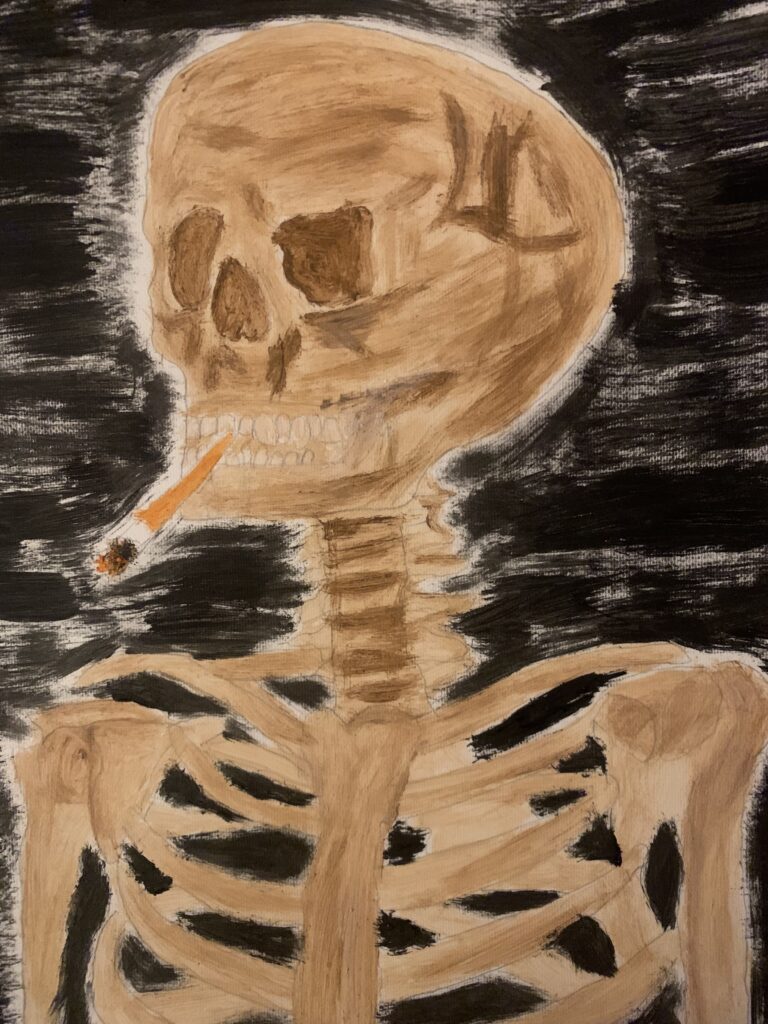
My art piece is a simple drawing of a skeleton smoking a cigarette. The skeleton represents the hidden internal damage that happens inside the body when someone smokes. The goal of my project is not to focus on artistic details but to highlight the scientific concept that smoking slowly weakens the skeletal system from the inside out. By connecting what we learned in class with scientific research, I was able to see how smoking affects bone cells, hormone regulation, mineral balance, and the entire remodeling process.
This project helped me understand how the skeletal system responds to stress and how important it is to maintain healthy bone cells. It also showed me how everyday habits can influence long term bone health in ways that are not always obvious. Overall, this project allowed me to connect course content with a real-world health issue and communicate that concept through a creative format.
References
Al-Bashaireh, A. M., Haddad, L. G., Weaver, M., Chengguo, X., Kelly, D. L., & Yoon, S. (2018). The Effect of Tobacco Smoking on Bone Mass: An Overview of Pathophysiologic Mechanisms. Journal of osteoporosis, 2018, 1206235. https://doi.org/10.1155/2018/1206235
Szulc, P., & Seeman, E. (2009). Thinking inside and outside the envelopes of bone: dedicated to PDD. Osteoporosis international : a journal established as result of cooperation between the European Foundation for Osteoporosis and the National Osteoporosis Foundation of the USA, 20(8), 1281–1288. https://doi.org/10.1007/s00198-009-0994-y
Ward, K. D., & Klesges, R. C. (2001). A meta-analysis of the effects of cigarette smoking on bone mineral density. Calcified tissue international, 68(5), 259–270. https://doi.org/10.1007/BF02390832
I thought your artwork was a powerful part of your STEAM project. Using a skeleton to represent the hidden effects of smoking helped me understand how the real damage happens inside the body, even when you can’t see it from the outside.