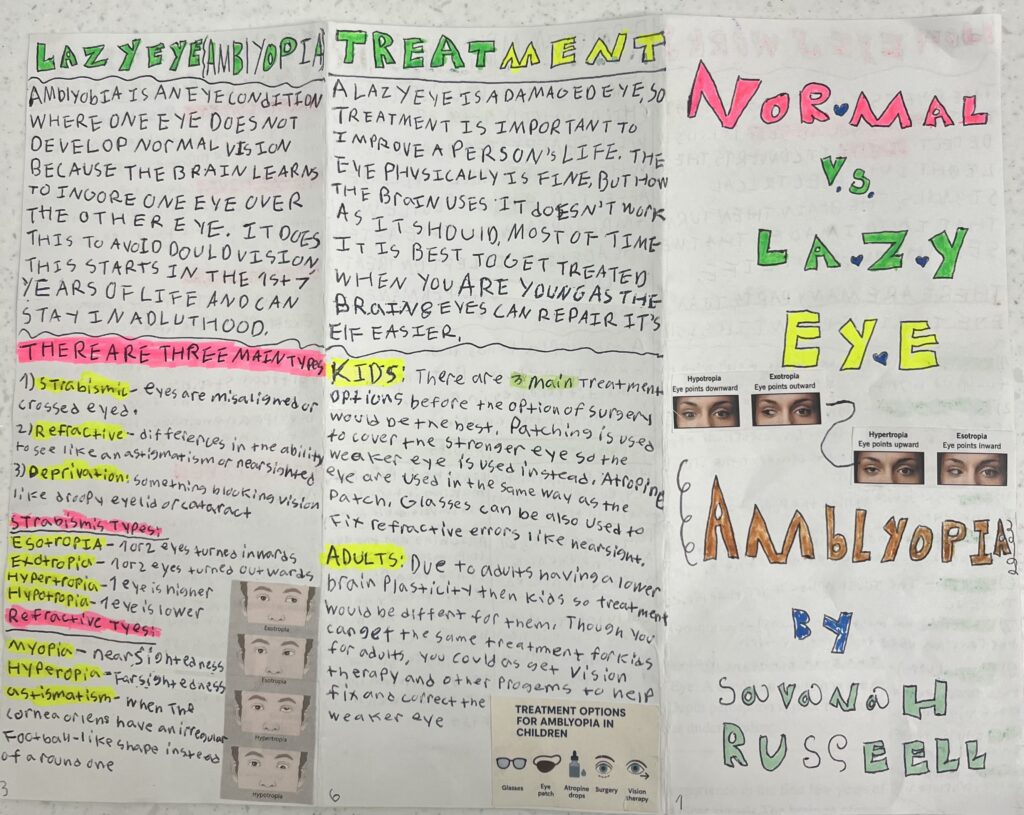
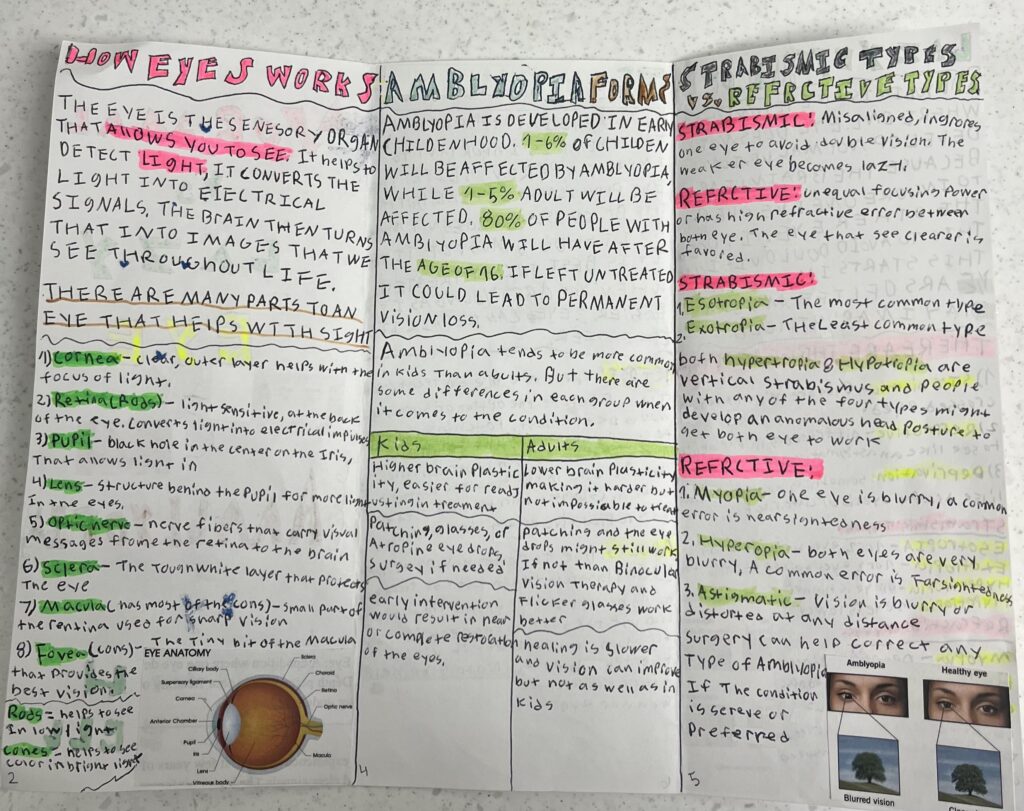
Savanah took the time to create a pamphlet where she describes what Amblyopia, often referred to as “Lazy Eye” is, how it works/happens, different kinds of amblyopia, and its treatments.
Amblyopia is an eye condition where one eye does not develop its full potential vision. This is due to the brain learning to ignore and rely on one eye over the other. This normally develops within the first year of a person’s life and can often continue on into adulthood. After the age of 16, 80% of people with this condition might experience permanent vision loss. However, amblyopia tends to be more common in children than in adults. As I learned through this pamphlet there are three main types of amblyopia:
1. Strabismic – This is when the eyes are misaligned or they are ‘cross-eyed’.
2. Refractive – One eye being near sighted and the other being far sighted, so a significant difference between the two.
3. Deprivation – Essentially caused by an obstruction of the eyelid in some shape or form.
Treatments for amblyopia vary significantly in its success rates between children and adults. Generally, the earlier treatment happens, the better. As technically the eye itself is not per-se damaged, and the use of the eye is what is causing issues, successful treatment depends on the overall health of a person. The younger the person, the more likely are they to recover and learn new behavior. For children often patching the so called dominant eye is used, so to force the brain to use and not ignore the weaker eye. Other times glasses with different strength in the two lenses are used, or surgery. For adults, the treatments are not significantly different in itself, rather the difficulty to change one’s brain’s reliance on an eye is harder.
I really liked your pamphlet, and how you explained what amblyopia is!
 Posted by

Savanah took the time to create a pamphlet where she describes what Amblyopia, often referred to as “Lazy Eye” is, how it works/happens, different kinds of amblyopia, and its treatments.
Amblyopia is an eye condition where one eye does not develop its full potential vision. This is due to the brain learning to ignore and rely on one eye over the other. This normally develops within the first year of a person’s life and can often continue on into adulthood. After the age of 16, 80% of people with this condition might experience permanent vision loss. However, amblyopia tends to be more common in children than in adults. As I learned through this pamphlet there are three main types of amblyopia:
1. Strabismic – This is when the eyes are misaligned or they are ‘cross-eyed’.
2. Refractive – One eye being near sighted and the other being far sighted, so a significant difference between the two.
3. Deprivation – Essentially caused by an obstruction of the eyelid in some shape or form.
Treatments for amblyopia vary significantly in its success rates between children and adults. Generally, the earlier treatment happens, the better. As technically the eye itself is not per-se damaged, and the use of the eye is what is causing issues, successful treatment depends on the overall health of a person. The younger the person, the more likely are they to recover and learn new behavior. For children often patching the so called dominant eye is used, so to force the brain to use and not ignore the weaker eye. Other times glasses with different strength in the two lenses are used, or surgery. For adults, the treatments are not significantly different in itself, rather the difficulty to change one’s brain’s reliance on an eye is harder.
I really liked your pamphlet, and how you explained what amblyopia is!