
 Posted by
Hello! I´m Õnnela!
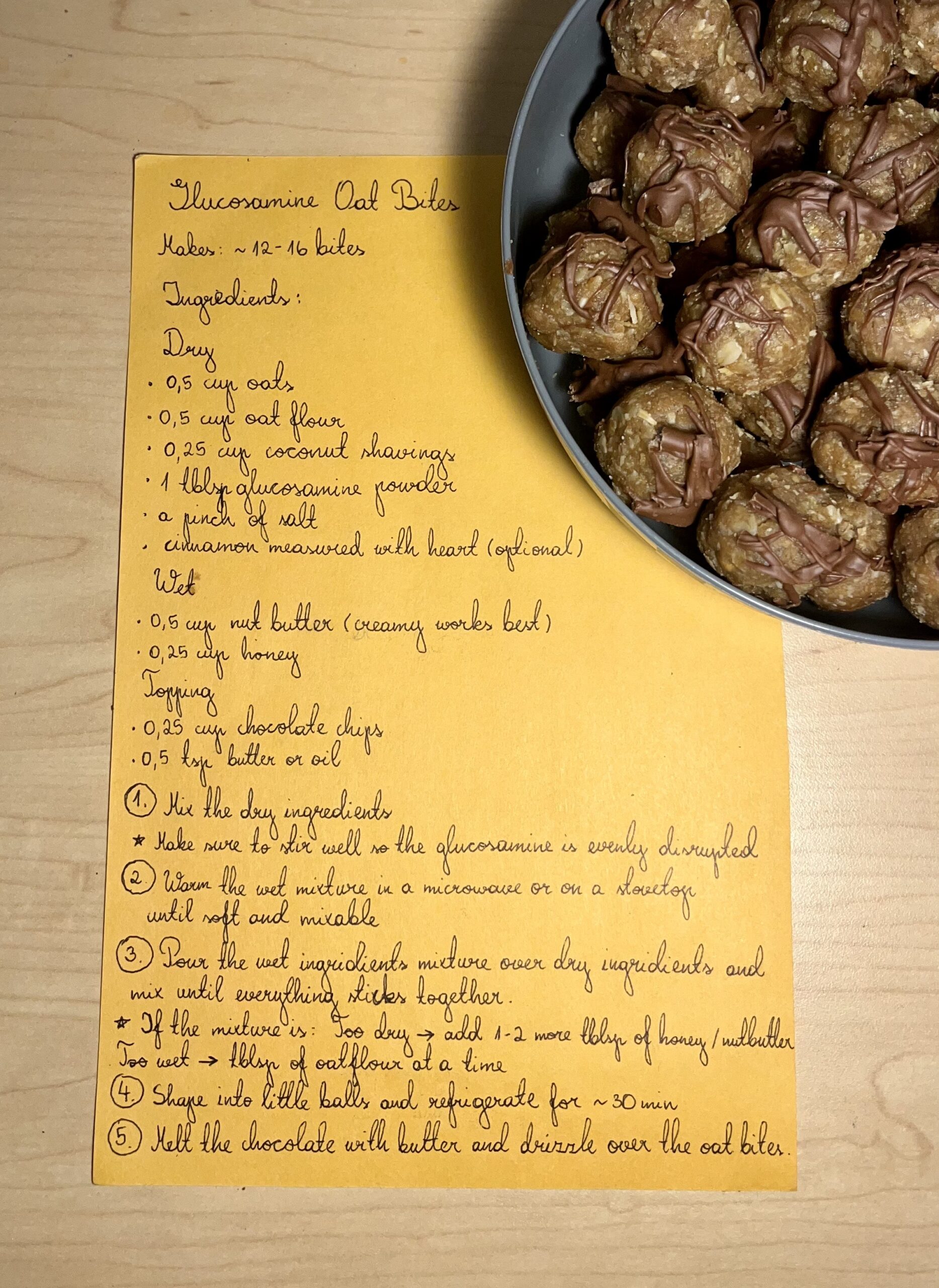
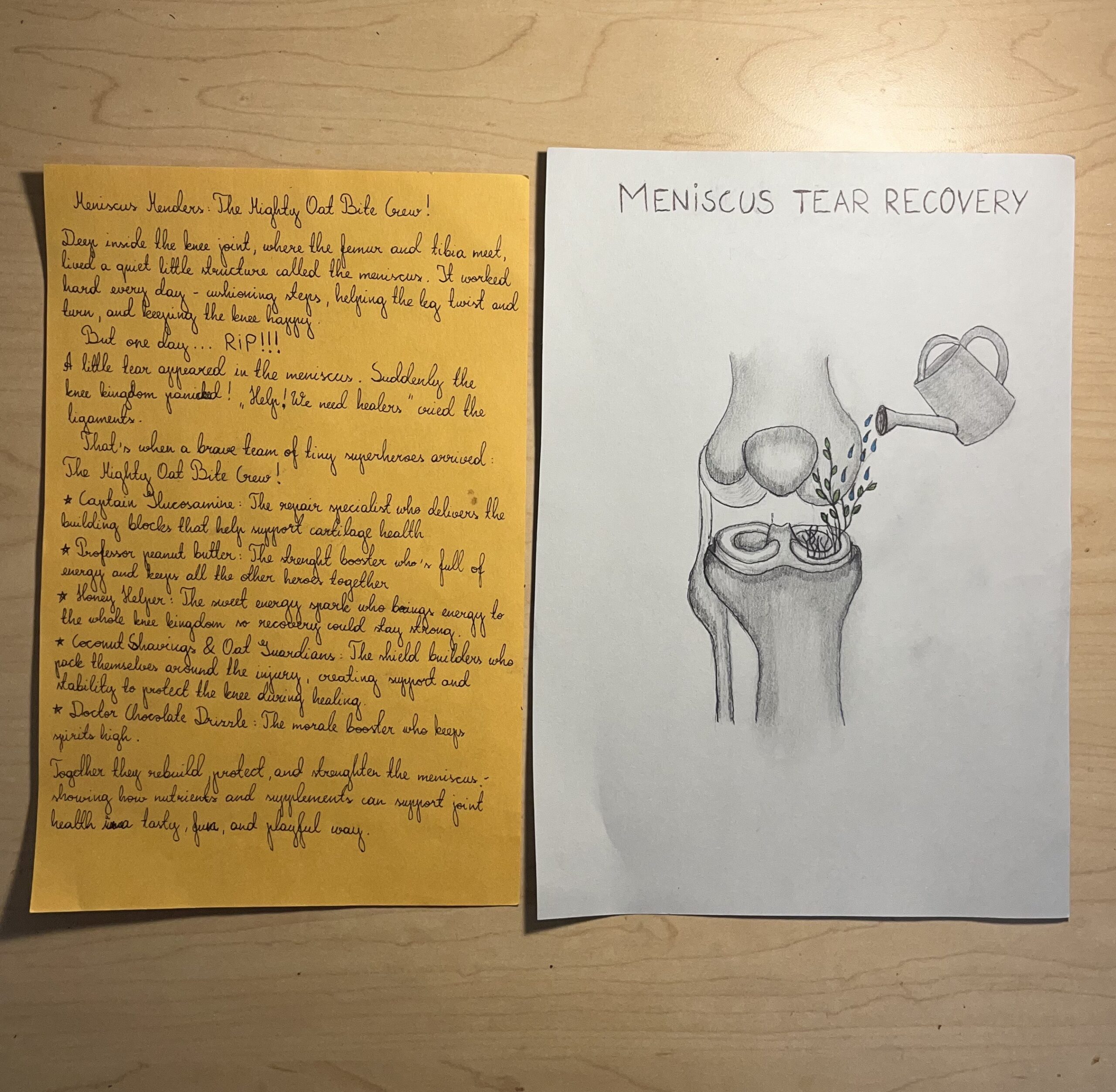
My STEAM project topic was meniscus tear recovery and I created a recipe for oat bites using glucosamine powder which provides support for cartilage and connective tissues while recovering from the injury. Since I didn´t make a 3D cake or something that represents the menisci itself, then I decided to make additional story and illustration for the recipe
.STEAM Project Essay: Knee Joint Structure and Meniscus Tear Recovery
Meniscus injuries are among the most common knee problems, particularly in athletes and physically active individuals. Recovery from these injuries is influenced by the unique structure of the knee joint, the biological characteristics of the meniscus, and supportive interventions. In this STEAM project, I explored the relationship between knee anatomy, meniscus tear recovery, and nutritional support by designing glucosamine-enriched oat energy balls. This integration of science and creativity allowed me to better understand the complex factors that influence meniscus healing.
Knee Structure and Function
The knee is a synovial hinge joint, primarily allowing flexion and extension but also permitting slight rotation when flexed. This combination enables the joint to support body weight, absorb shock, and maintain stability (Cleveland Clinic, n.d.). Its structure consists of the femur, tibia, and patella, stabilized by ligaments and cushioned by articular cartilage and the medial and lateral menisci. These fibrocartilaginous structures are essential for distributing load and protecting cartilage. Only the outer third of each meniscus has significant blood supply, while the inner portions rely mainly on synovial diffusion, creating the “red-red,” “red-white,” and “white-white” zones, which directly influence healing potential (Musculoskeletal Key, n.d.; PMC, 2012; Thomson Medical, n.d.).
Comparing the knee to other synovial joints further highlights its mechanical demands. Ball-and-socket joints, such as the hip and shoulder, allow multidirectional motion; pivot joints allow rotation around a single axis; condyloid joints, like the wrist, allow flexion, extension, and lateral movement; saddle joints, like the thumb, allow biaxial motion; and gliding joints, such as those in the wrist, allow limited sliding movements (LibreTexts, 2019). Unlike these joints, the knee must bear high loads while permitting rotational flexibility, which increases the risk of meniscus tears under twisting and compressive forces.
Meniscus Tear Recovery
Recovery from meniscus injuries depends on tear type, location, and vascularity. It generally follows three biological phases: inflammatory, proliferative, and remodeling (Marieb & Hoehn, 2018). During the inflammatory phase, immune cells clear damaged tissue and swelling occurs. The proliferative phase involves fibroblasts producing collagen to repair the meniscus, with healing most effective in the vascular outer zones. The remodeling phase strengthens the tissue, aligning collagen fibers to withstand mechanical stress.
Surgical intervention may involve meniscus repair or partial meniscectomy. Marigi et al. (2024) report that meniscal repair is preferred whenever feasible because it preserves joint biomechanics and reduces long-term cartilage degeneration. However, repair requires a longer recovery period with gradual reintroduction of load. Partial meniscectomy allows faster early recovery but removes tissue critical for load distribution, increasing long-term joint stress. Ouyang et al. (2015) further emphasize that meniscus morphology, such as discoid meniscus, affects tear patterns and recovery efficiency, demonstrating the close link between structure and healing.
STEAM Media Component: Glucosamine Oat Balls
To connect scientific research to a creative, hands-on approach, I developed glucosamine-enriched oat energy balls. Glucosamine is an amino sugar naturally found in cartilage and synovial fluid and contributes to glycosaminoglycan synthesis, supporting cartilage integrity (Henrotin, Mobasheri, & Marty, 2012; NCCIH, n.d.; NCBI Bookshelf, 2023). Although clinical evidence is mixed, glucosamine may help maintain joint function and provide a tangible, educational illustration of nutritional support for joint recovery.
Conclusion
Meniscus tear recovery is influenced by knee anatomy, tear location, vascularity, and morphology. Healing is most efficient in vascular zones and can be augmented through surgical repair, physical therapy, and potentially nutritional support. Research by Marigi et al. (2024) and Ouyang et al. (2015) illustrates how structure dictates recovery outcomes, while anatomical and nutritional sources provide a framework for understanding the biological mechanisms of healing. Integrating anatomy, research, and creative STEAM media allowed for a multidimensional exploration of meniscus repair and recovery.
References
Cleveland Clinic. (n.d.). Knee joint: Anatomy and function. https://my.clevelandclinic.org/health/body/24777-knee-joint
Henrotin, Y., Mobasheri, A., & Marty, M. (2012). Is there any scientific evidence for the use of glucosamine in the treatment of osteoarthritis? Arthritis Research & Therapy, 14(1), 201. https://doi.org/10.1186/ar3657
LibreTexts. (2019). Anatomy of selected synovial joints. https://med.libretexts.org
Marieb, E. N., & Hoehn, K. (2018). Human anatomy & physiology (11th ed.). Pearson.
Marigi, E. M., Davies, M. R., Marx, R. G., Rodeo, S. A., & Williams, R. J. (2024). Meniscus tears in elite athletes: Treatment considerations, clinical outcomes, and return to play. Current Reviews in Musculoskeletal Medicine, 17(8), 313–320.
Musculoskeletal Key. (n.d.). Meniscus form and function. https://musculoskeletalkey.com/meniscus-form-and-function
National Center for Complementary and Integrative Health. (n.d.). Glucosamine and chondroitin for osteoarthritis. https://www.nccih.nih.gov
NCBI Bookshelf. (2023). Glucosamine. https://www.ncbi.nlm.nih.gov/books/NBK547949
Ouyang, X., Wei, B., Hong, S. D., Xin, F., Wang, L., Yang, X., & Wang, L. (2015). Arthroscopic characteristics of normal and discoid meniscus injury, and efficiency of recovery in each type of meniscus injury. Cell Biochemistry & Biophysics, 72(2), 433–437.
PMC. (2012). The basic science of human knee menisci: Structure, composition, and function. https://www.ncbi.nlm.nih.gov/pmc/articles/PMC3435920
Thomson Medical. (n.d.). Knee meniscus anatomy. https://www.thomsonmedical.com/blog/knee-meniscus-anatomy
ONnela covered the topic of Meniscus injuries and the knee joint structure. The first part of her essay gave the foundation of the structure (synovial hinge joint) and explained in great detail what it consisted of and why it is so important. The main point was that this joint nt only carries heavy loads (our body weight) but also provides flexibility. For this particular reason, we are extremely susceptible to injuring this part of our body (i.e tears). The next portion of her essay spoke on how one heals from a meniscus tear. It was interesting to discover from this essay that the recovery process is dependent on three main factors which are tear type, location, and vascularity and that there are also three phases to the healing process. The three phases include inflammatory, proliferative, and remodeling. The final part of her essay explained why she chose making Glucosamine Oat Balls to use as her visual piece. Glucosamine which is an amino sugar possibly helps to maintain joint function.