Osgood-Schlatter disease (OSD) is one of the most common causes of anterior knee pain in physically active children, especially during growth spurt. This occurs at the tibial tuberosity, the attachment site of the patellar tendon, and is considered an overused traction injury of the growing bone. The 2022 review in Healthcare explains that OSD has multiple causes including mechanical stress, body structure, training load, and even psychosocial factors (Corbi at al., 2022). Repetitive movements like jumping, sprinting, and general quick direction changes place high stress on the patellar tendon.
The ratio of cases between male and females is 14:1. When there were no gender distinctions, the peak age seemed to be 12. OSD is most common in girls from ages 9-10 and boys from ages 12-15. This could be explained by the fact that girls reach the bone maturation stage of the tibial tuberosity 2 years earlier than boys. (Corbi at al., 2022). Some authors suggest the risk of developing OSD is higher in females during the epiphyseal stage, especially those who do sports. OSD is most common in adolescent soccer players and they account for 13.6% of all known pathologies in soccer players ages 12 -15. Around 20-30% of cases have been from other sports that feature anaerobic, explosive, and acyclic components and constant change in direction. This includes sports like basketball, volleyball, taekwondo, sports gymnastics, baseball, and running. (Corbi et al., 2022)
The main symptom is pain at the tibial tuberosity especially when running, kneeling, or resisting knee extension. Other symptoms from exams include tenderness, swelling, and thickening at the tendon insertion. While healthcare professionals can usually diagnose OSD based on symptoms, imaging may help. X-rays can show images of bones which show changes or fragmentation, however early OSD often looks normal on radiographs. The 2002 Skeletal Radiology study shows that MRI’s are more accurate than X-rays at detecting early stages of OSD. The research describes 5 MRI stages; normal, early, progressive, terminal, and healing. (Hirano et al., 2002)
Treatment is usually symptomatic. Anyone with continued symptoms may need surgical treatment if they do not receive conservative treatment. Conservative treatment includes physiotherapy and kinesiotherapy. Surgical treatments may mean open bursoscopic and arthroscopic technique. Arthroscopic surgery is said to be more beneficial over an open procedure due to early postoperative recovery (Bezuglov et al., 2020). Usually a complete recovery is expected with closure of the tibial growth plate. Overall prognosis for OSD is good, there is some discomfort when kneeling and activity can be restricted in a few cases (Circi et al., 2017).
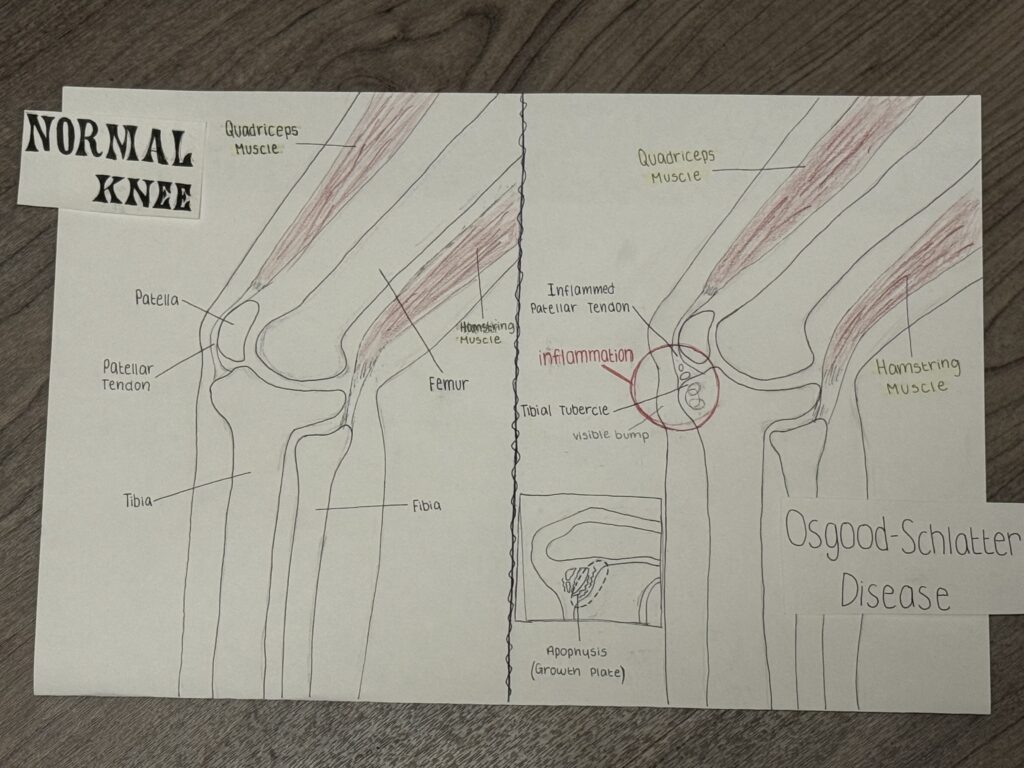
For my STEAM project I chose to do a drawing in a sort of poster form. The drawing includes a comparison of a normal knee and a knee with Osgood-Schlatter disease. The drawing includes the point of inflammation and where OSD is located in the knee. There are also labels of the two muscles in the knee (course objective) because the quadriceps muscle has a direct effect from OSD. The main parts that are affected by OSD are labeled.
Sources:
Bezuglov, E. N., Tikhonova, А. А., Chubarovskiy, P. V., Repetyuk, А. D., Khaitin, V. Y., Lazarev, A. M., & Usmanova, E. M. (2020). Conservative treatment of Osgood-Schlatter disease among young professional soccer players. International Orthopaedics, 44(9), 1737–1743. https://doi.org/10.1007/s00264-020-04572-3
Circi, E., Atalay, Y., & Beyzadeoglu, T. (2017). Treatment of Osgood–Schlatter disease: review of the literature. MUSCULOSKELETAL SURGERY, 101(3), 195–200. https://doi.org/10.1007/s12306-017-0479-7
Corbi, F., Matas, S., Álvarez-Herms, J., Sitko, S., Baiget, E., Reverter-Masia, J., & López-Laval, I. (2022). Osgood-Schlatter Disease: Appearance, Diagnosis and Treatment: A Narrative review. Healthcare, 10(6), 1011. https://doi.org/10.3390/healthcare10061011
Hirano, A., Fukubayashi, T., Ishii, T., & Ochiai, N. (2002). Magnetic resonance imaging of Osgood-Schlatter disease: the course of the disease. Skeletal Radiology, 31(6), 334–342. https://doi.org/10.1007/s00256-002-0486-z
Riae Lee
Steam Project Abstract: By Tyler Benefield
Steam Project Partner: Riae Lee
Riae’s Steam Project topic is Osgood-Schlatter Disease. Riae presented this subject with a poster showing the inner anatomy of a normal knee and one presenting with Osgood-Schlatter Disease. Her drawing does an excellent job of showing what is happening in the affected knee and the specific location where damage is occurring and the specific structures that are impacted by this disease. I did not know much about Osgood-Schlatter Disease prior to looking at and reading this Steam Project.
This disease seems to be part of a group of growth plate conditions causing musculoskeletal pain and potential internal damage during growth stages. Most adolescents affected are involved in sports and are often involved in activities involving quick, constant changes in direction and heavy impact on knees placing high stress on the Patellar Tendon. I found the ratio of males to females to be specifically alarming. This gender difference has been contributed to the differences in growth stages in males and females. Some researchers believe females are more susceptible to OSD during growth stages and even more so if they are involved in sports at this time. Symptoms of OSD include pain, swelling, resistance to extension and long term can lead to physical damage like tendon thickening and bone changes and fragmentation which may be visible with imaging at this stage. Most treatment options consist of physiotherapy and kinesiotherapy but some extreme cases may need surgery. Usually a complete recovery is expected with the closure of the epiphyseal plates. Having knowledge of some other types of knee diseases and musculoskeletal disorders I found it fascinating to see the specific physiological process of this condition compared to others. Riae did an excellent job of presenting in a clear and creative way and I feel I have gained much knowledge on her subject.
 Posted by

Osgood-Schlatter disease (OSD) is one of the most common causes of anterior knee pain in physically active children, especially during growth spurt. This occurs at the tibial tuberosity, the attachment site of the patellar tendon, and is considered an overused traction injury of the growing bone. The 2022 review in Healthcare explains that OSD has multiple causes including mechanical stress, body structure, training load, and even psychosocial factors (Corbi at al., 2022). Repetitive movements like jumping, sprinting, and general quick direction changes place high stress on the patellar tendon.
The ratio of cases between male and females is 14:1. When there were no gender distinctions, the peak age seemed to be 12. OSD is most common in girls from ages 9-10 and boys from ages 12-15. This could be explained by the fact that girls reach the bone maturation stage of the tibial tuberosity 2 years earlier than boys. (Corbi at al., 2022). Some authors suggest the risk of developing OSD is higher in females during the epiphyseal stage, especially those who do sports. OSD is most common in adolescent soccer players and they account for 13.6% of all known pathologies in soccer players ages 12 -15. Around 20-30% of cases have been from other sports that feature anaerobic, explosive, and acyclic components and constant change in direction. This includes sports like basketball, volleyball, taekwondo, sports gymnastics, baseball, and running. (Corbi et al., 2022)
The main symptom is pain at the tibial tuberosity especially when running, kneeling, or resisting knee extension. Other symptoms from exams include tenderness, swelling, and thickening at the tendon insertion. While healthcare professionals can usually diagnose OSD based on symptoms, imaging may help. X-rays can show images of bones which show changes or fragmentation, however early OSD often looks normal on radiographs. The 2002 Skeletal Radiology study shows that MRI’s are more accurate than X-rays at detecting early stages of OSD. The research describes 5 MRI stages; normal, early, progressive, terminal, and healing. (Hirano et al., 2002)
Treatment is usually symptomatic. Anyone with continued symptoms may need surgical treatment if they do not receive conservative treatment. Conservative treatment includes physiotherapy and kinesiotherapy. Surgical treatments may mean open bursoscopic and arthroscopic technique. Arthroscopic surgery is said to be more beneficial over an open procedure due to early postoperative recovery (Bezuglov et al., 2020). Usually a complete recovery is expected with closure of the tibial growth plate. Overall prognosis for OSD is good, there is some discomfort when kneeling and activity can be restricted in a few cases (Circi et al., 2017).
For my STEAM project I chose to do a drawing in a sort of poster form. The drawing includes a comparison of a normal knee and a knee with Osgood-Schlatter disease. The drawing includes the point of inflammation and where OSD is located in the knee. There are also labels of the two muscles in the knee (course objective) because the quadriceps muscle has a direct effect from OSD. The main parts that are affected by OSD are labeled.
Sources:
Bezuglov, E. N., Tikhonova, А. А., Chubarovskiy, P. V., Repetyuk, А. D., Khaitin, V. Y., Lazarev, A. M., & Usmanova, E. M. (2020). Conservative treatment of Osgood-Schlatter disease among young professional soccer players. International Orthopaedics, 44(9), 1737–1743. https://doi.org/10.1007/s00264-020-04572-3
Circi, E., Atalay, Y., & Beyzadeoglu, T. (2017). Treatment of Osgood–Schlatter disease: review of the literature. MUSCULOSKELETAL SURGERY, 101(3), 195–200. https://doi.org/10.1007/s12306-017-0479-7
Corbi, F., Matas, S., Álvarez-Herms, J., Sitko, S., Baiget, E., Reverter-Masia, J., & López-Laval, I. (2022). Osgood-Schlatter Disease: Appearance, Diagnosis and Treatment: A Narrative review. Healthcare, 10(6), 1011. https://doi.org/10.3390/healthcare10061011
Hirano, A., Fukubayashi, T., Ishii, T., & Ochiai, N. (2002). Magnetic resonance imaging of Osgood-Schlatter disease: the course of the disease. Skeletal Radiology, 31(6), 334–342. https://doi.org/10.1007/s00256-002-0486-z
Steam Project Abstract: By Tyler Benefield
Steam Project Partner: Riae Lee
Riae’s Steam Project topic is Osgood-Schlatter Disease. Riae presented this subject with a poster showing the inner anatomy of a normal knee and one presenting with Osgood-Schlatter Disease. Her drawing does an excellent job of showing what is happening in the affected knee and the specific location where damage is occurring and the specific structures that are impacted by this disease. I did not know much about Osgood-Schlatter Disease prior to looking at and reading this Steam Project.
This disease seems to be part of a group of growth plate conditions causing musculoskeletal pain and potential internal damage during growth stages. Most adolescents affected are involved in sports and are often involved in activities involving quick, constant changes in direction and heavy impact on knees placing high stress on the Patellar Tendon. I found the ratio of males to females to be specifically alarming. This gender difference has been contributed to the differences in growth stages in males and females. Some researchers believe females are more susceptible to OSD during growth stages and even more so if they are involved in sports at this time. Symptoms of OSD include pain, swelling, resistance to extension and long term can lead to physical damage like tendon thickening and bone changes and fragmentation which may be visible with imaging at this stage. Most treatment options consist of physiotherapy and kinesiotherapy but some extreme cases may need surgery. Usually a complete recovery is expected with the closure of the epiphyseal plates. Having knowledge of some other types of knee diseases and musculoskeletal disorders I found it fascinating to see the specific physiological process of this condition compared to others. Riae did an excellent job of presenting in a clear and creative way and I feel I have gained much knowledge on her subject.