
 Posted by
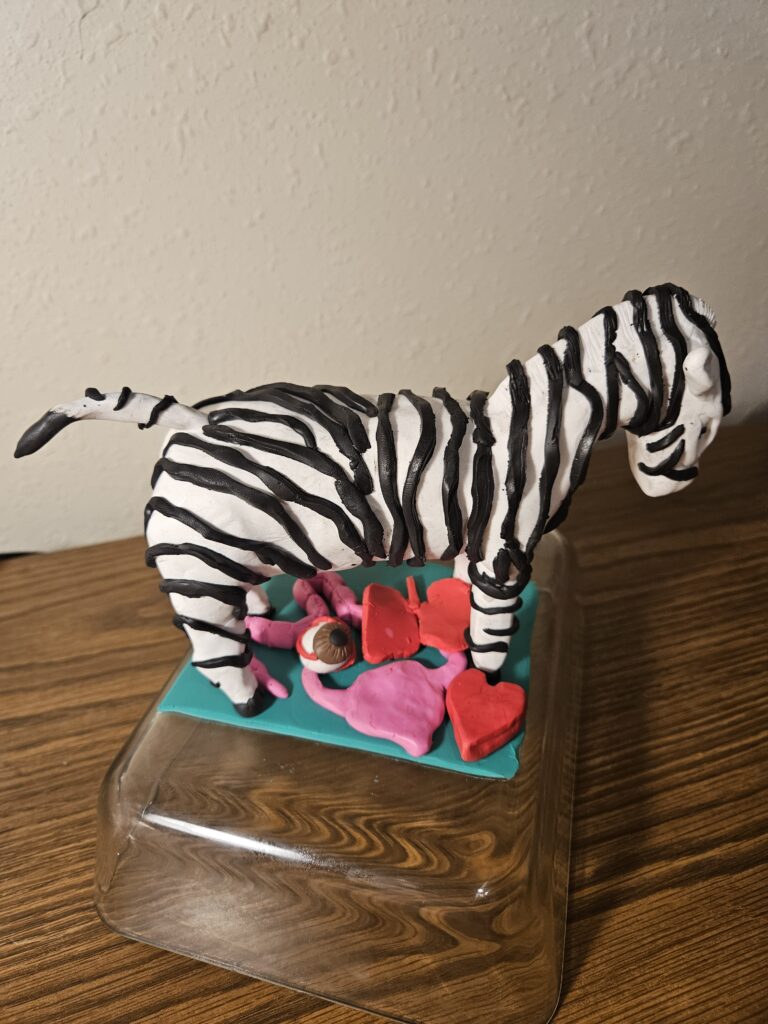
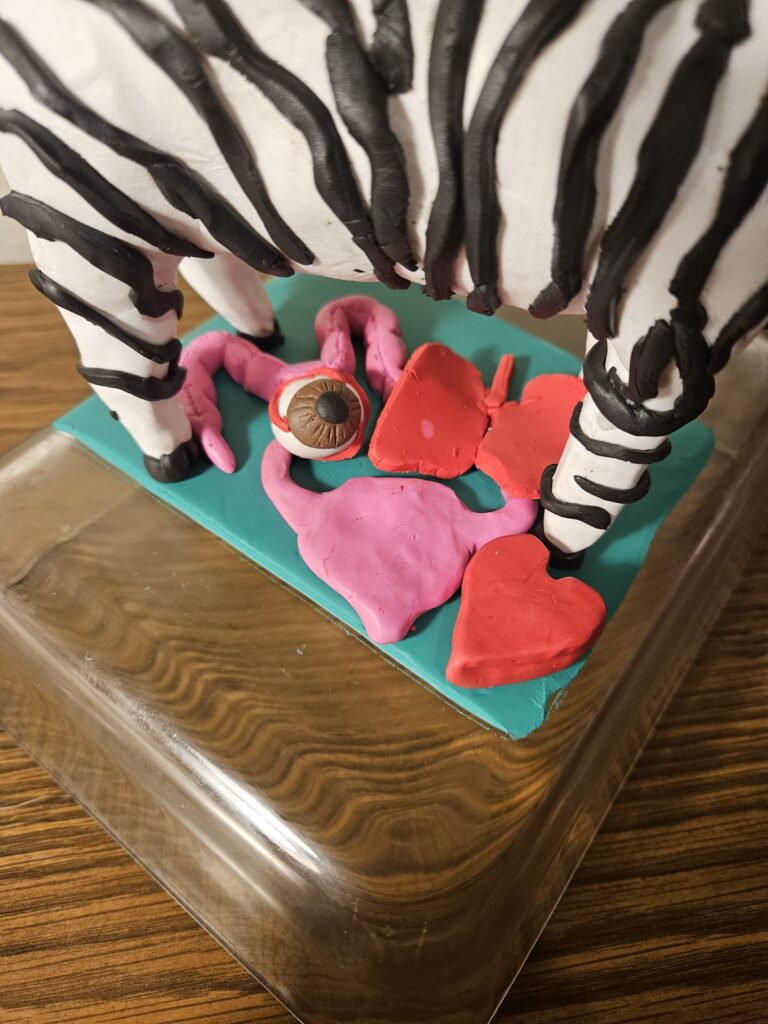
My art piece is a clay model of a zebra and the organs most affected by EDS. The zebra is a mascot for the disease in the same way pink represents breast cancer, and blue represents colon cancer. When doctors are in medical school, they are taught the saying, “If you hear hoofbeats, think horses, not zebras.” This is to encourage them to look for the most likely explanation to be the simplest or common one, and not to jump to rare or exotic diagnoses. Because of this, many patients like myself go undiagnosed for years. This leads to unnecessary pain, wasted time and money, and a lower quality of life. For some, the exotic diagnosis is correct.
For my project, I have researched a condition called Ehlers-Danlos Syndrome (EDS). This condition affects multiple areas and organs of the body through abnormalities in collagen structure. There are six subtypes of the condition, each classified by different gene defects. Ehlers-Danlos syndrome is a diverse connective tissue disorder affecting as many as 1 in 5,000 individuals. The most common form of EDS is hyperextensibility of the skin, hypermobility of joints often resulting in dislocations, and tissue fragility resulting in easy bruising, sunken scars after a superficial injury, and early rupture of membranes during pregnancy (Mao & Bristow, 2001). These classic symptoms resemble the disruption of collagen fibrils and extracellular matrix integrity.
In the past, scientists thought that EDS was a disorder of collagen metabolism. The identification of many malformations of collagen fibrils in patients with EDS triggered the idea that EDS is a disorder of fibrillar collagen metabolism (Mao & Bristow, 2001). However, well-studied types of the disease, including classic EDS, indicate that they arise from mutations in the genes that encode for collagen V. Classic EDS patients struggle with connective tissue hyperelasticity, joint instability, skin hyperextensibility, tissue fragility, and poor wound healing due to heterozygous mutations in COL5a1 or COL5a2 genes (Johnston et al., 2017). Classic EDS is defined by mutations in collagen V and haploinsufficiency of COL5A1, which is present in 67% of affected individuals (Johnston et al., 2017). These defects influence how collagen fibrils are assembled and regulated during tissue repair and development.
Collagen V is critical despite being a minor component of tendon and ligament matrices. The “Collagen V haploinsufficiency study” explains that, although collagen V is considered to play a minor role in tendons and ligaments, it is a highly significant regulator of fibrillogenesis, particularly during the early stages of fibril nucleation (Johnston et al., 2017). When collagen V is reduced, connective tissues experience structural abnormalities. Reduction of collagen V causes fewer collagen I fibrils that have increased diameters in tendons, ligaments, dermis, and the cornea (Johnston et al., 2017). These abnormalities impair a person’s mechanical performance. In the Col5a1+/- EDS mouse model, researchers observed that Col5a1+/– tendons exhibit lower amounts of mechanical ability following injury as compared to normal tendons (Johnston et al, 2017). Unlike healthy tissue, the Col5a1+/– tendons could not recover their strength (Johnston et al., 2017). This impaired healing makes sense given the disease’s molecular basis. Since one established function of collagen V is the limitation of fibril diameter, in classical EDS, the best indicator is a 25% increase in fibril diameter and rare composite fibrils, often called collagen cauliflowers (Mao & Bristow, 2001).
Even with advancements in the knowledge and understanding of EDS, there are still many cases that have no scientific explanation. The molecular defects described as of now are not enough to explain the disease in many patients with different forms of EDS (Mao and Bristow, 2001). This suggests that there are other components involved in the matrix that are at play. The discovery of tenascin-X (TNX) deficiency is another telltale sign that there is still more to be discovered about the condition. The association of TNX deficiency with EDS is crucial because it expands the search for genes in EDS patients, beyond the known issues with collagen and their modifying enzymes (Mao & Bristow, 2001). Ehlers-Danlos Syndrome is a connective-tissue disorder. Abnormal fibrillogenesis, especially when it involves collagen V, causes the symptoms related to EDS of tissue fragility, impaired healing, and chronic dysfunction. Continued research into non-collagen matrix proteins, gene regulation, and injury-response pathways must be done to eventually understand and treat this disorder fully.
References
Mao, J.-R., & Bristow, J. (2001, May 1). The ehlers-danlos syndrome: On beyond collagens. The Journal of Clinical Investigation. https://www.jci.org/articles/view/12881
Johnston, J. M., Connizzo, B. K., Shetye, S. S., Robinson, K. A., Huegel, J., Rodriguez, A. B., Sun, M., Adams, S. M., Birk, D. E., & Soslowsky, L. J. (2017). Collagen V haploinsufficiency in a murine model of classic Ehlers-Danlos syndrome is associated with deficient structural and mechanical healing in tendons. Journal of Orthopaedic Research, 35(12), 2707–2715. https://doi.org/10.1002/jor.23571
This STEAM project discusses a few of the different types of Ehlers-Danlos Syndrome. Ehlers-Danlos Syndrome is a group of connective tissue disorders which affect the body through collagen structure defects. The artist goes into detail about how the condition still needs further research to better understand how it works and how to treat it. The artist used clay to create a zebra and the most commonly affected organs in Ehlers-Danlos Syndrome. The zebra represents the mascot for EDS as medical professionals are taught the saying, “When you hear hooves, think horse, not zebra.” Ehlers-Danlos Syndrome is a rare condition, leading to delayed diagnosis as doctors first think “horse”, or the most common diagnosis, rather than “zebra”.