 Posted by
Bicep Tear: Process and Recovery
My objective is to discuss how bicep tears relate to skeletal, cardiac, and smooth muscles. Biceps tears usually occur at the distal tendon near the elbow, which is caused by an acute overload, degeneration, or a combination of both. Sudden eccentric loading, as with lifting something too heavy or attempting to resist an incredibly strong force, may be more than the tendon can bear and lead to tearing. (Kamineni n.d.) writes that distal biceps ruptures frequently happen with heavy lifting, where the tendon is suddenly forced to create an eccentric contraction. (Aurora Health Care n.d.) further states that unexpected heavy lifting, accidents, and falls are common modes of injury, particularly among middle-aged adults.
Symptoms vary depending on whether the tear is partial or complete. Partial tears preserve some tendon fibers and typically cause anterior elbow pain, tenderness, and difficulty with resisted supination or flexion. Complete ruptures may be associated with an audible pop, immediate sharp pain, swelling, bruising, visible muscle retraction, and marked weakness during elbow flexion and forearm supination. Diagnosis involves clinical examination and is complemented with imaging such as MRI or X-ray in order to understand the extent of injury to the affected area.
Treatment usually depends on the extent of the tear. Partial distal biceps tears are often initially treated nonsurgically. According to Bain et al. (2008), partial tears often respond well to rest, activity modification, anti-inflammatory medication, and physical therapy designed to restore range of motion and strengthen surrounding musculature. Kamineni indicates that conservative management may include approximately six weeks of rest followed by structured strengthening with low weight and high repetition. Symptoms that persist could require treatments such as platelet-rich plasma injections or surgery.
Most complete distal biceps tendon ruptures necessitate surgical repair, as untreated ruptures may be associated with chronic weakness, decreased supination strength, and deformity. Surgical techniques commonly involve reattachment of the tendon to the bone with the aid of implants such as cortical buttons or suture anchors. The need to choose appropriate surgical techniques in order to optimize functional outcomes is further supported by research in tendon procedures of the shoulder. (McBroom et al. 2024) show that variations in methods of managing the tendon, such as through tenotomy and tenodesis, will affect postoperative pain, function, and strength, thus underlining how surgical strategy is so important in tendon recovery more generally.
Rehabilitation after distal biceps repair often progresses through stages from immobilization to gradual mobilization and strengthening. Timing of surgical intervention is one of the main elements in optimal recovery. In a study on outcomes after distal biceps tendon repair, a ScienceDirect article reports that early surgical repair results in improved strength with fewer complications and better overall function compared with delayed repair, while increasing time from injury to surgery may lead to increased complication rates and decreased recovery (ScienceDirect, n.d.). The majority of patients achieve near-normal strength with minimal lasting deficits if promptly treated.
Most biceps tears result from acute overload or chronic tendon weakening. Partial tears may heal well with nonsurgical treatment, but complete distal ruptures usually require surgical repair. Early diagnosis and timely surgical intervention, if indicated, are important for maximizing the chance of optimal strength recovery, minimizing complications, and restoring functional use of the arm.
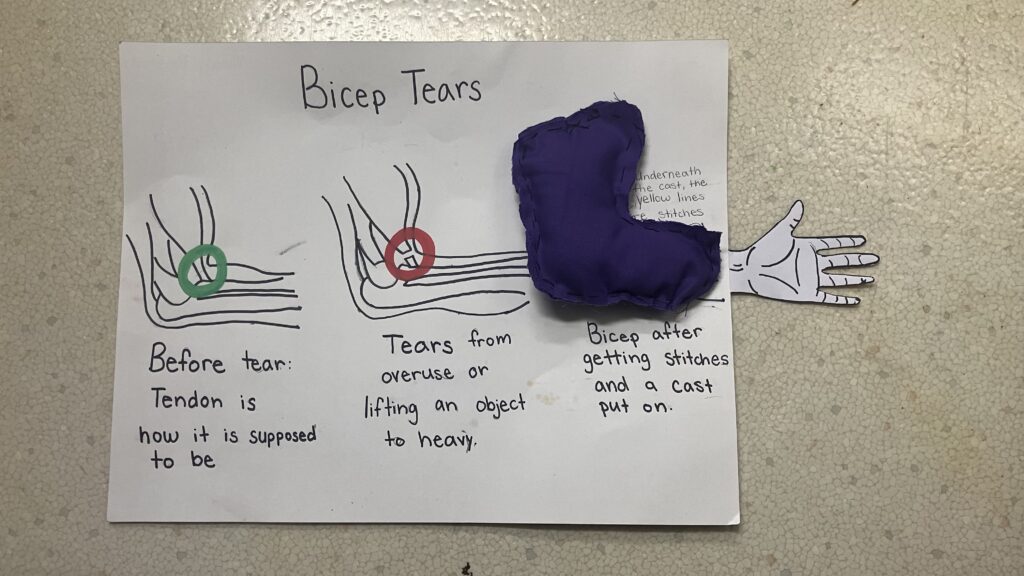
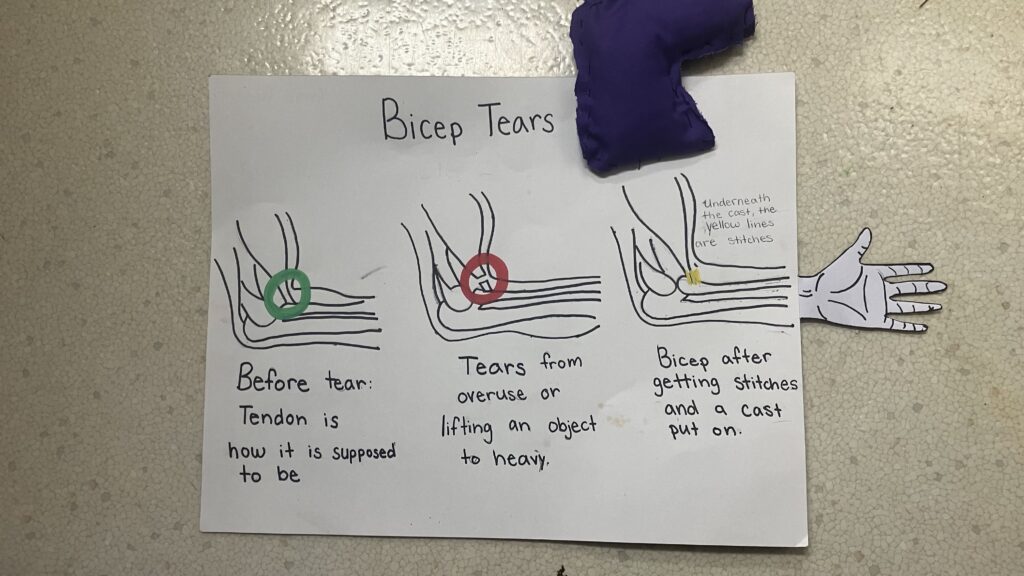
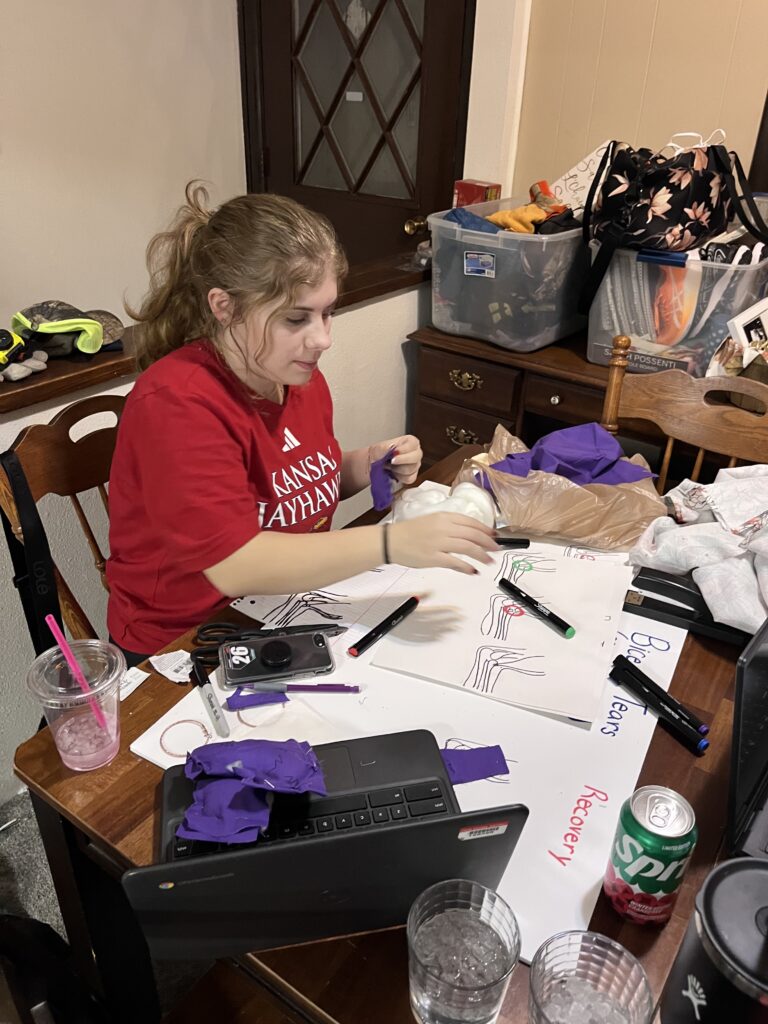
My artwork is a poster that illustrates the three important stages of a bicep tear: the arm before injury, which reflects the anatomy of a normal biceps tendon and its behavior during common movement; the moment of the tear, focusing on the sudden pull or strain that causes the rupture of the tendon fibers; and the recovery stage after treatment, showing the tendon after repair and the progressive regaining of strength and functionality after a period of rest, rehabilitation, or surgery. These three stages together visually describe the complete process of a bicep tear, from initial stability to injury to healing.
References
Aurora Health Care. (n.d.). Biceps tear. https://www.aurorahealthcare.org/services/orthopedics/conditions/biceps-tear
Bain, G. I., Johnson, L. J., & Turner, P. C. (2008). Treatment of partial distal biceps tendon tears. Sports Medicine and Arthroscopy Review, 16(3), 154–161. https://doi.org/10.1097/JSA.0b013e318183eb60
Kamineni, S. (n.d.). Distal biceps rupture. https://srinathkamineni.com/distal-biceps-rupture-2 McBroom, T. J., Torabian, K. A., Cherian, N. J., Gillinov, S. M., Siddiq, B. S., Chaharbakhshi, E. O., Eberlin, C. T., Kucharik, M. P., Abraham, P. F., & Martin, S. D. (2024).
Biceps tenotomy vs. tenodesis in patients undergoing transtendinous repair of partial thickness rotator cuff tears. JSES International, 8(4), 776–784. Tyler M. Bauer BS, Justin C. Wong MD, Mark D. Lazarus MD. Distal biceps tendon repair: Timing of repair and outcome. https://www.sciencedirect.com/science/article/pii/S1058274617308297
Reading Vivian’s post on bicep tears really showed me how injuries to the distal biceps tendon occur and how they relate to muscle function. I learned that an acute eccentric loading, such as that from lifting heavy objects, can easily cause overloading of the tendon beyond capacity and that these injuries are more common in middle-aged adults. I also thought it was interesting how symptoms range from mild anterior elbow pain and tenderness in partial tears to something more dramatic with swelling, bruising, visible muscle retraction, and overall weakness in complete ruptures. The part about the diagnosis focused on how important it is to combine clinical examination with imaging techniques such as MRI or X-ray. It seems like it correctly addresses the amount of damage. What really impressed me though was the detailed explanation of the treatment approaches. I learned that partial bicep tears often respond to nonsurgical treatments like rest, physical therapy, and anti-inflammatory medication, while complete ruptures almost always require surgical repair in order to prevent long term weakness and the arm being deformed. The explanation of rehabilitation stages-from immobilization to gradual strengthening emphasizes how much the timing of surgery affects recovery outcomes. Her poster that she designed really put it all into perspective for me on the process of a bicep tear. It showed the normal anatomy, point of injury, and recovery stages. I now have a much clearer picture of the anatomy, mechanism, treatment options, and recovery process about biceps tears.