
 Posted by
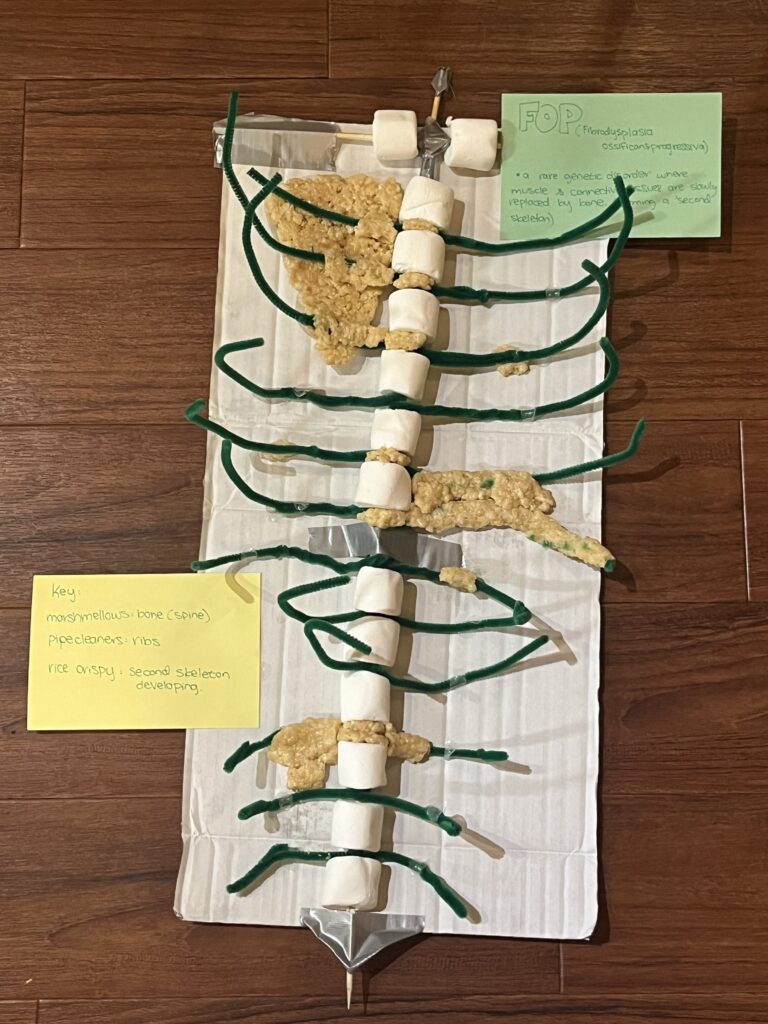
In my STEAM project I focused on comparing and contrasting the functions and structural differences of tissues, focusing specifically on connective tissue. Connective tissue is the most abundant tissue in the human body (Unit 3 Tissues Slide #30). All connective tissue is composed of ground substance, fibers and cells, and provide protection, insulation, as well as binding and support (Unit 3 Tissues Slide #30). Connective tissue can also transport substances and store fuel (Unit 3 Tissues Slide #30). Bone is a connective tissue that provides support and protection for body structures. (Unit 3 Tissues Slide #56). Bones have more collagen than most connective tissues, and make up the entire skeletal system (Unit 3 Tissues Slide #56). Bones give the body structure. Without them, we wouldn’t be much better off than jellyfish. Connective tissue proper is one of the components that allow the body to move. Take tendons for example, they connect muscle to bone, making them crucial for bodily movement. Bones can’t produce movement on their own. It takes many functioning parts to produce simple movements like walking and picking things up, and in patients with Fibrodysplasia Ossificans Progressiva, these simple movements are at stake.
Fibrodysplasia Ossificans Progressiva (FOP) is one of the most debilitating genetic conditions known to man. It disrupts the carefully balanced system that is connective tissues, and turns tendons, ligaments, and other connective tissues to bone (What is FOP?). With just over 900 confirmed cases worldwide, FOP is very rare, individuals have a literal one in a million chance of being born with it (What is FOP?). FOP has not been linked to race, gender, age, or location, making it impossible to predict (Late-onset fibrodysplasia ossificans…). FOP individuals are born looking and seeming very similar to the average population. The only common trait seems to be bigger than normal first toes (Late-onset fibrodysplasia ossificans…). FOP causes a second skeleton to form over the first, restricting movement and ultimately leading to early death for every individual diagnosed with it (What is FOP?). The formation of this destructive second skeleton begins when a patient experiences some sort of physical trauma. This could be as trivial as taking a tumble, or as serious as a surgery or broken bone (What is FOP?). In a normal individual, their bodies stem cells come to the trauma site and transform themselves into the damaged cells, multiplying to replace the lost cells (What is FOP). Stem cells have receptors that tell them what cell to turn into. The stem cells of an FOP patient are defective. They misinterpret a protein called activin-A as a signal to become bone, instead of repairing the damaged site (Kitoh 4). Enough of these misinterpretations happen, and the second skeleton is well underway. The first locations of bone development typically include the back of the neck, vertebrae and proximal regions, with the appendicular regions following (Kitoh 5). The loss of connective tissue and muscle paired with the excess of bone produced by this condition threatens the basic interactions between muscles and the skeletal system, which was the other course objective I chose.
Muscle contractions produce muscle tension (Unit 5 Muscles slide #24). This can be thought of as the force exerted on a load or object to be moved (Unit 5 Muscles slide #24). Muscle tension creates the movement of the body. With origins and insertions all over the body, skeletal muscles are the primary movers of our main frame. Smooth muscle on the other hand, is found in the walls of most hollow organs (Unit 5 Muscles slide #59). Smooth muscle is involved in involuntary processes, and skeletal muscle is involved largely in voluntary movements. In patients with FOP, only skeletal muscles are turned to bone. This is good as most involuntary muscle movements are crucial to day to day survival, but bad as without functioning skeletal muscle, the body rapidly loses the ability to move. The bone gives the body structure, the skeletal muscles provide the force needed to move that structure. Calcify those muscles, and an individual’s quality of life significantly decreases.
Works Cited
Kitoh, H. (2020, September 2). first_pagesettingsOrder Article Reprints Open AccessReview Clinical Aspects and Current Therapeutic Approaches for FOP. MDPI. Retrieved November 4, 2025, from https://www.mdpi.com/2227-9059/8/9/325
Late-onset fibrodysplasia ossificans progressiva with atypical presentation: A case report. (2019, July). ScienceDirtect. Retrieved November 4, 2025, from https://www.sciencedirect.com/science/article/pii/S2214911219301158
What is FOP? – IFOPA – International Fibrodysplasia Ossificans Progressiva Association. (n.d.). International FOP Association. Retrieved November 4, 2025, from https://www.ifopa.org/what_is_fop
Twila went into detail about fibrodysplasia ossificans progressiva.(FOP) It is a very rare genetic condition with only 900 cases worldwide. She explained the functions of connective tissue such as protection and support. Bone is a type of connective tissue that provides protection and support to the body’s
structure. FOP turns tendons, ligaments and connective tissues into bone. It forms a second skeleton over the first. This causes restricted movement and leads to early death. It begins after the patient experiences physical trauma, ranging from minor to major.
On a cellular level, the stem cells are defective. Normal stem cells multiply to replace the damaged cells. Patients with FOP the stem cells misinterpret the activin-A protein as a signal to become bone. The typical locations that calcify first is the back of the neck, vertebrae, along with the proximal and appendicular regions. This condition does not affect smooth muscle which is found in the hollow organs such as our heart. It only causes the skeletal muscles to calcify.
I found Twila’s art project to be unique because of the items she used. She chose to use food such as marshmallows and rice crispy treats. She also used a mix of other materials like pipe cleaners and shish kebabs. She used the materials to show the ribs and vertebrae forming the second skeleton. These materials create a distinct difference between what they represent. I liked that these materials were used to create a physical representation of this condition.