 Posted by

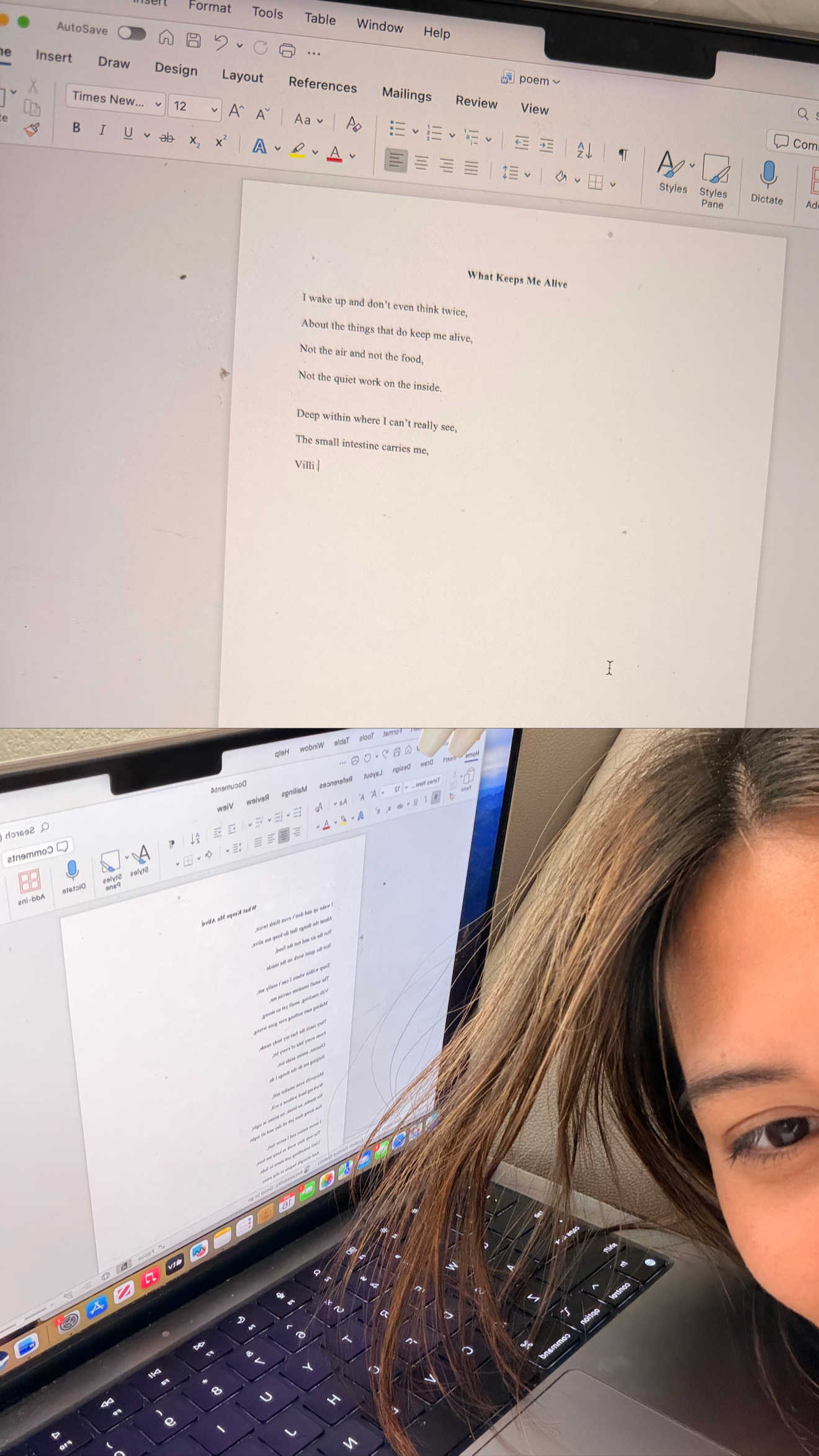
I wake up and don’t even think twice,
About the things that do keep me alive,
Not the air and not the food,
Not the quiet work on the inside.
Deep within where I can’t really see,
The small intestine carries me,
Villi reaching, small yet so strong,
Making sure nothing ever goes wrong.
They catch the fuel my body needs,
From every bite of every bit,
Glucose, amino acids too,
Helping me do the things I do.
Microvilli even smaller still,
Working hard without a will,
No thanks, no break, nothing in sight,
Just doing their job all day and all night.
I never notice and I never feel,
The way they work to keep me here,
Until something just starts to fade,
And strength begins to slip away.
Then I learn what I once had missed,
How life depends on things like this,
Not just the big but also small,
The unseen work that holds it all.
Essay:
This steam project focuses on the structure and function of the small intestine during digestion and absorption. The objective I covered in this project is to describe the structure and function of the small intestine in digestion and absorption. This project also explains how villi and microvilli help increase surface area so that our body can absorb nutrients better more especially glucose and amino acids.
The small intestine is the way it is to help the body absorb as many nutrients as possible. The inside lining has these small finger like projections called villi and each villus has insanely even smaller structures called microvilli. These structures increase the surface area which allows more nutrients to be absorbed at once (OpenStax, 2023). Without these structures, the body wouldn’t be able to get enough nutrients from food. The small intestine also uses different ways to in order to move nutrients into the body. Glucose and amino acids are absorbed through processes like active transport and facilitated diffusion (Kiela & Ghishan, 2016). Right after they’re absorbed, they go to the bloodstream and are used by the body for energy, growth, and repair. This shows how the structure of the small intestine supports its function. This project also looks at what happens when the small intestine is damaged. For example, in conditions just like celiac disease, the villi can become damaged. When this happens, the surface area is reduced and the body cannot absorb nutrients properly. This can lead to problems like weakness, weight loss, and poor health (Walton et al., 2016). This just shows how important the structure of our small intestine really is.
For the creative part of this project, I had chosen to write a poem. As someone who loves to express art through words, I figured correlating art and science would be an interesting piece. The poem shows how nutrients move through the small intestine and how villi and microvilli help within absorption. Instead of explaining everything in a very direct way, I’d use poem for simple imagery to show flow and movement. This helps make the idea easier to understand, more interesting and most especially, captivating. The poem describes nutrients moving through a space filled with folds and tiny structures which help catch and absorb them. This connects to the real function of the small intestine in such a creative way. Using poem makes the topic easier to remember and helps show the connection between structure, function, and appreciation for life.
Overall, this project shows that the structure of the small intestine really important for digestion and absorption. By combining science and art, this project helps explain the topic in a simple and engaging way.
References:
OpenStax. (2023). Anatomy and physiology (Chapter 23: The digestive system). Rice University. https://openstax.org/details/books/anatomy-and-physiology
Kiela, P. R., & Ghishan, F. K. (2016). Physiology of intestinal absorption and secretion. Best Practice & Research Clinical Gastroenterology, 30(2), 145–159. https://pmc.ncbi.nlm.nih.gov/articles/PMC4956471/
Walton, K. D., Kolterud, Å., Czerwinski, M. J., Bell, M. J., Prakash, A., Kushwaha, J., Grosse, A. S., Schnell, S., & Gumucio, D. L. (2016). Generation of intestinal surface: An absorbing tale. Development, 143(13), 2261–2272. https://pmc.ncbi.nlm.nih.gov/articles/PMC4958325/
Ms Sinlao’s steam project covers the small intestine and its functions though a poem as her medium. The poem highlights that the small intestine works involuntarily in the digestion process. The key points highlight that the microvilli yet small and are able to accomplish so much of the small intestine’s digestion. I really thought she did a wonderful job writing her poem, I wish I was as creative and able to write poetry like this.
In Ms Sinlao’s essay, she again highlights the importance of the microvilli in the small intestine. The small intestine wouldn’t be able to accomplish much of its digestion without this key component. She also highlights that glucose, and amino acids are absorbed, which is the key component in active transport and diffusion. She mentions celiacs disease where the microvilli become damaged and the body can’t properly absorb the nutrients.