Posted by
Recovery is often seen as just resting after training or a long day, but it is actually a complex and highly regulated process controlled by the body. I chose this topic because recently I have been paying more attention to how my energy, sleep, and stress levels change depending on how I train and recover. There are times when I feel like I am doing everything right, but still feel tired or not fully recovered. That made me curious about what is actually happening inside the body during recovery and why it sometimes does not work as expected. Instead of thinking of recovery as passive rest, I started to see it as something the body actively controls through different systems working together, especially through how it switches between stress and recovery states.
One of the most important systems involved is the endocrine system, which uses hormones to regulate body functions. Hormones act as chemical messengers that travel through the bloodstream and bind to specific receptors on target cells, changing how those cells behave (Tortora & Derrickson, 2022). A key hormone involved in stress and training is cortisol. Cortisol helps mobilize energy by increasing glucose availability, which is useful during exercise or stressful situations. However, an important detail is that cortisol follows a daily rhythm, normally peaking in the morning and decreasing throughout the day. When this rhythm is disrupted, for example by stress or poor sleep, it can negatively affect recovery and energy levels, even if total hormone levels are not extremely high (McEwen, 2007).
In contrast, recovery is strongly supported by hormones such as melatonin and growth hormone. Melatonin is released in response to darkness and helps regulate the sleep-wake cycle. What is especially interesting is that even small amounts of light at night can suppress melatonin production, which can reduce sleep quality and limit recovery. Growth hormone, on the other hand, is released in pulses, with the largest release occurring during deep sleep. This hormone plays a major role in muscle repair, protein synthesis, and restoring energy balance (Van Cauter & Plat, 1996). This shows that recovery is not just about sleep duration, but also about whether the body reaches the deeper stages of sleep where these processes occur.
These hormonal processes are regulated by feedback systems that keep the body in balance. Negative feedback loops prevent hormones from becoming too high or too low. For example, when cortisol levels increase, signals are sent to the brain to reduce further release. This type of regulation helps maintain homeostasis, but it can also be disrupted by chronic stress or lack of recovery. Over time, repeated stress can alter how sensitive the body is to these signals, making it harder to return to a balanced state and slowing down the recovery process (McEwen, 2007).
The nervous system works closely with the endocrine system to control recovery. The autonomic nervous system includes the sympathetic and parasympathetic systems, which have opposite roles. The sympathetic system activates the “fight or flight” response, increasing heart rate, breathing, and energy output. This is necessary during training, but staying in this state for too long can reduce recovery. The parasympathetic system promotes the “rest and digest” state, which supports digestion, slows the heart rate, and allows the body to repair itself. Importantly, recovery depends not just on activating this system, but on how effectively the body can switch into it after stress.
An important connection between these systems is that the parasympathetic nervous system is most active during deep sleep, which is also when growth hormone release is highest. This shows how the nervous and endocrine systems are directly linked in supporting recovery. Additionally, increased parasympathetic activity is associated with better recovery and improved performance, especially in athletes (Chennaoui et al., 2015). This highlights that recovery is not just about rest, but about the body’s ability to shift into a physiological state that supports repair and restoration.
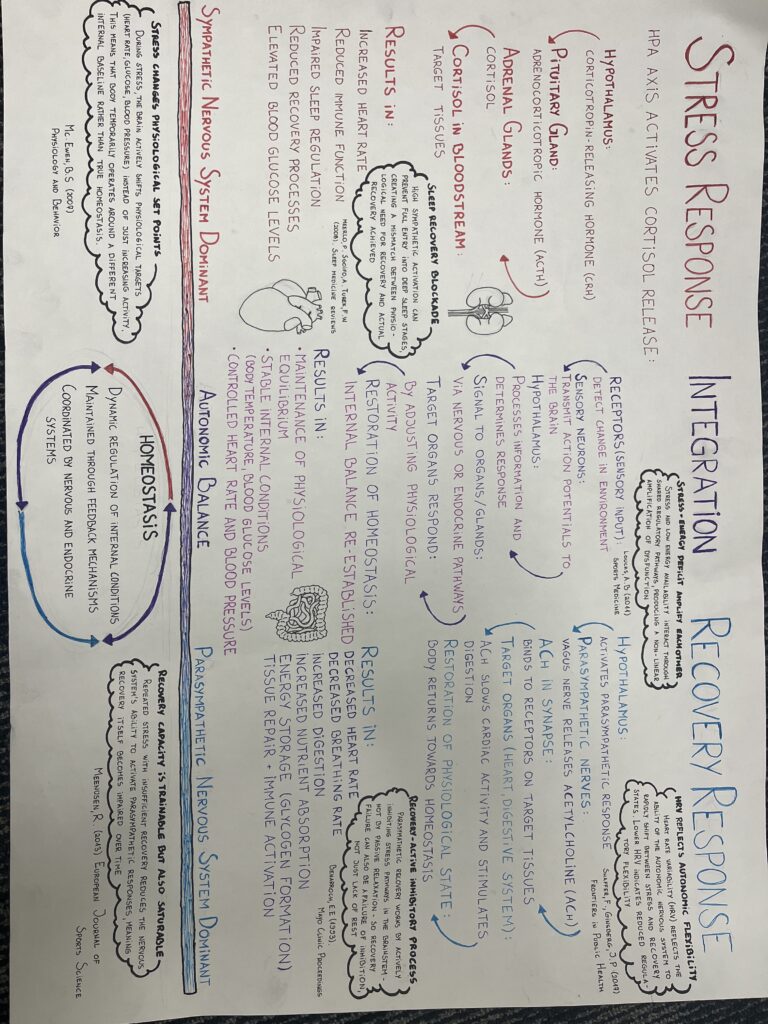
For the creative part of this project, I created a poster called “The Recovery Switch.” In my drawing, I focused on illustrating how the body moves between a stress state and a recovery state by showing the physiological processes involved in each. I used labeled diagrams and simple doodles to represent key components such as organs and parts of the nervous system. The stress side shows processes like increased heart rate, energy mobilization, and sympathetic activation, while the recovery side shows parasympathetic activity, repair, and energy restoration. I also added some interesting facts about how all those mechanisms work. This visual approach helps organize complex mechanisms in a clear way and makes it easier to see how different systems work together, while also emphasizing that recovery depends on the body’s ability to shift between these states.
This project helped me understand that recovery is not just about resting, but about how the body actively regulates itself through hormones, feedback loops, and nervous system activity. It also showed me that small factors, like sleep quality, stress levels, and energy balance, can affect how easily the body switches into recovery. Understanding this made the concept of recovery feel more scientific and less random, and it helped explain why balance between stress and recovery is important for both performance and overall health.
Citations:
Chennaoui, M., Arnal, P. J., Sauvet, F., & Léger, D. (2015). Sleep and exercise: A reciprocal issue? Sleep Medicine Reviews, 20, 59–72.
McEwen, B. S. (2007). Physiology and neurobiology of stress and adaptation: Central role of the brain. Physiological Reviews, 87(3), 873–904.
Van Cauter, E., & Plat, L. (1996). Physiology of growth hormone secretion during sleep. The Journal of Pediatrics, 128(5), S32–S37.
Tortora, G. J., & Derrickson, B. (2022). Principles of anatomy and physiology (17th ed.). Wiley.