
 Posted by
Heart disease is the leading cause of death in the United States and remains a major global health issue (Palaniappan et al., 2026). It affects the cardiovascular system, which includes the heart, blood vessels, and blood. This system is responsible for transporting oxygen, nutrients, and waste throughout the body. When it becomes damaged or weakened, serious conditions such as heart attacks, stroke, and atherosclerosis can occur. In rural Alaska, heart disease presents unique challenges due to environmental, cultural, and healthcare access factors (Ebbesson et al., 2005) . Understanding these causes and identifying realistic prevention strategies is essential for improving health outcomes in these communities.
One of the primary causes of heart disease is the buildup of plaque in the arteries, known as atherosclerosis. This process restricts blood flow and can lead to heart attacks or strokes. Atherosclerosis develops when low-density lipoprotein (LDL) cholesterol accumulates in the inner lining of the arteries, triggering an inflammatory response. Over time, immune cells like macrophages absorb this cholesterol and transform into foam cells, creating fatty streaks that harden into plaques. These plaque narrowing the arteries and making them less flexible, which increases the risk of clot formation and sudden blockage. These plaques release inflammatory signals called cytokines, which further damage the artery and increase the likelihood of rupture and clot formation. Risk factors include high blood pressure, obesity, diabetes, smoking, and poor diet (Centers for Disease Control and Prevention, 2024). In Alaska, diet plays a particularly important role. Traditional diets once rich in fish and omega-3 fatty acids have shifted toward more processed, Western foods high in sugar, salt, and unhealthy fats. Researchers have linked this dietary transition to increased rates of cardiovascular disease in Alaska Native populations (Howard et al., 2010).
However, the relationship between diet and heart disease is complex. While many researchers believe omega-3 fatty acids protect against heart disease, research in Alaska Native populations has shown that higher consumption does not always reduce conditions like carotid atherosclerosis (Ebbesson et al., 2008). This suggests that other factors, such as genetics, overall diet composition, and lifestyle, also play significant roles. Additional studies have found that certain fatty acids may even be associated with increased cardiovascular risk factors, further highlighting the complexity of nutrition and heart health (Ebbesson et al., 2015). This suggests that prevention strategies cannot rely on a single nutrient or food group but must consider overall diet, lifestyle, and environmental context. In rural Alaska, this means that effective solutions need to balance traditional practices with modern health knowledge rather than replacing one with the other.
Limited access to healthcare also plays a significant role in the development and progression of heart disease in Bush Alaska. Many communities are remote and lack nearby hospitals or specialists. This makes it difficult for individuals to receive regular check-ups, early diagnosis, or treatment for conditions like hypertension or diabetes. Environmental conditions, including extreme cold and long winters, can also reduce opportunities for physical activity, contributing to sedentary lifestyles and increased risk of cardiovascular disease.
In rural Alaska, the effects of heart disease are especially serious and often life-threatening due to delays in diagnosis and treatment. When blood flow is reduced, the heart must work harder to pump blood, which can weaken the heart muscle over time. Reduced oxygen supply can damage tissues and organs. The cardiovascular system works closely with the respiratory system, as oxygen from the lungs is transported by red blood cells through the bloodstream. If this system is disrupted, the entire body is affected. Because the heart and lungs work together to deliver oxygen throughout the body, disruptions in this system can quickly become life-threatening, especially in areas where immediate medical care is not available. In remote communities, limited access to emergency care can make these effects more dangerous, as treatment is often delayed
Even with these barriers, prevention is still possible in remote villages. Expanding access to healthier foods, supporting traditional diets, and increasing opportunities for physical activity can directly reduce risk. Promoting physical activity through community programs or culturally relevant activities can also make a difference. Education about heart disease and its risk factors is essential so individuals can recognize symptoms early and seek care. Additionally, expanding access to telemedicine and mobile healthcare services can help bridge the gap in medical care for remote populations.
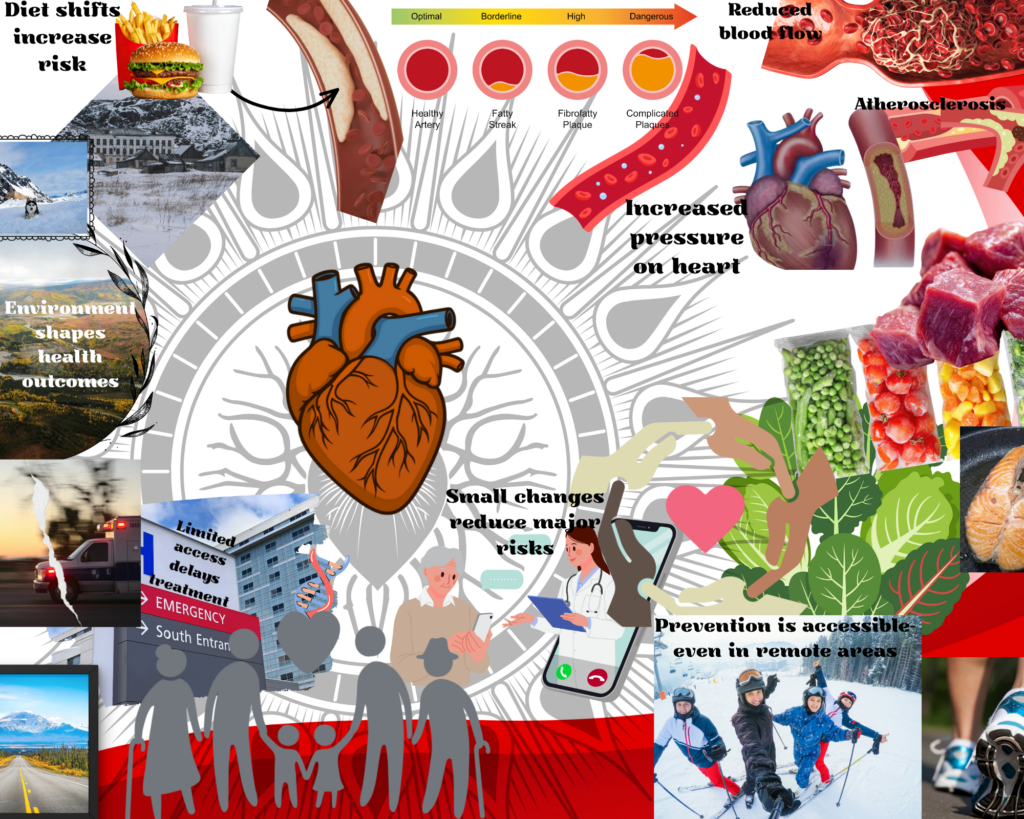
My digital collage visually represents the causes, effects, and prevention of heart disease in a clear, organized way. It connects to course objectives 40, 41, 42, and 48 by focusing on heart regulation, blood flow pathways, cardiac structure, and the interaction between the heart and lungs. The collage includes images of arteries with plaque buildup, diagrams of heart structure and circulation, and examples of both unhealthy and healthy lifestyle choices.
The central heart also functions as a visual anchor, symbolizing how every factor in the collage connects back to one critical system. The use of gray silhouettes represents how heart disease can affect entire families and communities, not just individuals, reinforcing the shared impact of the issue. The surrounding sections are arranged by cause (upper left), effect (upper right), and prevention (lower right), helping guide the viewer through the information. Elements like gray family silhouettes and Alaskan landscape imagery connect the science to real people and places, showing that heart disease is not just a biological issue but something that affects entire communities.
The collage also highlights challenges specific to remote Alaska, such as limited access to healthcare and environmental barriers. By combining scientific detail with real-world context, it shows both the physical processes of heart disease and its broader impact on daily life.
Heart disease is not caused by just one factor but by a combination of influences that work together. In rural Alaska, reducing its impact means recognizing the unique environmental conditions, lifestyle factors, and cultural context of these communities. This project shows how combining scientific understanding with community-focused awareness can help create more effective ways to prevent and manage cardiovascular disease. Understanding heart disease in this context requires looking beyond biology alone and recognizing how environment, culture, and access shape health outcomes.
References
Centers for Disease Control and Prevention. (2024, October 24). Heart disease facts. https://www.cdc.gov/heart-disease/data-research/facts-stats/index.html
Ebbesson, S. O. E., Adler, A. I., Risica, P. M., Ebbesson, L. O. E., Yeh, J.-L., Go, O. T., Doolittle, W., Ehlert, G., Swenson, M., & Robbins, D. C. (2005). Cardiovascular disease and risk factors in three Alaskan Eskimo populations: The Alaska-Siberia project. International Journal of Circumpolar Health, 64(4), 365–386. https://doi.org/10.3402/ijch.v64i4.18014
Ebbesson, S. O. E., Roman, M. J., Devereux, R. B., Kaufman, D., Fabsitz, R. R., MacCluer, J. W., Dyke, B., Romenesko, T., Ebbesson, L. O. E., Nobmann, E. D., & Howard, B. V. (2008). Consumption of omega-3 fatty acids is not associated with a reduction in carotid atherosclerosis: The genetics of coronary artery disease in Alaska Natives study. Atherosclerosis, 199(2), 346–353. https://doi.org/10.1016/j.atherosclerosis.2007.10.020
Ebbesson, S. O. E., Voruganti, V. S., Higgins, P. B., Fabsitz, R. R., Ebbesson, L. O. E., Laston, S., Harris, W. S., Kennish, J., Umans, B. D., Wang, H., Devereux, R. B., Okin, P. M., Weissman, N. J., MacCluer, J. W., Umans, J. G., & Howard, B. V. (2015). Fatty acids linked to cardiovascular mortality are associated with risk factors. International Journal of Circumpolar Health, 74, Article 28055. https://doi.org/10.3402/ijch.v74.28055
Palaniappan, L. P., Allen, N. B., Almarzooq, Z. I., Anderson, C. A. M., Arora, P., Avery, C. L., Baker-Smith, C. M., Bansal, N., Currie, M. E., Earlie, R. S., Fan, W., Fetterman, J. L., Barone Gibbs, B., Heard, D. G., Hiremath, S., Hong, H., Hyacinth, H. I., Ibeh, C., Jiang, T., … Khan, S. S. (2026). 2026 heart disease and stroke statistics: A report of US and global data from the American Heart Association. Circulation, 153(9), e123–e215. https://doi.org/10.1161/CIR.0000000000001412
Weissman, N. J., & Wenger, C. R. (2010). Cardiovascular disease prevalence and its relation to risk factors in Alaska Eskimos. Nutrition, Metabolism and Cardiovascular Diseases, 20(5), 350–358. https://doi.org/10.1016/j.numecd.2009.04.010

This essay by Nuala explores the complex factors that contribute to heart disease in rural Alaska, and she highlights how environmental, cultural, and healthcare-access challenges shape cardiovascular health in these communities. Nuala explains how heart disease develops biologically, focusing on atherosclerosis, the buildup of LDL-driven plaque that narrows arteries, triggers inflammation, and increases the risk of heart attack and stroke. She connects these processes to broader lifestyle and dietary changes among Alaska Native populations, highlighting the shift from traditional omega-3-rich foods to processed Western diets. Although omega-3 fatty acids are viewed as protective, Nuala’s essay emphasizes research showing that their effects are not always straightforward, and she suggests that genetics, overall diet, and lifestyle also play big roles. Her essay also talks about the structural barriers that remote Alaskan villages face, including limited access to health care, long travel distances, and harsh weather that restricts physical activity. These factors delay diagnosis and treatment, making cardiovascular outcomes more severe. Despite these challenges, Nuala shows realistic prevention strategies like improving access to healthy foods, supporting traditional dietary practices, expanding telemedicine, and promoting culturally relevant physical activity. The digital collage that she made, along with the essay, visually organizes the causes, effects, and prevention of heart disease while connecting them to course concepts like circulation, cardiac structure, and heart-lung interaction. By blending scientific explanation with the reality of rural Alaska, Nuala really shows that effective prevention needs understanding both biological mechanisms and the cultural and environmental context in which heart diseases happen.