Cortisol’s Control Over Thyroid Hormones, by Michi J. Roberts, examines how long-term stress affects the thyroid gland via hormonal interactions, fulfilling the task of explaining how hormones impact the development and regulation of other hormones.
From Roberts’ opinion, the hormone cortisol involved in stress response is secreted through the HPA axis. While this mechanism can be helpful to us now and then, high levels of cortisol inhibit the HPT axis, thereby preventing the secretion of TRH and TSH and slowing down metabolism from T4 to T3. As a result, there occurs hypothyroidism which presents itself as fatigue, weight gain, and insensitivity to cold.
Roberts supports her argument through quoting a number of studies, including Smith and Vale (2006) and López et al. (2010). Also she takes into account facts from various websites on this topic, such as Cleveland Clinic, and a report on Cushing’s syndrome of 2024. It is worth mentioning that the latter source is highly convincing, providing some numbers proving a relation between high levels of cortisol and low thyroid activity.
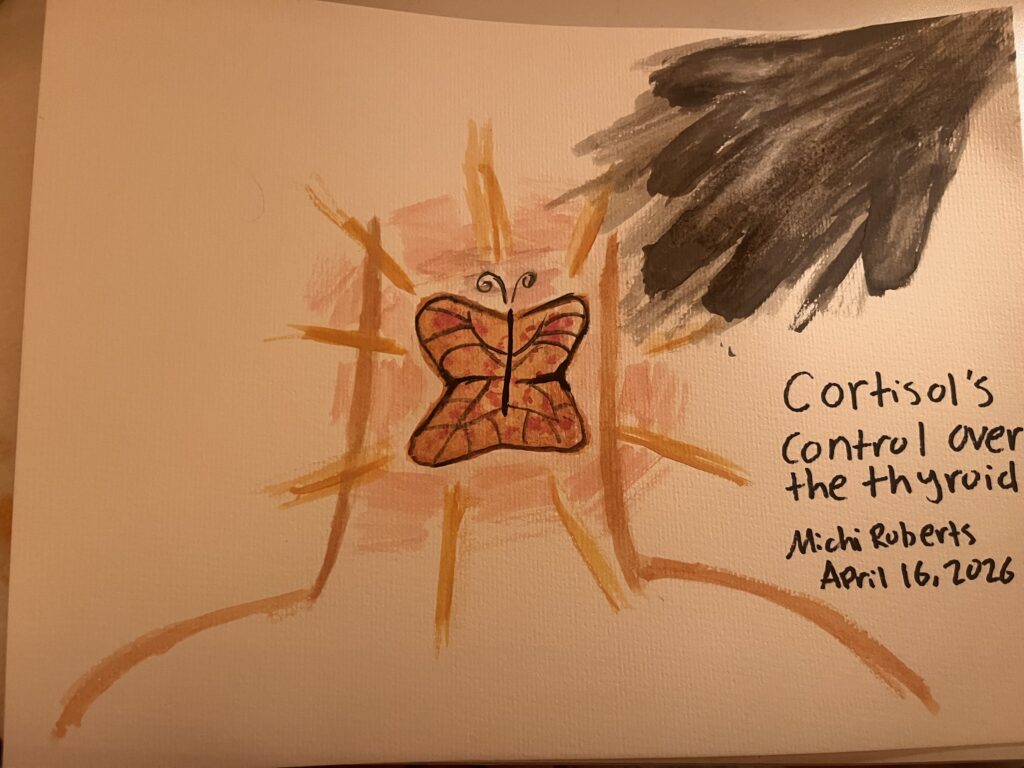
The following picture demonstrates quite clearly how everything happens through showing the picture of a butterfly standing amidst bright orange lines of stress, which symbolize HPA-axis. At the same time, the dark shadow looming over the butterfly (i.e. over the butterfly shaped thyroid gland) proves the prevalence of cortisol. In other words, this essay along with this picture demonstrates how our body responds to stress and cortisol.
It is a very well-researched and thoughtful article that is engaging and informative.
 Posted by

Cortisol’s Control Over Thyroid Hormones, by Michi J. Roberts, examines how long-term stress affects the thyroid gland via hormonal interactions, fulfilling the task of explaining how hormones impact the development and regulation of other hormones.
From Roberts’ opinion, the hormone cortisol involved in stress response is secreted through the HPA axis. While this mechanism can be helpful to us now and then, high levels of cortisol inhibit the HPT axis, thereby preventing the secretion of TRH and TSH and slowing down metabolism from T4 to T3. As a result, there occurs hypothyroidism which presents itself as fatigue, weight gain, and insensitivity to cold.
Roberts supports her argument through quoting a number of studies, including Smith and Vale (2006) and López et al. (2010). Also she takes into account facts from various websites on this topic, such as Cleveland Clinic, and a report on Cushing’s syndrome of 2024. It is worth mentioning that the latter source is highly convincing, providing some numbers proving a relation between high levels of cortisol and low thyroid activity.
The following picture demonstrates quite clearly how everything happens through showing the picture of a butterfly standing amidst bright orange lines of stress, which symbolize HPA-axis. At the same time, the dark shadow looming over the butterfly (i.e. over the butterfly shaped thyroid gland) proves the prevalence of cortisol. In other words, this essay along with this picture demonstrates how our body responds to stress and cortisol.
It is a very well-researched and thoughtful article that is engaging and informative.