
 Posted by
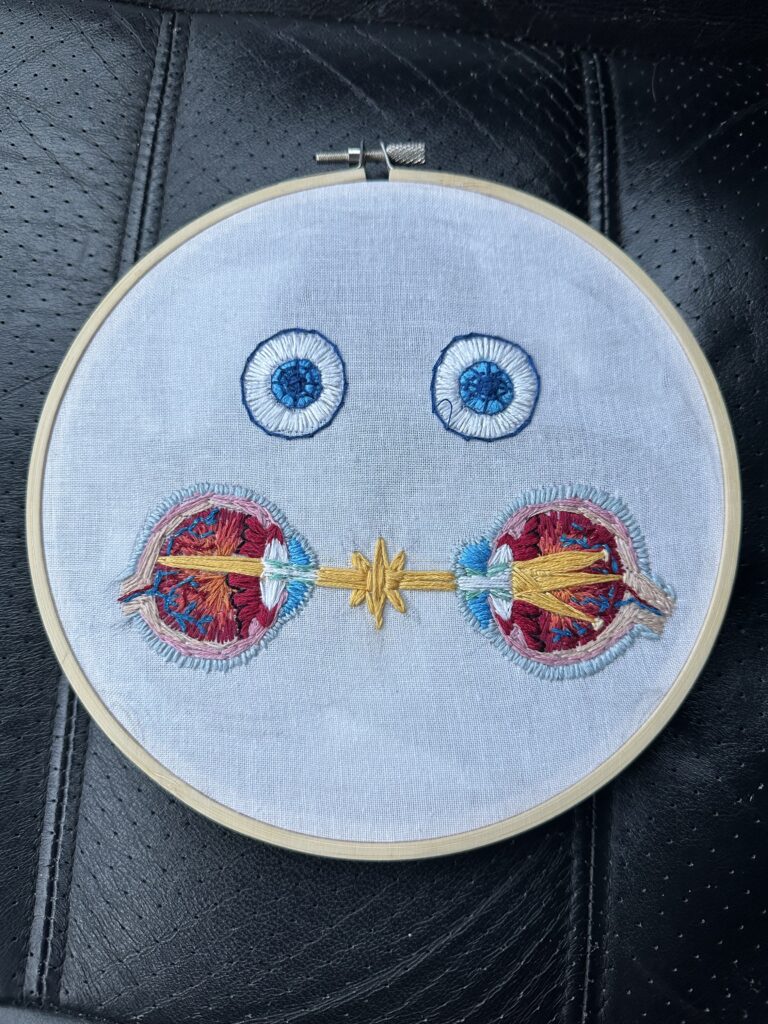

My completed and WIP pictures attached above ^^
My STEAM Project is an embroidery of an eye with diplopia, commonly referred to as “seeing double”. The objective it represents is to “explain how sensory cells translate stimulus into action potentials”. This relates to my topic because the condition of diplopia changes the way that sensory cells communicate with the brain and eyes, therefore changing the way we perceive visual inputs.
Diplopia occurs as a result of multiple conditions. However, this assignment will be focusing on diplopia as a result of astigmatism, which is when the cornea is an irregular shape. Astigmatism is incredibly common in the general population, with multiple studies showing “a prevalence of up to 60%” (Son, S. et al.,). This common irregularity is usually the result of a lack of uniform thickness throughout the entire cornea. The non-uniformity causes the aqueous humor to strain against this weakened spot, causing an unusual bulge of the cornea. Aqueous humor is the fluid in the front of the eye which works to both keep the eye moisturised as well as inflated, and it’s naturally somewhat pressurised in order to help the eye keep its spherical shape. When the cornea isn’t equally thick across its surface, it changes the way pressure is distributed, and the thinner section(s) of the cornea end up receiving more pressure than usual, leading to the misshapenness that causes astigmatism. One common metaphor used to describe the condition is that a regular cornea is shaped like a soccer ball or a basketball, and that astigmatic cornea is shaped like a football or a rugby ball. Another corneal irregularity that produces this effect is keratoconus, and it’s one of the leading causes of corneal astigmatism.
Astigmatism affects the way that light is perceived by our sensory cells because the curvature of the cornea causes light to refract onto more than one focal point. When this happens, vision appears blurry because multiple images are being displayed at once, affecting our sensory cells’ ability to send signals to the brain. Studies have shown that astigmatism causes a delay of signals to the brain, as pictured below (Son, S. et al.,). Despite this, though, the nervous system has proved itself capable of adjusting to visual aberrations such as astigmatism, even when the condition goes untreated for a long period of time (Son, S. et al.,).
A delay of signals to the brain due to astigmatism is a negligibly tiny span of time, but the effects of astigmatism can be shockingly dangerous. Studies have shown that even individuals who are only moderately visually impaired have a harder time seeing pedestrians when driving at night, during which the distance and time required for said impaired subjects to notice simulated pedestrians significantly increased as opposed to driving during daytime (Wood, Joanne M. et al.,). Additionally, when tested to determine whether astigmatism affects reading speeds and errors in individuals with Computer Vision Syndrome (CVS), patients with induced astigmatism reported significant symptoms following completing computer tasks (Rosenfield, M. et al.,). CVS is a large complex of vision problems that relate to computer usage, and its symptoms can include issues such as dry eye, asthenopia and various accommodative difficulties (Rosenfield, M. et al.,). When left untreated, our neurons are capable of adapting to the irregular focus caused by astigmatism (Sawides, L. et al.,). However, many studies have shown that doing so is not in the best interest of astigmatic patients and can even be dangerous to others.
Works Cited
Rosenfield, M., Hue, J. E., Huang, R. R., & Bababekova, Y. (2012). The effects of induced oblique astigmatism on symptoms and reading performance while viewing a computer screen. Ophthalmic & physiological optics : the journal of the British College of Ophthalmic Opticians (Optometrists), 32(2), 142–148. https://doi.org/10.1111/j.1475-1313.2011.00887.x
Sawides, L., Marcos, S., Ravikumar, S., Thibos, L., Bradley, A., & Webster, M. (2010). Adaptation to astigmatic blur. Journal of vision, 10(12), 22. https://doi.org/10.1167/10.12.22
Son, S., Moon, J., Kang, H., Kim, Y. J., & Lee, J. (2021). Induced astigmatism biases the orientation information represented in multivariate electroencephalogram activities. Human brain mapping, 42(13), 4336–4347.
https://doi.org/10.1002/hbm.25550
Wood, J. M., Tyrrell, R. A., Chaparro, A., Marszalek, R. P., Carberry, T. P., & Chu, B. S. (2012). Even moderate visual impairments degrade drivers’ ability to see pedestrians at night. Investigative ophthalmology & visual science, 53(6), 2586–2592. https://doi.org/10.1167/iovs.11-9083