 Posted by
Nattika Kate Benda
Don Larson
Steam Project
Non-contact ACL injuries
For my Steam project I looked more into the non-contact anterior cruciate ligament (ACL) Injuries. I would like to explain more about the mechanisms of injury, the different types of tears, and the general muscle groups involved. This research surrounds the objective of knowing the muscles involved in the knee joint, and it diverts by explaining more about how ACL injuries occur.
ACL injuries are injuries to the anterior cruciate ligament. This can be through different types of tears to the ligament due to stress. There are three types of “tears”: A minor sprain, partial tear, and complete tear. There are ways to determine what class of tear the ACL injury is, this is usually done by clinical examination. In a knee with a partial ACL tear there will be a few more millimeters of forward motion of the tibia at the knee joint compared to the opposite leg. In a knee with a complete ACL tear, there will usually be 5 millimeters or more of increased forward motion of the tibia compared to the opposite leg (Westin & Noyes, 2012).
The ACL is the major restraint against anterior forces applied to the tibia. Consequently, when the ACL is approached with excessive anterior loads and near full knee extension it is more likely to tear or get injured. ACL injuries are likely to happen during deceleration and acceleration motions as well. This is likely happening alongside excessive quadriceps contraction, reduced hamstrings co-contraction at or near to full knee extension, and an internal rotation of the knee (Shimokochi & Shultz, 2008). Knee hyperextension is also often associated with the mechanism of ACL injury, along with weight bearing conditions. (Shimokochi & Shultz, 2008). The muscles surrounding the knee also play a large role in the different forces that are influencing the ACL’s movement as well as it’s loading forces.
The muscles involved with moving the knee are the quadriceps, hamstrings, and some gastrocnemius muscle contractions. The quadriceps are one of the major forces that produce anterior-directed forces on the tibia, this pairs with the flexion angle of the knee to increase ACL tensile force (Shimokochi & Shultz, 2008). The knee angle is quite important as it affects the anterior shear force component. This follows as when the anterior shear force component becomes larger near full knee extension, this moves the direction of the force posteriorly. With a near full knee extension and unopposed quadriceps contraction, this can theoretically increase ACL tensile forces (Shimokochi & Shultz, 2008). The hamstrings are thought to produce posterior shear forces compared to the quadriceps. These work together to stabilize the knee. ACL tensile forces also seem to decrease due to the co-contractions of the hamstrings, while the quadriceps continue to have contractions. ACL tensile forces also seemed to reduce as the knee flexion angle increased, so with regard to the hamstrings we can say that the protective function may decrease at extended knee angels (Shimokochi & Shultz, 2008). The research regarding gastrocnemius muscle contractions is inconclusive.
Conclusively, the quadriceps contraction forces along with the hamstring’s co-contraction forces are highly likely to influence the ACL’s risk of injury and loading. With the knee at near full extension this can lead to excessive quadriceps contraction forces as well as the hamstrings being placed in a shortened position, leading to little stability within the knee. This along with a sudden acceleration/deceleration motion most likely increases the ACL tensile force, and is likely to be the one of the causes to ACL injuries.
It was interesting to know more about how ACL tears actually occur so I can be more conscious of the injury when doing sports.
Shimokochi, Y., & Shultz, S. J., (2008). Mechanisms of noncontact anterior cruciate ligament injury. National Library of Medicine, PMC2474820, 396-408. https://doi.org/10.4085/1062-6050-43.4.396
Westin, S. B., & Noyes, F. R. (2012). ACL injury: Everything you need to know to make the right treatment decision : error:#name?. Publish Green.
https://ebookcentral.proquest.com/lib/uaf/detail.action?docID=4517475

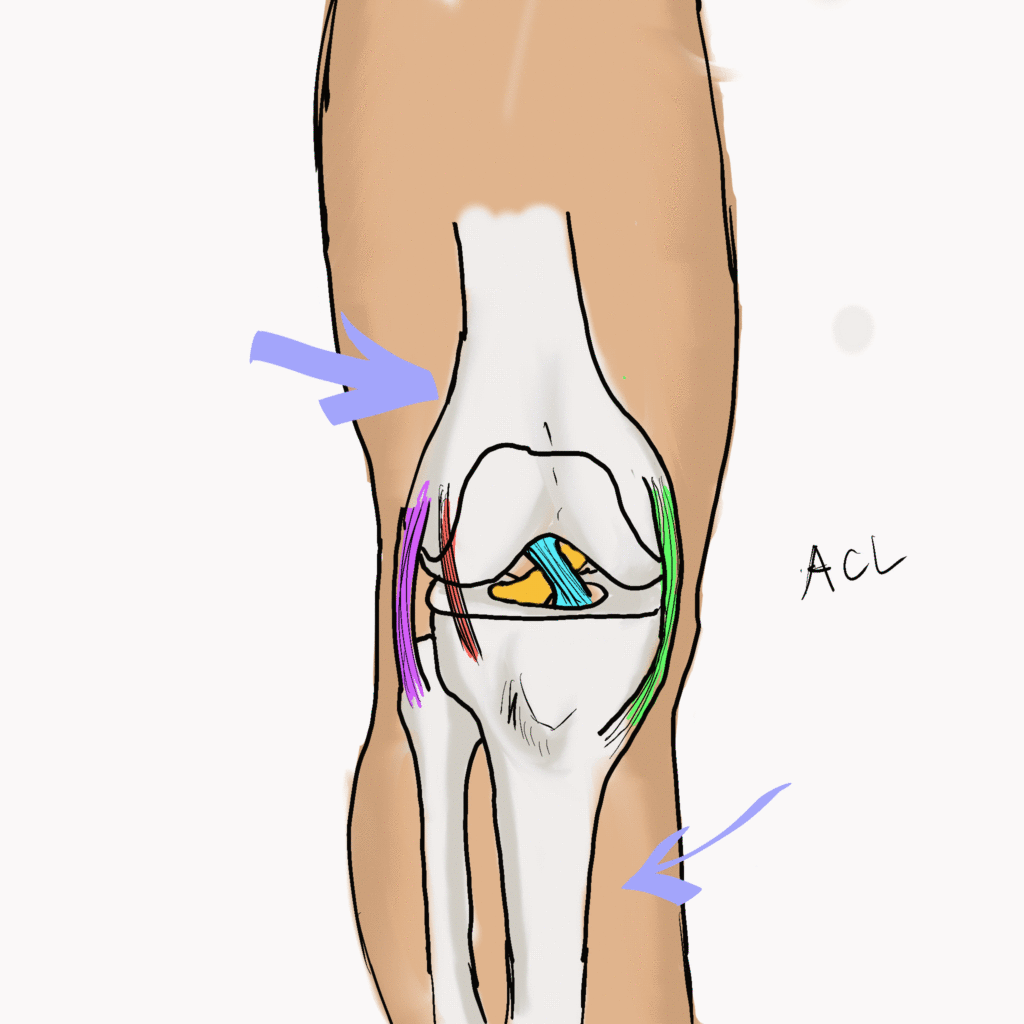
After reading over this STEAM project, I know way more about ACL injuries. I’ve learned that there are many ways other than physical contact that can cause an ACL tear to occur. For example, hyperextended knee joints, sudden deceleration or acceleration, or excessive quadricep contraction. The most common cause of ACL tears that are non-contact are from the sudden stopping/starting motion. This is because the quadriceps are the main force that create forces going toward the front of the body or anteriorly. This causes more stress on the ACL leading it to tear. Another new thing I learned from the presentation is that there are three different types of ACl tears. There are sprains, partial tears, and full or complete tears. there are also ways to test which degree tear has occurred in a patient. Doctors will pull in the anterior direction on the tibia and if there is slight movement of only a couple millimeters then it is most likely a partial tear. But if there is at least five millimeters of movement in the anterior direction it is going to be a partial tear. Overall I do thing this project was put together well and help inform the audience that there are more ways to tear the ACL than the most known, contact sports.