
 Posted by

Remy Gray
Human A&P
“We are All Mad Here”: Toxic Encephalopathy from Mercury Poisoning
My objective for this project is from Unit 6, specifically to identify the 4 main structures of the brain and their functions from the unit objective page, as toxic encephalopathy is related to brain function and structure. Mercury is highly toxic to humans and is characterized by its silver metallic coloring and being liquid at room temperature (Azevedo et al, 2012). Mercury has been around humans since before written language, as cinabiro was used by prehistoric man as paint due to its red gold coloring, and since then has been used for many other purposes, such as photography and as a treatment for syphilis (Azevedo et al, 2012). The most common and well-known vehicle of mercury ingestion, however, is due to contaminated fish; it is well known in Alaska and by fishermen to be careful of fish caught in certain waters, as methyl mercury binds to proteins within the fish due to trophic interactions and builds up as the fish ages (Clarkson et al, 2006). Generally, the amount of mercury found in fish is mostly safe as long as you eat in moderation and are not pregnant.
Mercury is considered a high-risk environmental pollutant and a danger to public health due to its high toxicity and mobility in the environment, and sources are both human-made and natural (Azevedo et al, 2012). Mercury can travel through the water cycle after emission as it circulates through the air in vapour form and enters soils and the ocean through precipitation. Once methylated, fish and sea animals can absorb it through protein binding or through the food chain (Clarkson et al, 2006). Methylmercury is easily absorbed in organs and can sit in tissues, but cannot cross the blood-brain barrier until it is demethylated into elemental mercury. Elemental mercury is readily absorbed through most membranes and can deposit large amounts of mercury into the brain (Azevedo et al, 2012). Mercury salts, in contrast, are mostly insoluble and do not often get absorbed into the body. The toxicity of mercury is based on dose and rate of exposure; low levels of exposure can lead to some mild symptoms, but high levels of exposure can be fatal (Azevedo et al, 2012).
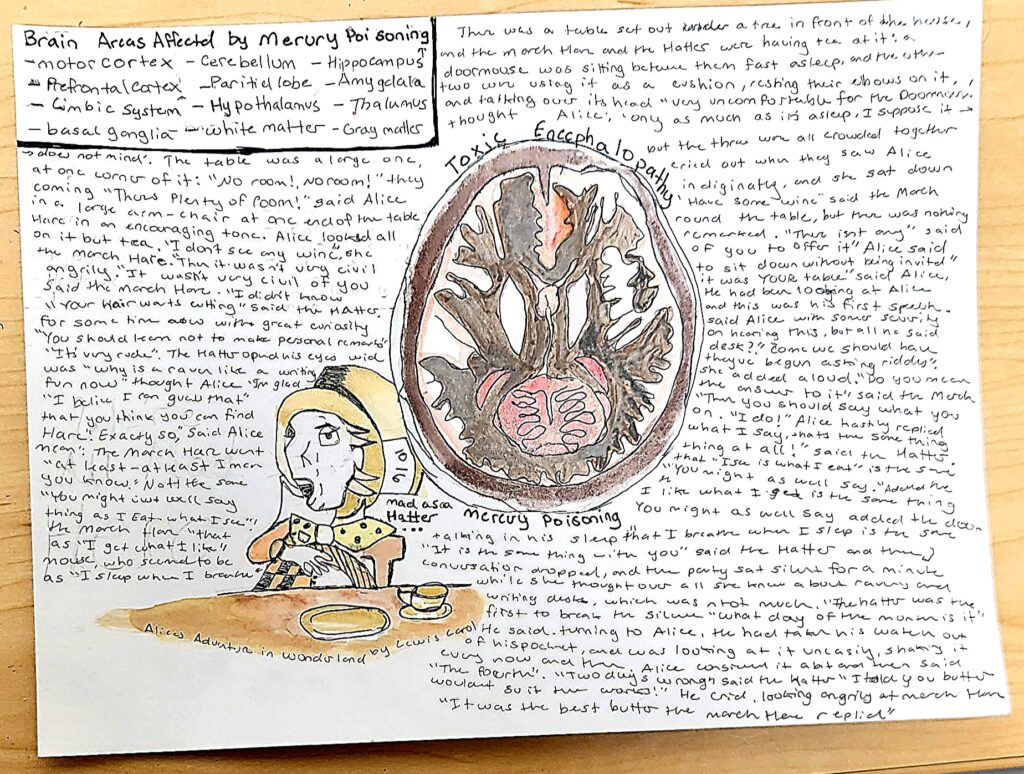
Lewis Caroll’s The Mad Hatter has been linked to mercury poisoning due to both his profession as a hatter and his actions throughout Caroll’s novel “Alice in Wonderland” (1865). Mercury was extensively used in the hatting industry in the 1800s to stiffen rabbit fur for felt hats, this elemental mercury vapour was then inhaled by the hat maker (Clarkson et al, 2006)). The first clinical description of erethism mercurialis (Mad Hatters Disease) in hatters was reported just five years before Caroll published his work (O’Carrol et al, 1995). My depiction of Lewis Carroll’s Hatter and the excerpt of his chapter “ The Mad Tea Party” from Alice in Wonderland in the background is an example of the symptoms of mercury poisoning in a way that is both abstract while still part of the pop culture zeitgeist.
In extreme cases toxic encephalopathy can occur if the exposure is severe or prolonged enough and is characterized by widespread brain dysfunction via toxic substances such as mercury as shown in my painting (red portions are the affected portions) toxic encephalopathy to different degrees is a likely outcome to inhaling vaporized elemental mercury, although the dose makes the poison and toxic encephalopathy exists on a spectrum (Clarkson et al, 2006). The MRI scan (Zhou et al, 2025) painting is based of a patent that was exposed to mercury via a mercury containing chinese medicine and was admitted to the hospital with “symmetrical alterations in the brain parenchyma (including both cerebrum and cerebellum), characterized by hypoperfusion on MRI perfusion imaging.” and was diagnosed with mercury poisoning encephalopathy. The patient died soon after being admitted. The painting was based on the MRI scan of the head and is specifically photo B.
As stated before mercury vapour can cross the blood brain barrier and affect multiple portions of the brain to different severities and Fields et al in 2017 systematically reviewed studies of workers that have been exposed to elemental mercury vapours. Some common symptoms among each of the workers noticed tremors (postural and kinetic), reduced motor coordination (fine motor control), reduced distal sensation (sensory deficits), peripheral neuropathy, mood swings and irritability and changes in neurobehaviour. Different tests such as steadiness tests, perdue pegboard tests, neurobehavior tests, vibrotactile threshold testing, finger to nose tests, biomonitoring and nerve conduction tests were used throughout different studies to confirm the presence of Mad Hatters Disease.These symptoms mean that many workers were affected in different parts of the brain such as the cerebellum, motor cortex, sensory cortex, limbic system, visual cortex, auditory cortex, and the prefrontal cortex, this explains most neurological symptoms experienced by those with mercury poisoning. Fields also concluded that symptoms diminish after exposure ends but those with high levels of exposure may experience persistent subclinical impairments but if the dose and exposure is low enough one can recover.
To conclude mercury as a substance has been with and used by humanity for thousands of years despite its toxicity, and is expected to be with us for many more. There are different types of mercury and the severity of poisoning is dependent on both dose and rate. Because it is not a common acute toxin mercury caused toxic encephalopathy is rarely talked about past its historic roots and references in pop culture.
References
Clarkson, T. W., & Magos, L. (2006). The toxicology of mercury and its chemical compounds. Critical Reviews in Toxicology, 36(8), 609–662. https://doi.org/10.1080/10408440600845619
Fernandes Azevedo, B., Barros Furieri, L., Peçanha, F. M., Wiggers, G. A., Frizera Vassallo, P., Ronacher Simões, M., Fiorim, J., Rossi de Batista, P., Fioresi, M., Rossoni, L., Stefanon, I., Alonso, M. J., Salaices, M., & Valentim Vassallo, D. (2012). Toxic effects of mercury on the cardiovascular and central nervous systems. Journal of Biomedicine & Biotechnology, 2012, 949048. https://doi.org/10.1155/2012/949048
Fields, C. A., Borak, J., & Louis, E. D. (2017). Persistence of mercury-induced motor and sensory neurotoxicity: Systematic review of workers previously exposed to mercury vapor. Critical Reviews in Toxicology, 47(10), 845–870. https://doi.org/10.1080/10408444.2017.1342599
O’Carroll, R. E., Masterton, G., Dougall, N., Ebmeier, K. P., & Goodwin, G. M. (1995). The neuropsychiatric sequelae of mercury poisoning. The Mad Hatter’s disease revisited. The British Journal of Psychiatry: The Journal of Mental Science, 167(1), 95–98. https://doi.org/10.1192/bjp.167.1.95
Roffler, G. H., Gastaldi, A., Lieske, C., Beckmen, K., Castellini, J. M., & Barst, B. D. (2025). Switching to marine prey leads to unprecedented mercury concentrations in a population of coastal Alaska wolves. The Science of the Total Environment, 980, 179542. https://doi.org/10.1016/j.scitotenv.2025.179542
Zou, M., Li, J., Yao, H., Dong, Q., Zeng, Q., Tang, Q., Zhang, J., Li, H., & Wang, J. (2025). Toxic encephalopathy due to mercury: A rare case report and literature review. Medicine, 104(37), e44037. https://doi.org/10.1097/MD.0000000000044037
STEAM Abstract Remy Gray: “We are All Mad Here”: Toxic Encephalopathy from Mercury Poisoning
Remy’s project examines how exposure to mercury causes encephalopathy by disrupting major brain structures and functions. Mercury can accumulate in the environment and enter the body through fish that have been contaminated or inhaled. Elemental mercury can also cause neurological symptoms like tremors, sensory loss, mood changes, and cognitive impairment if it crosses the blood-brain barrier. A clinical case shows how high exposure can cause widespread brain damage and, in some cases, death. Remy’s project emphasizes mercury’s history, toxicity, and lasting neurological effects when exposed.