 Posted by
For my STEAM project, I decided to explore what occurs to the Peripheral Nervous System after a Spinal Cord Injury. This is displayed through my drawing, which shows a human with an SCI. This SCI is in the lumbar portion of the spine. Because this injury is lower down, it results in the rid of movement and feeling in the lower limbs.
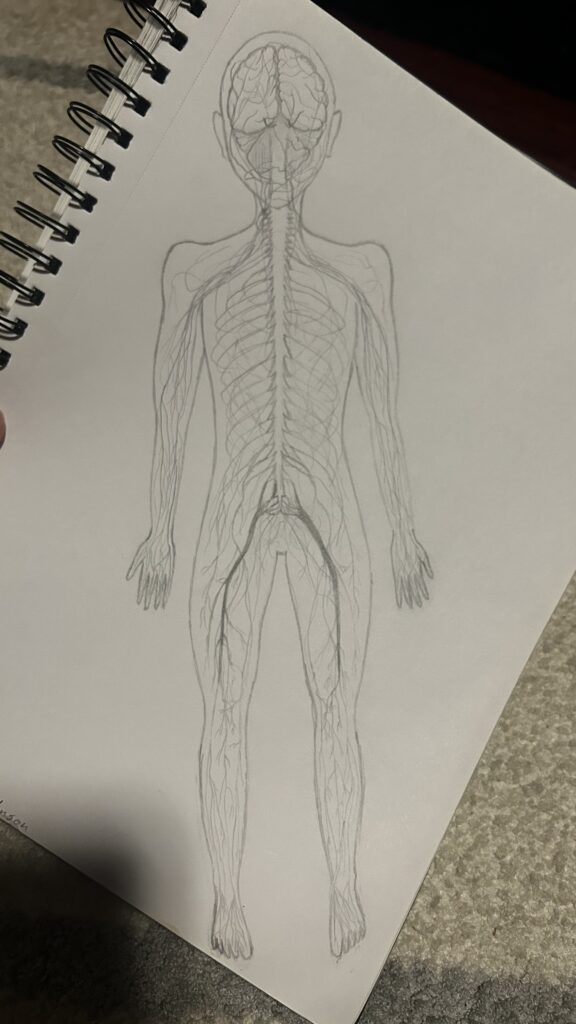
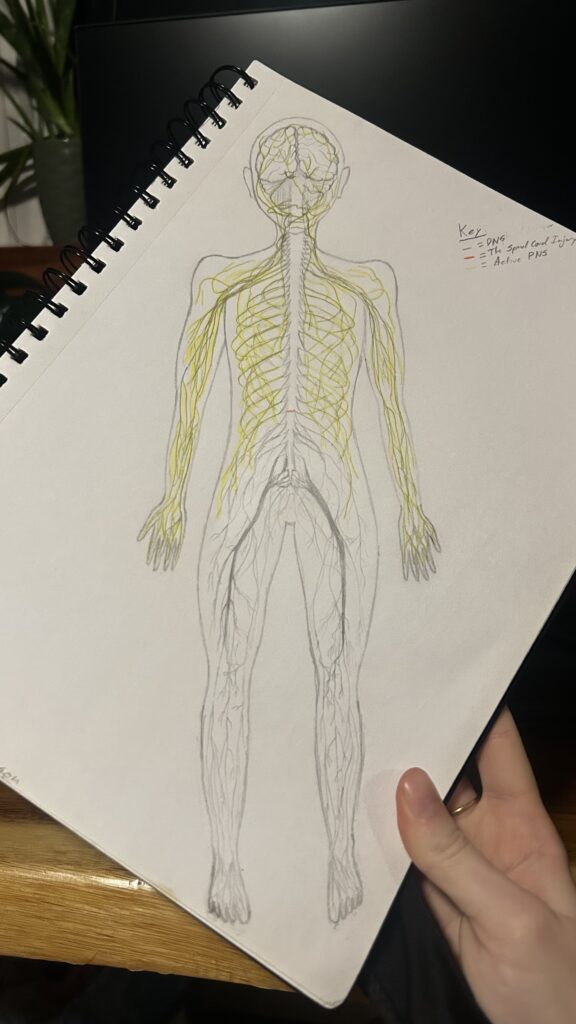
In this STEAM Project done by Samantha Johnson, they outlined the human body with the Peripheral Nervous System and the Central Nervous System to represent what happens to the Peripheral Nervous System after a spinal cord injury. They covered two objectives from Unit 6: Identify the various components and key structures of the nervous system, as well as compare and contrast the peripheral and central nervous systems. The yellow, upper portion of the Peripheral Nervous System shows the still active system, while the uncolored, lower portion shows that a spinal injury occurred in the lumbar section of the spine. When an injury occurs in the lumbar section of the spine, the body begins to lose sensation and command to any point below the injury. The connections to and from the spinal cord below the injury are cut off, and the peripheral nerves can’t process any stimuli to travel back up the spinal cord to the brain. Without processing any stimuli, the Peripheral Nervous System begins to deteriorate, leading to muscle atrophy. Deterioration of these nerves and muscles leads to spontaneous activity since they no longer receive proper inputs.