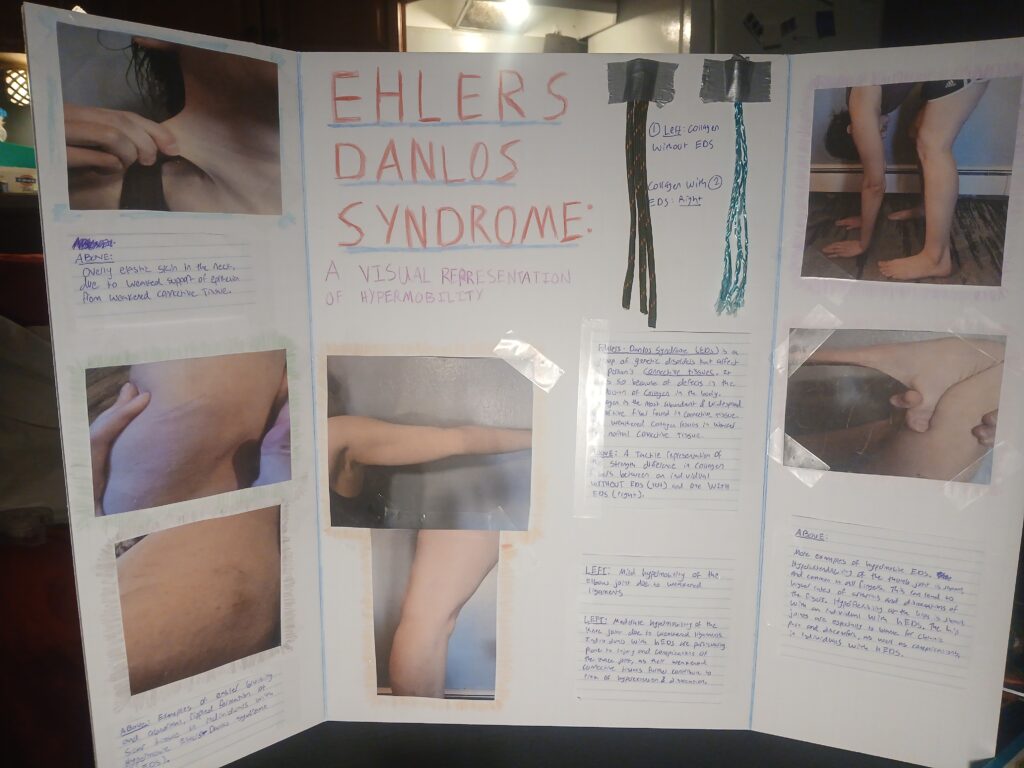
This project encompasses the many aspects that come with Ehlers-Danlos Syndrome (EDS). EDS is a group of 13 genetic conditions. Depending on the specific condition of Ehlers-Danlos Syndrome, symptoms may include joint hypermobility, weak skin, chronic pain, and an increased amount of dislocations and sprains. EDS only affects connective tissue, which is the most widespread of tissues. There are four classifications of connective tissue: blood, bone, cartilage, and connective tissue proper. Connective tissue specifically is very important for our body’s functions. Connective tissue helps with support, protection, insulation, transportation through blood, and lastly storing reserve fuel for the body to use. EDS specifically affects the way that the body creates collagen. This leads to weaker supportive fibers within connective tissues. Because there is weakened connective tissues there can be problems the skin, joints, ligaments, the blood, and potentially other organs. The most broadly known symptoms of EDS is hypermobility or hEDS. This can mean things like increased mobility in joints and even stretchy skin. This is largely due to weakened dense regular connective tissue proper and dense irregular connective tissue proper. These specific tissues have a higher amount of support fibers compared to cells. Unfortunately, this can lead to chronic pain and discomfort in the joints. Additionally, there is a higher risk of ligament sprains and joint dislocation. The most danger type of this condition is called Vascular Ehlers-Danlos Syndrome (vEDS). This condition can have the same effects as hEDS but all include arterial and intestinal fragility, which can cause an increased risk of aneurysm and arterial rupture. For the presentation there was a poster board created that included pictures of EDS symptoms and included a representation of collagen with/without EDS.
 Posted by

This project encompasses the many aspects that come with Ehlers-Danlos Syndrome (EDS). EDS is a group of 13 genetic conditions. Depending on the specific condition of Ehlers-Danlos Syndrome, symptoms may include joint hypermobility, weak skin, chronic pain, and an increased amount of dislocations and sprains. EDS only affects connective tissue, which is the most widespread of tissues. There are four classifications of connective tissue: blood, bone, cartilage, and connective tissue proper. Connective tissue specifically is very important for our body’s functions. Connective tissue helps with support, protection, insulation, transportation through blood, and lastly storing reserve fuel for the body to use. EDS specifically affects the way that the body creates collagen. This leads to weaker supportive fibers within connective tissues. Because there is weakened connective tissues there can be problems the skin, joints, ligaments, the blood, and potentially other organs. The most broadly known symptoms of EDS is hypermobility or hEDS. This can mean things like increased mobility in joints and even stretchy skin. This is largely due to weakened dense regular connective tissue proper and dense irregular connective tissue proper. These specific tissues have a higher amount of support fibers compared to cells. Unfortunately, this can lead to chronic pain and discomfort in the joints. Additionally, there is a higher risk of ligament sprains and joint dislocation. The most danger type of this condition is called Vascular Ehlers-Danlos Syndrome (vEDS). This condition can have the same effects as hEDS but all include arterial and intestinal fragility, which can cause an increased risk of aneurysm and arterial rupture. For the presentation there was a poster board created that included pictures of EDS symptoms and included a representation of collagen with/without EDS.