 Posted by
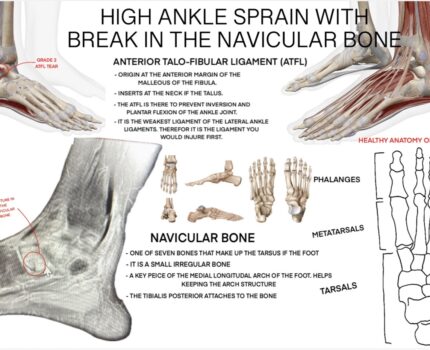
I decided to do my STEAM project on an injury I got in August of this year. I injured my left ankle. It was a grade three high ankle sprain with a complete tear of the Anterior Talo-Fibular Ligament, also called the ATFL. I also got a fracture in the navicular bone. It was an easy decision to do my steam project on this, as I learned a lot from it and want to research it deeper. The course objective that covers this project is to know the stages of bone development and repair. This is from Unit Six, where we had about the skeletal system.
An ankle sprain is an injury that involves a stretching or a tear of the ligaments in the ankle joint. It is classified into three grades: Grade 1, 2, and 3. The most common ligaments to injure are the Anterior Talofibular ligament and the calcaneofibular ligament, also known as the CFL. (Physiopedia, 2025) The most important actions to take after you sprain your ankle are elevating, icing, and put compression on it. This is to reduce swelling and inflammation. You will experience instability within the ankle joint. Rehabilitation will play a significant role in the healing process. Research showed that the ligaments within the ankle joint and the stability of the foot all come down to how the foot is positioned. Like the CFL, it plays a big role in stabilizing the foot. It helps to prevent the ankle from rolling inwards. In this study it was also found that the ATFL doesn’t cause huge destabilization if it is torn. The sprain will be a lot more difficult if there is a fracture involved.
The navicular bone is a part of the tarsals. It is located on the medial side of the mid-foot. Navicular bone fractures are not very common. They are serious, because the placement of the bone is very difficult and goes under a lot of strain when you use your foot. It is placed right above the arch on your foot, and it supports the arch. There is limited blood supply to this bone which makes it avascular. In a normal fracture, blood clots get replaced by soft cartilage and fibrous tissue. Then after a while the soft cartilage hardens as osteoblasts give the bone nutrients like calcium. Eventually the hardened cartilage gets replaced by regular bone tissue. Treatment for this type of fracture is the same as most fractures. Cast and non-weight bearing. Research showed that seven out of nine athletes had long term complications after a fracture in the navicular bone. (Jacob and Paterson, 2013) Another article from Attia et al., says that the success rate from more invasive treatment like surgery is higher compared to a conservative treatment. It says that surgery had a higher long – term success rate and the risk of refracture is significantly lower. (Attia et al.,)
Having both an ankle sprain and a fracture in the foot is more difficult. A healing process is very individual, but talking from my perspective, it takes more time. If you sprain your ankle, it is suggested that you get up and walk as soon as possible. This is so the ankle can start moving again and the healing of the ligaments will be a shorter process. With a break you will have to go non-weight bearing. I was in a cast for two weeks, and then another five weeks in a boot. This made the ankle weak and the muscles (tibialis posterior, peroneals, gastrocnemius, and soleus) that is there to stabilize the ankle, won’t get the strengthening it need. The ankle will get weak, stiff and it will lead to other complications from your achilleas to the lower back.
Sources:
VB Body Suit
Jacob, K. M., & Paterson, R. S. (2013). Navicular stress fractures treated with minimally invasive fixation. Indian journal of orthopaedics, 47(6), 598–601. https://doi.org/10.4103/0019-5413.121589
Navicular Stress Fracture Outcomes in Athletes: Analysis of 62 Injuries. Saxena, Amol et al. The Journal of Foot and Ankle Surgery, Volume 56, Issue 5, 943 – 948 https://doi.org/10.1053/j.jfas.2017.06.009.
Anterior Talo-Fibular Ligament (ATFL). (2025, July 26). Physiopedia, . Retrieved 03:30, November 17, 2025 from https://www.physio-pedia.com/index.php?title=Anterior_Talo-Fibular_Ligament_(ATFL)&oldid=370873.
Navicular. (2024, November 7). Physiopedia, . Retrieved 05:29, November 17, 2025 from https://www.physio-pedia.com/index.php?title=Navicular&oldid=362755.
Ankle Sprain. (2025, September 8). Physiopedia, . Retrieved 19:35, November 17, 2025 from https://www.physio-pedia.com/index.php?title=Ankle_Sprain&oldid=371878.
This STEAM project looks into Grade 3 high ankle sprains combined with a navicular bone fracture, using a real injury as the foundation of this research. This project goes further into the objective of understanding the stages of bone development and repair in the skeletal system. Amanda explains that a Grade 3 ankle sprain involves a complete tear of the Anterior Talofibular Ligament (ATFL), one of the primary stabilizing ligaments of the ankle, often resulting in joint instability and prolonged recovery. Icing, elevation, and compression are immediately recommended treatments, along with the importance of rehabilitation for ligament healing and restoring stability.
This project also goes into the structure and function of the navicular bone, a main tarsal bone that supports the arch of the foot. Navicular fractures have a limited blood supply, meaning they heal slowly and are serious, but are uncommon. The stages of bone repair are explained similarly tom clot formation to cartilage development, and eventual replacement with new bone tissue. According to multiple studies, navicular fractures often lead to long-term complications, although surgical treatment may offer higher success rates than conservative methods.
Amanda ensures to highlight the challenges of recovering from both a ligament tear and a fracture at the same time. Including muscle weakness, stiffness, and potential long-term effects on mobility. The personal experience and scientific research put together make for great scientific research to demonstrate the complexity of skeletal injury and repair.