
 Posted by
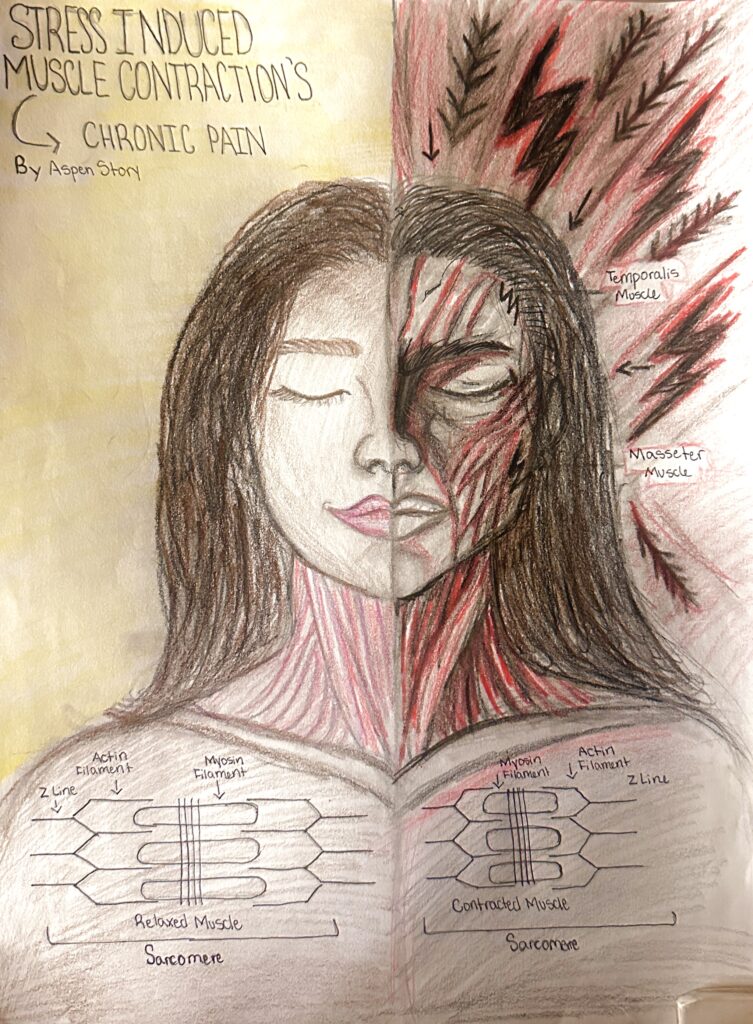
This paper expands on how a muscle contraction is induced. Specifically, how stress can induce muscle contractions leading to chronic pain, such as tension headaches and or TMJ disorders. Chronic stress triggers neural and muscular receptors resulting in the tightening of cranial and facial muscles. Persisted stress results in chronic pain patterns commonly seen as tension-type headaches.
A muscle contraction is induced through a multiple of steps. These include a nerve impulse first getting sent to the muscle tissue. Acetylcholine is then released and binds to the receptor on the sarcolemma. This then generates an action potential across the sarcolemma and T-tubules, triggering the sarcoplasmic reticulum to release Ca++ ions. These ions bind with troponin. Myosin then binds with actin and forms the cross-bridge allowing myosin heads to bend and pull on the actin filaments causing them to slide along myosin, which triggers the contraction ( Dahal, 2023).
When we add stress, this activates the sympathetic nervous system releasing neurotransmitters. Certain neurotransmitters such as adrenaline increase muscle activity and motor neuron firing, causing persisted muscle contractions. In a study by Malmo and Shagass it was found that action potentials recorded from neck muscles in patients with stress and anxiety was much higher than in those without (Sainsbury & Gibson, 1954). The same results were found when studying anxious patients with head complaints, showing more muscle activity in the neck during stress than in those without ( Sainsbury & Gibson, 1954).
Stress can lead to chronic muscle contractions which can result in tension-type headaches also referred to as muscle contraction headaches. These headaches mainly feel like pressure, or tight bands wrapped around your head. In repeated muscle contractions of the head and neck it is shown that pericranial myofascial tissues are much more tender. EMG studies have shown increased muscle activity in tension-type headaches. It is said that continuous motor neuron firing can contribute to the cause of the sensitization of peripheral nociceptors and trigger points. Studies then showed that sensitive pericranial muscles and trigger points were directly related to the severity of the headache in chronic tension-type headaches. The sustained activation of pericranial muscles produces tenderness and peripheral sensitization that, after a prolonged amount of time, will amplify pain and turn into chronic tension-type headaches (Bendtsen & Fernandez-de-la-Penas, 2011)
Furthermore, stress related jaw clenching also contributes to persistent masseter muscle contractions. This can cause chronic effects and chronic pain, such as headaches. TMJ ( Temporomandibular Joint Disorder) is commonly known for causing pain in the joint or surrounding tissues. Its causes are “multifactorial” including teeth grinding, but also stress or anxiety. 75% of patients with TMJ disorder have a psychological deviation. Evidence suggests that stress and anxiety can magnify TMJ disorders. The TMJ joint becomes overloaded, which leads to inflammation and pain. People with stress or psychological deviations often unknowingly clench their jaw, causing masticatory muscle hyperactivity (Buescher, 2007).
Stress does much more than influence our mood, it directly influences the body’s muscular and neurological patterns. Stress heightens muscle activity creating persistent contractions in cranial, facial and masseter muscles. Over time this sustained tension can lead to chronic pain disorders such as tension-type headaches and TMJ disorder.
References
Bendtsen, L., & Fernández-de-la-Peñas, C. (2011). The Role of Muscles in Tension-Type Headache. Current Pain and Headache Reports, 15(6), 451–458. https://doi.org/10.1007/s11916-011-0216-0
Buescher, J. J. (2007). Temporomandibular Joint Disorders. American Family Physician, 76(10), 1477–1482. https://www.aafp.org/pubs/afp/issues/2007/1115/p1477.html#afp20071115p1477-b8
Dahal, P. (2023, August 3). Muscle Contraction: Definition, Proteins, Types, Steps. Microbenotes.com. https://microbenotes.com/muscle-contraction-mechanism/
Sainsbury, P., & Gibson, J. G. (1954). SYMPTOMS OF ANXIETY AND TENSION AND THE ACCOMPANYING PHYSIOLOGICAL CHANGES IN THE MUSCULAR SYSTEM. Journal of Neurology, Neurosurgery & Psychiatry, 17(3), 216–224. https://doi.org/10.1136/jnnp.17.3.216
I viewed Aspen’s project on how stress induced muscle contraction and it helped me better understand how muscle contractions occur and how stress can lead to chronic pain, such as tension type headaches and TMH disorders.
The project illustrates the difference between relaxed and contracted muscles at the sarcomere level, which helped my understanding of the physiological process of muscle contraction. I have a better understanding on how a nerve impulse triggers acetylcholine release, generates an action potential, releases calcium ions, and allows myosin to pull actin filaments, causing the muscle to contract.
This project also helped me understand how stress influences the process. I learned that stress activates the sympathetic nervous system which releases neurotransmitters like adrenaline. This increases motor neurons firing and heightens muscle activity, which results in persistent contraction in cranial, facial, and jaw muscles. The project shows how these contractions can lead to chronic pain by highlighting tense areas such as the temporalis and masseter muscles showing how the sarcomeres shorten during contraction.
Aspen’s project enhanced my understanding of the connections between stress, neuromuscular activity, and chronic pain. It made me more aware that stress does not only affect mood, but actively changes muscle behavior. This project explains that stress does not only affect mood, but actively changes muscle behavior. This project explains that stress activates the sympathetic nervous system, increasing neurotransmitters like adrenaline, which raises motor neuron firing and keeps muscles contracted. I can see this in my own workouts when I notice my shoulders or jaw feel tighter on stressful days, making it harder to fully relax my muscles.
Knowing that this tension occurs at the sarcomere level and can cause problems like tension headaches or TMJ makes me appreciate why warm ups and stretching are important for performance and comfort.
Well done, Aspen.