
 Posted by
What Happens Without ACL Treatment?
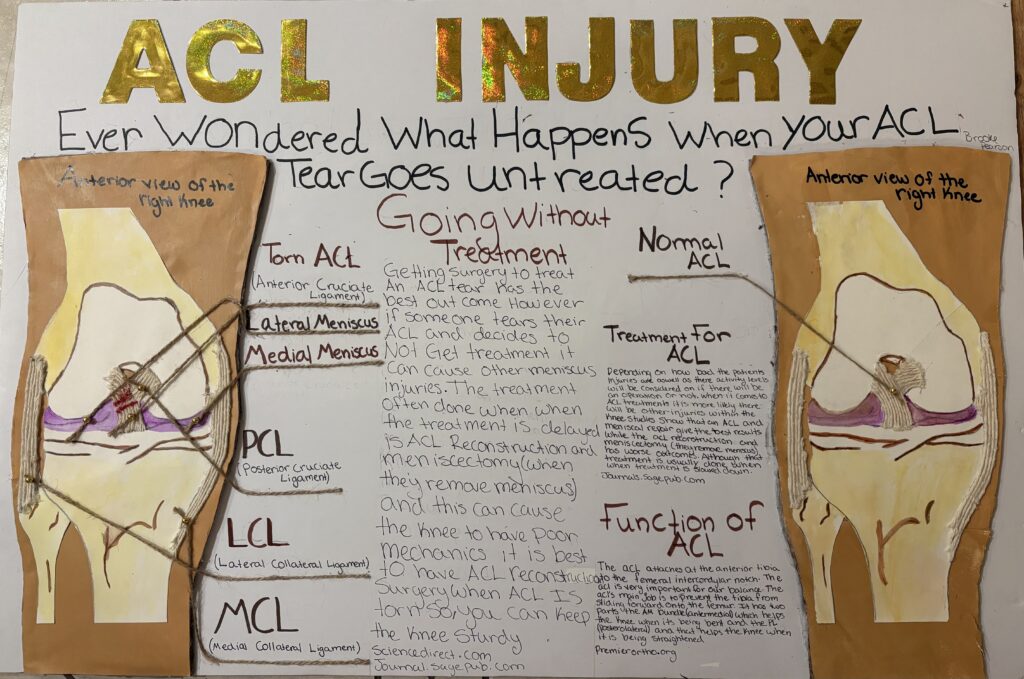
For my project I chose to do an informative poster on the ACL without treatment. I included two drawings of what the right knee and what it would look like without the knee. One drawing was without a torn ACL and one was a picture with a torn ACL. I chose three parts on my poster to talk about, the function of the ACL, the treatments for a torn ACL and what happens without treatment.
The ACL also known as the anterior cruciate ligament is attached to the middle of the anterior introcondylar of the tibia merging with the anterior part of the lateral meniscus. The ACL main job is to prevent the tibia from sliding onto the femur. It can be broken into two spots the AM which is the anteromedial which helps the knee as it is being bent and the PL posterolateral which helps the knee as it is being straightened. These together help the knee to have a good range of motion. (Markatos, 2012b)
You usually experience an ACL tear when doing things like pivoting, and hard cutting. It is closely related to competitive sports. The patient will describe a popping sound that will follow with swelling and then pain. Treatment for an ACL tear varies depending on the patient’s goals and activity level. (Diermeier et al., 2020) Sometimes there can be an acute ACL tear and even then a study was done and only 10% of the patients got back to doing sports without pain. Without the proper ACL treatments there can be more of a chance to get later meniscus injuries (P., 2017) There are many options for ACL treatment, one being the ACL reconstruction which is the most effective. They usually will take a graft from another part of your body to reshape your ACL. There is also the ACL reconstruction and meniscectomy in which they reconstruct your ACL and then take out your meniscus this is usually done when the treatment has been pushed off causing more wear and tear on your meniscus. Studies have shown that Performing ACL reconstruction along with meniscal repair can make the knee come out feeling more normal in motion and lead to better reported outcome in both the short and long term. When it comes to tearing your ACL more often than not there will be other injuries in the knee meniscus injuries reported 23% to 42% cartilage lesions are 27% and combination of meniscus and chondral lesions are at 15% of cases. Due to this issue there is already a higher chance of someone with ACL construction surgery to have osteoarthritis later on (Diermeier et al., 2020).
This relates to the course objective: Know the structure of the knee joint and compare this joint type to the other 5 joint types because the knee joint is a synovial hinge joint. The knee joint needs the ligaments to prevent things from sliding, they support the knee and make it stable so there isn’t much movement. The knee is described as a hinge joint because it has a limited amount of movement it can take. The knee is very vulnerable to horizontal movement. However when it comes to the other joint types it’s different. Pivot joints allow for rotation to happen around an axis like in between the vertebrae. The saddle joint allows two bones to fit together like a person on a saddle like the bone on the base of the thumb. The plane joint allows the bones to slide against one another like the tarsal bones in the foot. The ball in the socket joint has the largest amount of motion in the body like the femur and humerus. The condyloid joint allows for two planes of movement like the knuckle joints of the hand. Although they are all synovial joints the hinge joint which is the structure of the knee joint is different because it only does things like bending and straightening. Without all the proper ligaments working right and present in the knee could cause the knee to be unstable as the ligaments provide support so the knee won’t make much movement. (Betts et al., 2024)
References
Anterior Cruciate Ligament (ACL) Tear. (n.d.). Retrieved from Premier Orthopaedic website: https://www.premierortho.org/services/knee/anterior-cruciate-ligament-tear/
Betts, J. G., Young, K. A., Wise, J. A., Johnson, E., Poe, B., Kruse, D. H., … DeSaix, P. (2024). Anatomy and Physiology 2e.
Diermeier, T., Rothrauff, B. B., Engebretsen, L., Lynch, A. D., Ayeni, O. R., Paterno, M. V., … Johnson, D. L. (2020). Treatment After Anterior Cruciate Ligament Injury: Panther Symposium ACL Treatment Consensus Group. Orthopaedic Journal of Sports Medicine, 8(6), 232596712093109. https://doi.org/10.1177/2325967120931097
Markatos, K., Kaseta, M. K., Lallos, S. N., Korres, D. S., & Efstathopoulos, N. (2012). The Anatomy of the ACL and Its Importance in ACL Reconstruction. European Journal of Orthopaedic Surgery & Traumatology, 23(7), 747–752. https://doi.org/10.1007/s00590-012-1079-8
P., G. (2017). Fate of the untreated anterior cruciate ligament-injured knee. Journal of Orthopaedics, 14(3), A1–A3. https://doi.org/10.1016/j.jor.2017.07.006
Cleveland Clinic. (2023, August 2). ACL Tear & Injury: Symptoms & Recovery. Retrieved from Cleveland Clinic website: https://my.clevelandclinic.org/health/diseases/16576-acl-tear
ACL Injuries. (n.d.). Retrieved from Atlanta Bone and Joint Specialists website: https://www.atlantaboneandjoint.com/acltear.html
Brooke’s STEAM project covers the question of what happens if you don’t have surgery after an ACL injury. The poster had three main focuses: the function of the ACL, torn ACL treatment, and what happens without treatment. It expands on the class’s unit object about the five joint types. Brooke’s project uses a posterboard with drawings and 3D diagrams of the knee to illustrate the difference between a healthy and damaged knee.
The anterior cruciate ligament’s (ACL) primary function is to prevent the tibia from contact with the femur and act as a general stabilizer within the knee.
Tears and damages to the ACL usually occur when sudden, intense stress is put onto the knee joint through pivots and acute movement changes. This injury is associated with athletes due to sports’ higher frequency of these potentially damaging movements.
For ACL tears, those who receive surgery have a better overall outcome than those who do not. Autografts and meniscectomy are common and effective treatment options.
When surgery is declined, the likelihood of related injuries increases significantly. Going without repair can cause permanent damage to the knee structure and limit overall function.
The project’s biggest takeaways are the causes of ACL tears and the importance of taking care of my knees both preemptively and subsequently if injury occurs. Great work!