
 Posted by
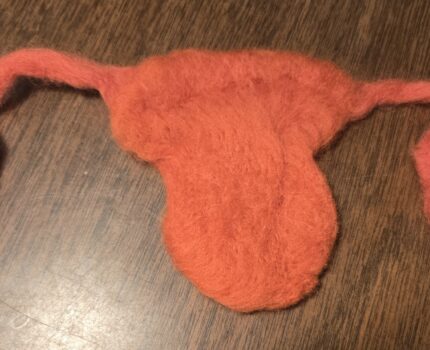


For my STEAM project, I researched how PCOS is caused and affected by hormones to disrupt the menstrual cycle. The course objective I chose to cover was to describe how ovulation, menses, pregnancy, and spermatogenesis are hormonally regulated. I used felt to make a uterus with one ovary representing how a normal ovary should look and the other representing one with PCOS. The uterus itself is fairly normal in both, however the ovary with PCOS is obviously larger and less uniform.
PCOS stands for polycystic ovary syndrome and it affects up to approximately ten to thirteen percent of women around the world according to the WHO. (World Health Organization, 2026) The primary signs of PCOS include cysts on the ovaries visible with ultrasound, hirsutism, and insulin resistance. All of these signs are the result of hormonal abnormalities, with excess androgen being the primary known cause. Androgens like testosterone negatively impacts follicles in the ovaries by preventing them from fully developing and eventually shedding. These underdeveloped follicles end up often being six times larger than normal and unfortunately can lead to them developing into cysts when they refuse to shed from the lining of the uterus.
The increased androgens are now thought to be from significantly increased luteinizing hormone. This is because LH can lead to thecal cells from the ovary synthesizing more testosterone. LH levels higher than normal have also been seen to affect fertility by increasing the risk of miscarriage. Fertility issues are one of the most common problems seen in patients with PCOS. Additionally, follicle-stimulating hormone is quite a bit lower in women with PCOS. FSH works to convert the testosterone produced by the thecal cells into estradiol with the enzyme it activates called aromatase. While this could be interpreted to mean that dysregulation of LH and FSH add to each other for negative effects on patients, it does not seem that FSH currently has enough of an impact to affect estradiol synthesis as evaluated by Emanuel et al. (Emanuel et al., 2022)
Another hormone that seems to be causing PCOS is anti-Mullerian hormone which often has increased levels in patients with PCOS. AMH can decrease estradiol production by inhibiting aromatase and ultimately lead to the amenorrhea typically seen with PCOS.
Insulin resistance is an incredibly common sign of PCOS and thought to exacerbate other parts of PCOS, primarily testosterone stimulated by luteinizing hormone. This resistance to insulin has mainly been observed with adipose tissue and skeletal muscle struggling to use glucose. Unfortunately, insulin resistance has been directly linked to increased risk of cardiovascular issues by causing abnormalities in reactivity of the heart. International guidelines have been changed to classify the disease as a CVD-risk enhancing condition as highlighted by Dokras, A. (Dokras, A., 2025) PCOS has also been linked to liver disease, particularly Non-alcoholic Fatty Liver Disease, from the excess androgens and insulin resistance.
The last hormone researched that has been seen to cause and even enhance the effects of PCOS is sex hormone binding globulin which has lower levels in patients with PCOS. SHBG would normally bind to testosterone to prevent too much from entering the cells but the insulin resistance prevents SHBG from being produced.
As is obvious from the many hormones listed here, PCOS is a condition with many different factors and hormones taking place. There have been many more dysregulated hormones linked to causing PCOS or caused by PCOS. It is important to understand that it is not just one system or hormone being affected by PCOS as it means needing an approach to the condition that addresses at least most of these issues.
Citations:
Dokras, A. (2025). PCOS in 2025 – Insights and Innovations. Fertility and Sterility, 124. https://doi.org/10.1016/j.fertnstert.2025.09.025
Emanuel, R. H. K., Roberts, J., Docherty, P. D., Lunt, H., Campbell, R. E., & Möller, K. (2022). A review of the hormones involved in the endocrine dysfunctions of polycystic ovary syndrome and their interactions. Frontiers in Endocrinology, 13. https://doi.org/10.3389/fendo.2022.1017468
World Health Organization. (2026, January 22). Polycystic ovary syndrome. World Health Organization. https://www.who.int/news-room/fact-sheets/detail/polycystic-ovary-syndrome
Great article, very helpful!
Your insight amplifies an essential message contained within the topic.
Appreciate the effort you put into this.
A brief comment with substantial relevance to professionals.