Amalene created a poster representing the impact both warm and cold temperature have on the process of rigor mortis. Amalene clearly describes rigor mortis in her poster by saying, “rigor mortis is a process after death where the muscles in the body stiffen.” Amalene implemented written description as well as illustration in her poster. Similar to a bubble map, the poster is split into two individual sections and also provides information that relates to both. One side of the poster represents the impact of warm temperature, and the other represents cold.
On the side of the poster relating to cold, Amalene simply describes that cold temperature slows down rigor mortis. The poster describes that cold temperature slows the process of chemical reactions. This means that both the connection of actin and myosin is slowed, as well as the release of calcium. Although cold temperature slows down the process of rigor mortis, it actually extends the duration once it has set in. This is because cold temperature slows down the process of decomposition and calcium release.
On the side of the poster relating to warmth, it is described that warm temperature speeds up the process of rigor mortis. Warm temperature allows for a more rapid connection between actin and myosin, as well as faster release of calcium. While rigor mortis sets in faster in warm temperatures, the warmth also leads to the effects having a shorter duration.
One thing that I learned from Amalene’s STEAM project is that actin and myosin activity is directly impacted by the temperature of the environment. Additionally, I learned that the simplicity of a poster can be one of its biggest strengths when describing a complex process. Overall, the impacts of warmth and cold have seemingly opposite effects on the process of rigor mortis, and Amalene did a great job communicating her information and course objectives through her STEAM project.
 Posted by
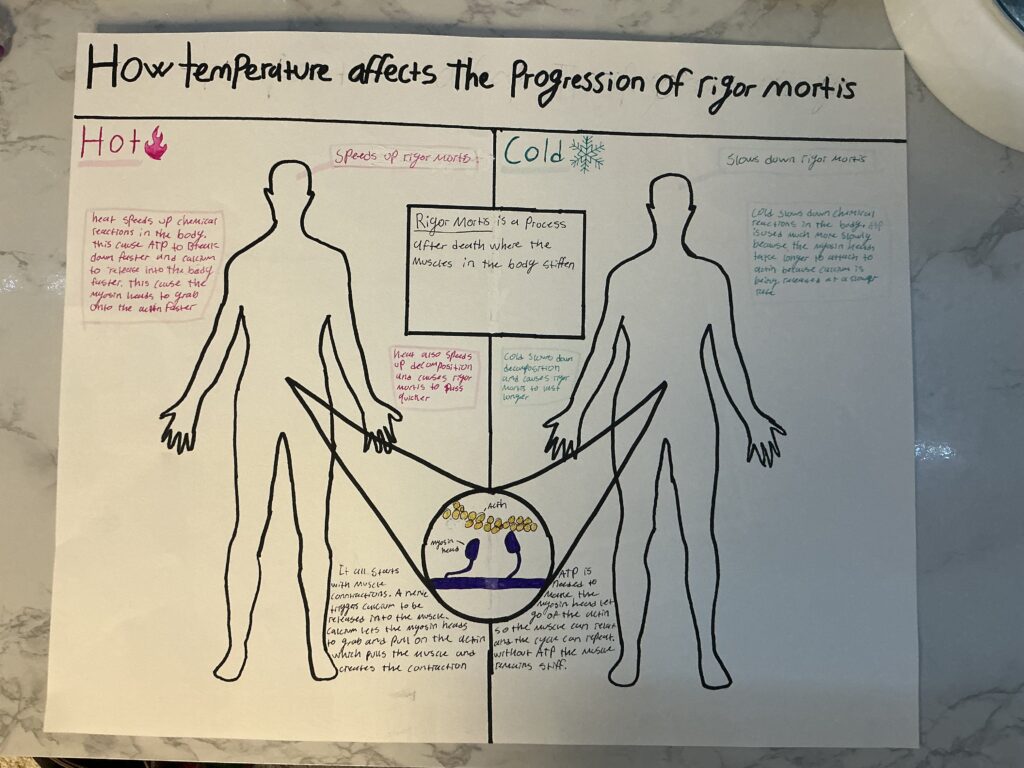
Amalene created a poster representing the impact both warm and cold temperature have on the process of rigor mortis. Amalene clearly describes rigor mortis in her poster by saying, “rigor mortis is a process after death where the muscles in the body stiffen.” Amalene implemented written description as well as illustration in her poster. Similar to a bubble map, the poster is split into two individual sections and also provides information that relates to both. One side of the poster represents the impact of warm temperature, and the other represents cold.
On the side of the poster relating to cold, Amalene simply describes that cold temperature slows down rigor mortis. The poster describes that cold temperature slows the process of chemical reactions. This means that both the connection of actin and myosin is slowed, as well as the release of calcium. Although cold temperature slows down the process of rigor mortis, it actually extends the duration once it has set in. This is because cold temperature slows down the process of decomposition and calcium release.
On the side of the poster relating to warmth, it is described that warm temperature speeds up the process of rigor mortis. Warm temperature allows for a more rapid connection between actin and myosin, as well as faster release of calcium. While rigor mortis sets in faster in warm temperatures, the warmth also leads to the effects having a shorter duration.
One thing that I learned from Amalene’s STEAM project is that actin and myosin activity is directly impacted by the temperature of the environment. Additionally, I learned that the simplicity of a poster can be one of its biggest strengths when describing a complex process. Overall, the impacts of warmth and cold have seemingly opposite effects on the process of rigor mortis, and Amalene did a great job communicating her information and course objectives through her STEAM project.