Brenna expertly summarized the effects of Crohn’s disease on the entire body. She communicated the fact that Crohn’s disease affects the mouth, esophagus, skin, stomach, joints, liver and bile ducts, intestines, and rectum in an illustration of the human body with each of these organs/systems. She notes that Crohn’s disease is a chronic inflammatory bowel disease. Brenna then went into detail on how Crohn’s disease involves the immune system becoming unregulated and working overtime, continually activating immune cells and causing inflammation. Chronic inflammation then leads to damage in the intestine, resulting in the tissue becoming thickened, enflamed, and uneven due to ulcers and swelling. These structural changes have a major impact on the ability of the digestive system to function efficiently. Intestinal tissue is unable to absorb nutrients because of the damage. Brenna also notes a positive feedback loop that makes Crohn’s disease even more detrimental. The intestinal barrier becomes compromised and more permeable, allowing foreign particles and bacteria to pass through the barrier more easily. This triggers the immune system to respond, leading to increased activation and inflammation. Brenna notes that Crohn’s disease is not curable, but there are ways to mitigate the damage with proper management. This includes medications such as immunosuppressants and anti-inflammatory drugs, as well as dietary and lifestyle changes. Overall, Brenna’s STEAM project exemplifies how structural damage has major effects on function, specifically with Crohn’s disease and digestion.
 Posted by
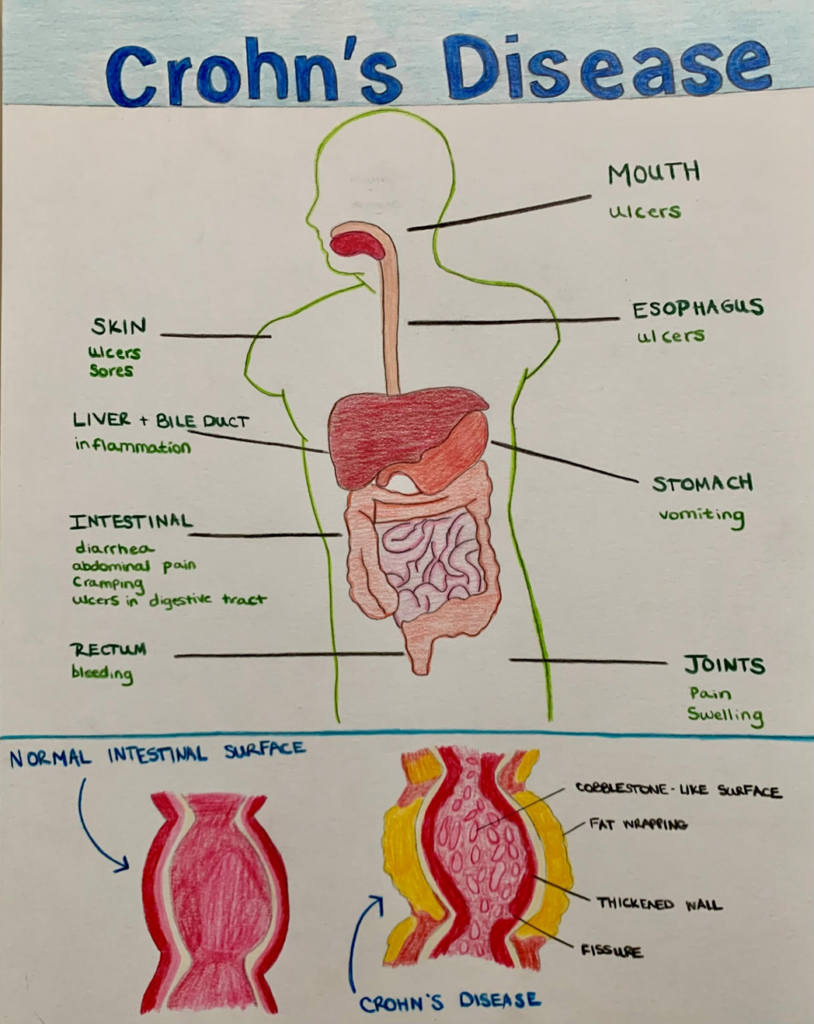
Brenna expertly summarized the effects of Crohn’s disease on the entire body. She communicated the fact that Crohn’s disease affects the mouth, esophagus, skin, stomach, joints, liver and bile ducts, intestines, and rectum in an illustration of the human body with each of these organs/systems. She notes that Crohn’s disease is a chronic inflammatory bowel disease. Brenna then went into detail on how Crohn’s disease involves the immune system becoming unregulated and working overtime, continually activating immune cells and causing inflammation. Chronic inflammation then leads to damage in the intestine, resulting in the tissue becoming thickened, enflamed, and uneven due to ulcers and swelling. These structural changes have a major impact on the ability of the digestive system to function efficiently. Intestinal tissue is unable to absorb nutrients because of the damage. Brenna also notes a positive feedback loop that makes Crohn’s disease even more detrimental. The intestinal barrier becomes compromised and more permeable, allowing foreign particles and bacteria to pass through the barrier more easily. This triggers the immune system to respond, leading to increased activation and inflammation. Brenna notes that Crohn’s disease is not curable, but there are ways to mitigate the damage with proper management. This includes medications such as immunosuppressants and anti-inflammatory drugs, as well as dietary and lifestyle changes. Overall, Brenna’s STEAM project exemplifies how structural damage has major effects on function, specifically with Crohn’s disease and digestion.