 Posted by

Females have historically been underrepresented in scientific research, especially in areas like sports science and nutrition. This has made it more difficult to fully understand female physiology, even though there are clear biological differences between males and females. One of the most important differences is the menstrual cycle, which involves regular hormonal fluctuations that influence metabolism, appetite, and energy balance. While more research is beginning to focus on females, there is still limited information on how dietary energy intake changes across the menstrual cycle. Understanding these changes is especially important for active females and athletes, because energy intake directly affects performance, recovery, and overall health.
The menstrual cycle typically lasts between 21 and 35 days and is divided into two main phases: the follicular phase and the luteal phase. The follicular phase begins on the first day of menstruation and lasts until ovulation, while the luteal phase occurs after ovulation. However, the cycle can also be broken down further into four phases: early-follicular, late-follicular, ovulatory, and mid-luteal. Each phase has a different hormonal environment. Estrogen is low at the beginning of the cycle, rises leading up to ovulation, and then decreases, while progesterone is highest during the luteal phase (Elliott-Sale et al., 2021). These hormonal changes play a major role in regulating appetite and energy intake.
Research shows that energy intake is not constant across the menstrual cycle. Many studies suggest that females tend to eat less during the follicular phase and more during the luteal phase. The increase in energy intake from the follicular to luteal phase can range from about 90 to over 500 kilocalories per day (Gil et al., 2009; Martini et al., 1994; Reimer et al., 2005). Additionally, energy intake is often lowest in the days leading up to and during ovulation, when estrogen levels are at their highest (Roney & Simmons, 2017). However, not all studies agree, and some have found no significant differences in energy intake across phases (Gorczyca et al., 2016). These inconsistencies are likely due to differences in research methods, small sample sizes, and difficulty accurately identifying menstrual cycle phases.
Hormones are a key reason for these changes. Estrogen is generally associated with decreased appetite, while progesterone tends to increase appetite, especially during the luteal phase. This helps explain why energy intake is often higher later in the cycle. These fluctuations are important because they can impact energy availability, especially in active individuals. If energy intake is too low during certain phases, it can lead to negative effects such as decreased performance, increased injury risk, and hormonal imbalances. However, it is also important to recognize that these patterns vary between individuals, meaning not everyone experiences the same changes.
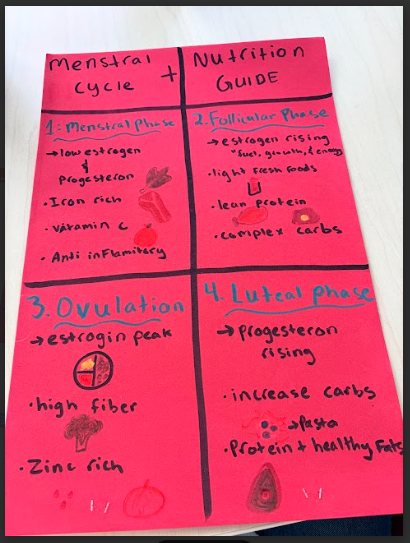
For my project, I created a poster that visually represents these concepts in a way that is easy to understand. I decided to organize my poster by breaking the menstrual cycle into the four main phases: early-follicular, late-follicular, ovulatory, and luteal. This made it easier to clearly show how hormone levels and energy intake change throughout the cycle, rather than just comparing two broad phases. Each section of the poster focuses on what is happening hormonally and how that connects to nutrition.
In each phase, I included a short explanation of hormone levels, specifically estrogen and progesterone, and how they affect appetite and energy needs. For example, in the early-follicular phase, I showed that both hormones are low, which is associated with lower energy intake. In the late-follicular and ovulatory phases, I highlighted the rise in estrogen and explained how this may suppress appetite, leading to lower food intake. In the luteal phase, I focused on the increase in progesterone and how this can increase hunger and cravings, which connects to the higher energy intake seen in research.
I also included recommendations for foods that might be beneficial during each phase. For example, I suggested nutrient-dense foods and balanced meals during lower appetite phases to help maintain energy intake. During the luteal phase, I included foods that are higher in energy and satisfying, since this is when hunger tends to increase. This part of the poster connects the scientific research to practical, real-life applications, which was one of my main goals.
To make the poster visually engaging, I used Sharpie to create bold headings and clear sections for each phase. I also drew original diagrams to represent hormone changes and the different phases of the cycle. These drawings helped make the information more understandable and less overwhelming compared to just using text. I wanted the poster to be something that people could quickly look at and still learn from, even if they did not have a strong science background.
Overall, I focused on making the poster both informative and visually clear. Breaking the cycle into four phases allowed me to include more detailed information, while still keeping it organized. The combination of scientific explanations, nutrition suggestions, and original visuals helped me present the information in a way that is both accurate and easy to follow.
In conclusion, research suggests that energy intake tends to be lower during the follicular phase, especially around ovulation, and higher during the luteal phase. However, the exact amount of change varies between individuals and studies. Because of this variability, a personalized approach to nutrition may be the most effective. Creating this poster helped me better understand how hormonal changes impact energy intake and how this information can be applied in real life, especially for active females.
References
Elliott-Sale, K. J., Minahan, C. L., de Jonge, X. A. K. J., Ackerman, K. E., Sipilä, S., Constantini, N. W., Lebrun, C. M., Hackney, A. C., & McNulty, K. L. (2021). Methodological considerations for studies in women: The menstrual cycle and exercise. Sports Medicine, 51(5), 843–861.
Gil, M. R., et al. (2009). Regulation of menstrual cycle and alimentary consumption in women. Nutrition Research, 29(5), 293–299.
Gorczyca, A. M., et al. (2016). Changes in dietary intake across the menstrual cycle in healthy women. The American Journal of Clinical Nutrition, 104(2), 343–351.
Martini, M. C., et al. (1994). Effects of the menstrual cycle on energy and nutrient intake. The American Journal of Clinical Nutrition, 60(6), 895–899.
Reimer, R. A., et al. (2005). Dietary and metabolic differences across menstrual phases. Journal of Clinical Endocrinology & Metabolism, 90(3), 164–170.
Roney, J. R., & Simmons, Z. L. (2017). Ovarian hormone fluctuations predict changes in food intake. Hormones and Behavior, 92, 21–28.