
 Posted by
Asthma: Symptoms, Diagnosis, and Treatment
The focus of my STEAM project will be the Respiratory System, more particularly the effects of disease on the Respiratory System. I will cover the condition known as asthma including what it is, how it affects breathing, how it can be diagnosed, and what are current treatment options for people suffering from this condition.
It is estimated that 300 million people globally have asthma, which would represent roughly 4% of the global population. In the US, roughly 8% of the population is diagnosed with the condition. Even animals are increasingly being diagnosed with asthma further indicating how large of a problem asthma is becoming.
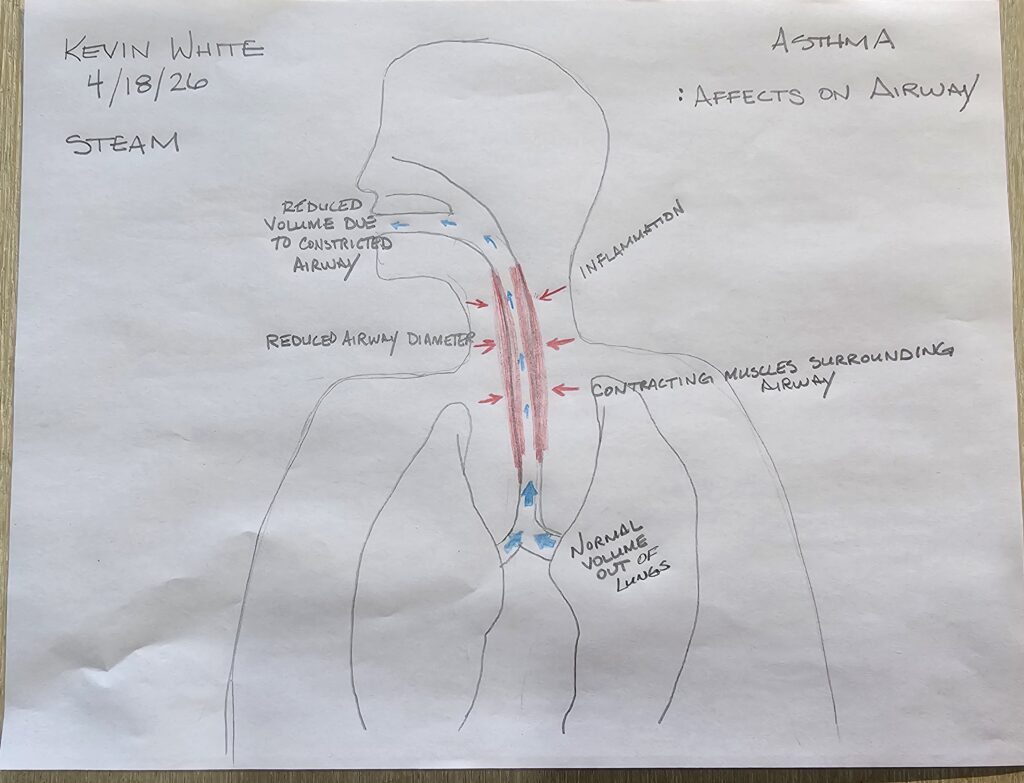
Asthma is defined as a chronic, long-term respiratory disease that inflames and narrows the airways in the lungs, making it difficult to breathe. A person with asthma has minor swelling in the airways of their lungs all the time. During a flare up, the airways swell further and produce mucus. The muscles wrapping around the airways may also tighten making breathing even more difficult. The combination of these factors is known as an asthma attack.
It has further been asserted that asthma is characterized by inflammatory changes throughout the submucosa of the airways in particular and not the alveoli or lung parenchyma. Other characteristics associated with asthmatic airway inflammation are hypertrophy and hyperplasia of the airways smooth muscle cells, increased mucous goblet cells, and deposition of extracellular matrix proteins beneath the epithelial membrane in the submucosa. Collectively this is termed remodeling.
When diagnosing asthma in a patient, a doctor will undergo many steps. The doctor will review the patients’ medical history such as symptoms and exposure to known risks. This would be followed by a physical exam, including examination of the nose, throat and upper airways. Coughing, wheezing, chest tightness and difficulty breathing will be noted. A spirometry test will measure the volume of exhaled air along with the time it takes to complete. If this test is inconclusive, it may be run again with the addition of a known asthma trigger such as methacholine. If the test results degrade following this it is an indication of asthma.
Once diagnosed, there are levels of care to manage the condition. Treatments can be categorized as long-term asthma control treatments or quick-relief (rescue) medications. There are further treatment options for allergy-induced asthma and biologics which target underlying biological responses that cause inflammation in the lungs. I will focus on the common treatments for the condition.
Long-term treatments for asthma include inhaled corticosteroids, leukotriene modifiers, long-acting beta antagonists (LABAs), long-acting muscarinic antagonists (LAMAs), combination inhalers, and theophylline. The most common of these are inhaled corticosteroids. These reduce swelling and tightening in the airways. They generally need to be used for months before their benefits are maximized. The known side effects of this medication are minor and manageable. Often these can be combined with LABAs or LAMAs which are both bronchodilators that open airways and reduce swelling.
Quick relief medications can be used for short-term relief of symptoms in an acute situation where an asthma attack has started or seems imminent. These are short-term but rapid in their relief. People with minor symptoms can manage their asthma with just these typically, however, if their asthma worsens a long-term treatment may also be necessary.
In conclusion, asthma is a widely diagnosed condition that seems to be increasing, especially in first world environments. Although it can be dangerous, it is easily diagnosable and there are a wide variety of treatments available. People, even animals, suffering from asthma, are able to manage their symptoms effectively and live fairly normal lives.
References:
Mayo Clinic. (2024, July 2.) Asthma medications: Know your options. Asthma medications: Know your options – Mayo Clinic
National Library of Medicine. (2017, March 22.) Asthma, a Comprehensive Cinical Review. Asthma, a Comprehensive Clinical Review – PMC
The Institute of Allergy and Clinical Immunology. (2025, July.) New Advances in Asthma Care: Improving Management and Outcomes. New Advances in Asthma Care: Improving Management and Outcomes – The Journal of Allergy and Clinical Immunology: In Practice
American Lung Association. (n.d.) Asthma. Asthma | American Lung Association