 Posted by
For my project, I have decided to conduct research on how the digestive system is affected when someone has been suffering with bulimia long term. This topic would fall under the course objective of, knowing the tissues and cells of the organs in the digestive system. I learned a lot through my research in this project. As someone who has suffered with disordered eating in the past, many of the things I was reading hit home with me. I think a lot of people get into a cycle of only thinking about their bodily image and trying to find any means possible to try and achieve that. When you are completely wrapped up in all of it it is hard to see what the negative outcomes are on your body until it is too late.
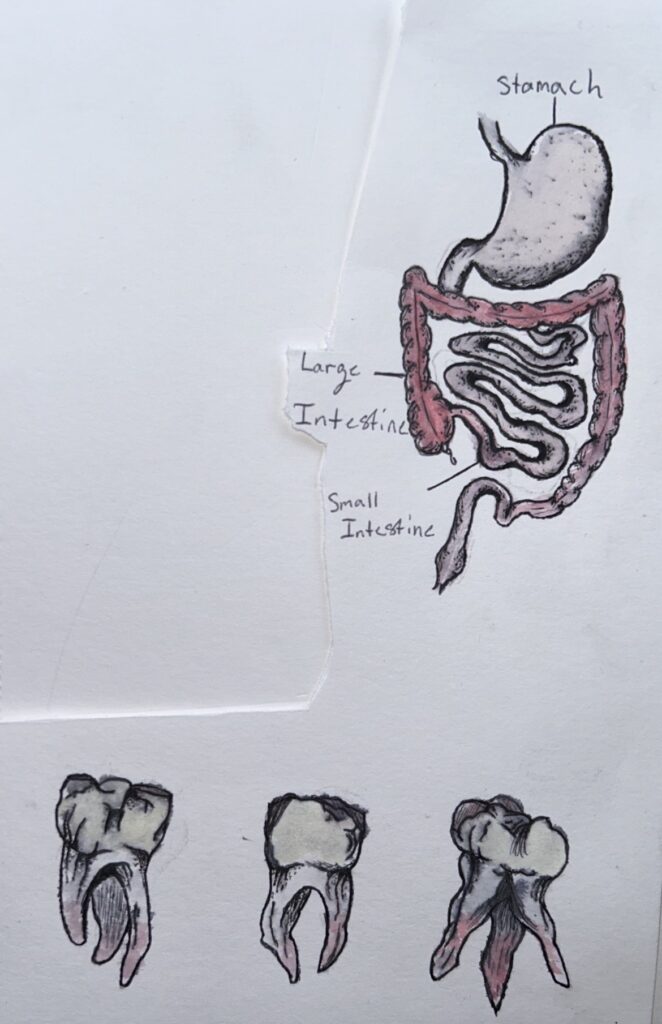
I decided to create a drawing for my visual piece and paint it. I started out by going through pictures of teeth and the gastrointestinal tract to get some inspiration of what I wanted to do. After I found some dental models of healthy teeth that I liked, I continued making sketches until I was happy with a rough draft of them. I then began transferring my rough draft over to my sketchbook making sure to use careful, crisp, clean lines. I wanted to add some damage to the teeth so I flattened them slightly and added subtle cracks in hope of conveying a sense of erosion. The hardest part was shading everything so that the shadows are in the right places which took me a few tries. Once I was ready I decided to outline my drawings and go over the shading in black pen. My final touch was to add some color by mixing acrylic paint with water to create the perfect water color effect.
Bulimia nervosa is an eating disorder that is symptomatically characterized by a wave of binge eating followed by extreme purging in an effort to not gain weight(Anderson et al., 1997). A large amount of food is consumed in a short amount of time. Afterwards, out of guilt, sadness, or disgust the person feels the need to purge all of the food they just ate by vomiting, taking laxatives, extensive exercising, or having a very strict diet for a period of time. It occurs mostly between the ages of 15-25 in females. Bulimia can cause a significant amount of damage to the body and can even cause death in some cases. The changes in gastrointestinal motility can cause pain, bloating heartburn, diarrhea, and constipation. Hyperamylasemia is also a common find in people suffering from bulimia nervosa(Kaplan, 1987). Hyperamylasemia is when levels of amylase are elevated in the blood. Serum amylase comes from both salivary glands and the pancreas. In cases of hyperamylasemia it can be an indicator of pancreatitis. With cases presenting with enlarged parotid glands it can point to a salivary problem. The parotid glands are large salivary glands located in front and below each ear. Dental erosion can also occur in cases of long term bulimia nervosa(Scheutzel, 1996). This happens when stomach acid enters the mouth cavity acting on hard dental tissues and is associated with chronic vomiting or gastrointestinal reflux over a long period of time. Dental erosion is the irreversible loss of tooth enamel which can cause cracking, chipping, sensitivity, and yellowing of the teeth.
Works Cited
Anderson, L., Shaw, J.-M., & McCargar, L. (1997). Physiological Effects of Bulimia Nervosa on the Gastrointestinal Tract. National Center for Biotechnology Information. https://pubmed.ncbi.nlm.nih.gov/9286483/
Kaplan, A. (1987). Hyperamylasemia and bulimia: A clinical review. Wiley Online Library. https://doi.org/10.1002/1098-108X(198707)6:4<537::AID-EAT2260060410>3.0.CO;2-DDigital Object Identifier (DOI)
Scheutzel, P. (1996). Etiology of dental erosion–intrinsic factors. National Library of Medicine. https://pubmed.ncbi.nlm.nih.gov/8804885/
This is a really well done project on the damage that bulimia nervosa does to the digestive system. The author starts by describing the personal reasons choosing this topic and how it resonated with them. The author then discusses the creative decisions made during the creation of their artistic portion of the project, such as the decision to add cracks and flatten out the teeth to show the damage associated with bulimia nervosa. The author describes how bulimia nervosa is an eating disorder where a person goes on a binge eating spree before purging themselves. This purging occurs through forcing themselves to vomit, taking laxatives, or fasting for extended periods of time. This can cause damage to the gastrointestinal tract, bloating, diarrhea, constipation, pain, and heartburn. She also mentions how bulimia is also associated with hyperamylasemia, which is when high levels of amylase are present in the blood that could indicate pancreatitis. The author then discusses the impacts that she drew about, which was the dental erosion due to the coating of stomach acid that occurs due to excessive vomiting. Overall, this project was very well crafted and packed with information on bulimia nervosa.