
 Posted by
Ectopic Pregnancy
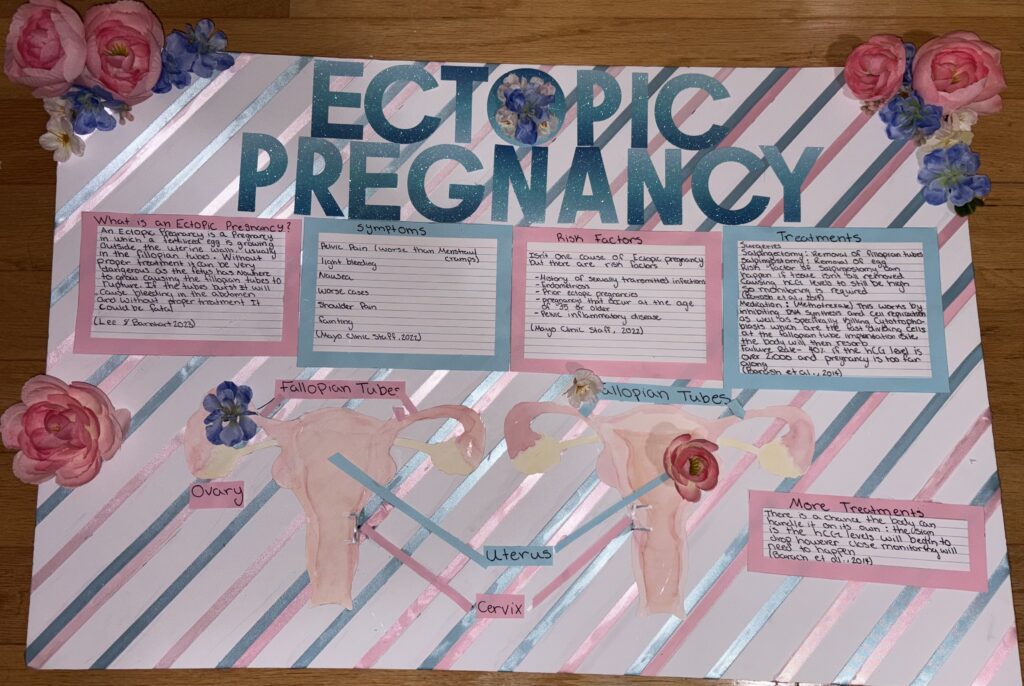
For my project I chose to do an ectopic pregnancy. I picked this topic because it is important to be aware of. For the display of my project I made an informative poster. On my poster I’ve included: What an ectopic pregnancy is, symptoms, causes, and treatments. On the bottom of the poster I’ve included two model uteri, one that displays a natural pregnancy and one that displays an ectopic pregnancy, both models representing a fertilized egg as a flower. My project on ectopic pregnancy relates to the course objective: explaining common disorders during pregnancies and their cause, because I accurately explain this disorder and list the causes.
An ectopic pregnancy is a pregnancy in which a fertilized egg is growing outside of the uterine walls, usually in the fallopian tubes. Without proper treatment it can be very dangerous as the fetus has nowhere else to grow causing the fallopian tubes to rupture. If the tubes burst it will cause bleeding in the abdomen and without proper treatment it can be fatal. (Lee & Barnhart, 2023) Ectopic pregnancy affects up to 2% of pregnancies a year and is the cause of 9% of pregnancy related deaths in America. (Barash et al., 2014) The most common symptom that occurs is pelvic pain often described worse than menstrual cramps. Early on there can be no symptoms. As the fertilized egg begins to grow symptoms begin to get worse, light bleeding nausea begins to occur and pelvic pain really starts to set in. In some cases if the fallopian tubes burst, blood begins to leak causing shoulder pain, ultimately this symptom depends on where the blood happens to be collecting and which nerve it’s affected by and fainting. (Mayo Clinic Staff, 2022)
There isn’t one cause of an ectopic pregnancy, however there are risk factors some include history of sexually transmitted infections, pelvic inflammatory disease, endometriosis, pregnancies that occur at the age of 35 or higher, prior ectopic pregnancies, past surgeries on the fallopian tubes, and smoking. (Lee & Barnhart, 2023) Sometimes diagnosing someone with an ectopic pregnancy can be hard because their hCG level will show they are pregnant. Some ways a doctor will be able to tell is by doing a transvaginal ultrasonography. This allows the doctor to get closer to the uterus and fallopian tubes, however it can be hard to see if it’s before 5.5 weeks of the pregnancy. By 5.5 weeks the doctor should be able to see the gestational sac with the yolk sac inside the uterus if they can’t this could mean an ectopic pregnancy. This option isn’t always clear so the doctors will do blood tests for hCG levels. When someone is pregnant hCG levels will rise 50% every 48 hours if this does not occur it could also indicate an ectopic pregnancy. Usually 20 % of ectopic pregnancy hCG levels rise normally in the beginning, so the doctors will have to perform the ultrasonography and hCG levels until they figure out what is wrong. (Barash et al., 2014)
Treatments for an ectopic pregnancy can include medicational options. This is usually done when the ectopic pregnancy is discovered early. This option includes methotrexate and it works by inhibiting DNA synthesis and cell replication as well as specifically killing cytotrophoblasts which are the fast dividing cells at the fallopian tube implantation site, the body will then resorb. The failure rate of this is 40% if the hCG levels are above 2,000. Other treatments include surgeries. Doctors can perform a salpingectomy, the removal of fallopian tubes or a salpingostomy for someone who wants to preserve future fertility so they just remove the egg; they are performed either through a laparoscopy or a laparotomy which is usually saved for patients with more severe cases. After someone undergoes a salpingostomy there is a chance the tissue wasn’t all removed and if that happens they will still be showing signs of elevated hCG. For the doctors to ensure that doesn’t happen they will do blood tests. In some cases the doctors might not have to take action right away; this only happens if the hCG levels are already going down, there is no clear ectopic pregnancy found in the fallopian tubes, and the symptoms are very mild, if this is the case the doctors will very heavily monitor the patient to make sure everything goes back to normal. (Barash et al., 2014)
References
Barash, J. H., Buchanan, E. M., & Hillson, C. (2014). Diagnosis and Management of Ectopic Pregnancy. American Family Physician, 90(1), 34–40. https://www.aafp.org/pubs/afp/issues/2014/0701/p34.html
Jacobson, J. (2019). Uterus: MedlinePlus Medical Encyclopedia Image. Medlineplus.gov. https://medlineplus.gov/ency/imagepages/19263.htm
Lee, I. T., & Barnhart, K. T. (2023). What Is an Ectopic Pregnancy? JAMA, 329(5), 434. https://doi.org/10.1001/jama.2022.22941
Mayo Clinic Staff. (2022, March 12). Ectopic Pregnancy – Symptoms and Causes. Mayo Clinic; Mayo Clinic. https://www.mayoclinic.org/diseases-conditions/ectopic-pregnancy/symptoms-causes/syc-20372088
What Is an Ectopic Pregnancy? How Can I Know I Have One? | Women’s Clinic of Atlanta. (2024, April 15). Women’s Clinic of Atlanta. https://www.womensclinicofatlanta.com/what-is-an-ectopic-pregnancy-how-can-i-know-i-have-one/?post_type=blog_post
This project focuses on ectopic pregnancy, its symptoms, cause, and treatment options. An ectopic pregnancy is described as a pregnancy that is growing outside of the uterus/uterian walls. Ectopic pregnancies are most commonly found in the fallopian tubes. As the fallopian tubes are not designed to grow a fetus, they often rupture or burst. This can lead to internal bleeding and potentially death. When the fertilized egg first starts to develop, symptoms are minor and worsen as the pregnancy continues. These may include cramping of the pelvis, light bleeding, nausea, and pain in the shoulder, depending on whether the fallopian tubes have burst. There is one main cause of ectopic pregnancies, though there are certain factors that may increase the likelihood of this occurring. These include a geriatric pregnancy (those of the age 35 or older), prior experience of ectopic pregnancies, history of sexually transmitted diseases, smoking, endometriosis, etc. To diagnose someone with an ectopic pregnancy, a common way to tell is through a transvaginal ultrasound. Diagnosing prior to 5.5 weeks of pregnancy is difficult, as the gestational sac has yet to develop. To further clarify a diagnosis HCG hormone levels will be tested. If these are not doubling as they should this may indicate an ectopic pregnancy. Both medication and surgery are options for treatment.