 Posted by
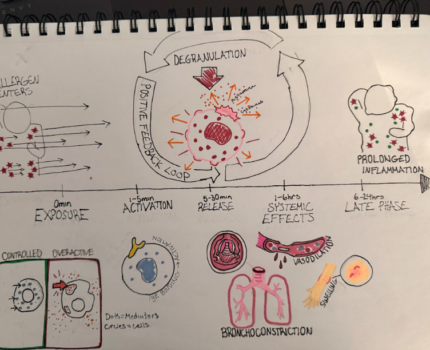
This illustration shows a timeline of anaphylactic immune dysregulation, highlighting how the body’s normal defense system becomes dangerously overreactive within the first 24 hours after exposure to an allergen. At the beginning, the allergen enters the body and binds to IgE antibodies on mast cells, triggering activation within minutes. This leads to Mast Cell degranulation, where chemical mediators like histamine are rapidly released in a positive feedback loop that amplifies the response. As the reaction progresses, these mediators cause widespread systemic effects, including bronchoconstriction in the lungs, vasodilation of blood vessels, and tissue swelling. Unlike a controlled immune response, this over reaction becomes harmful and life-threatening. In the late phase, prolonged inflammation occurs as additional immune cells are recruited, extending tissue damage and symptoms. Overall, this diagram demonstrates how a protective immune mechanism can become dysregulated and escalate into an acute allergic emergency.

Anaphylaxis is the most extreme form of immune dysregulation turning the immune system against the host and creating a life-threatening reaction. Melanie Gonzales project traces the timeline on how the coordination of the normal immune system coordination becomes amplified during anaphylaxis. During typical conditions white blood cells such as neutrophils and macrophages protect the body from intruders by responding to pathogens through controlled inflammation mediated by cytokines and histamine. When an allergen triggers this system however there is an excessive activation of basophils, mast cells, histamine, leukotrienes, prostaglandins and platelet activation factors that cause widespread vasodilation, vascular leakage, and hypotension. Fisher et al (2018) and Worm et al (2025) investigated this process and explained in their articles that IgE antibodies bound to high affinity FcεRI receptors initiate this cascade of reactions upon re-exposure of the allergens. An article published by Stone et al. in 2009 demonstrated that certain cytokines such as IL-2 etc. and TNF correlate with severity. Rober et al. noted that neutrophils, eosinophils, macrophages and platelets produce toxic molecules that amplify inflammation through reactive oxygen species. These studies are very important as they reveal that anaphylaxis is not just an allergic response but a failure of immune regulation and signaling pathways. We can understand more about this system and mapping the progression of symptoms this project signifies the importance of a regulated immune system and how the systems meant to protect can lead to one’s death. This overview and project emphasizes the importance of the more delicate systems that balance between protection and overreaction.