
 Posted by
“Untying the Knot: Your Heart is Actually a Spiral.” (2013). MedImagery. https://medimagery.wordpress.com/2013/10/28/untying-the-knot-your-heart-is-actually-a-spiral/

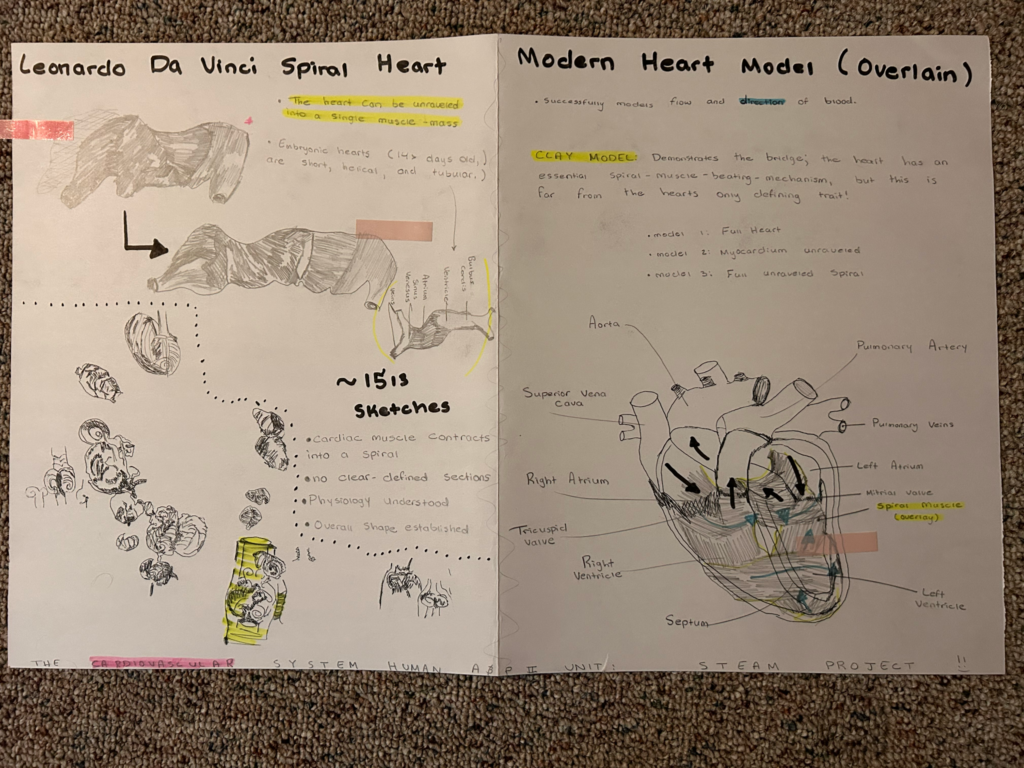
The (Da Vinci) spiral design shows us how cardiac muscle fibers are arranged to produce a twisting motion during contraction, which increases efficiency in pumping blood. This connects to the cardiovascular unit from class by modeling how structure determines function, (specifically how the organization of the myocardium supports coordinated contraction, pressure generation, and blood flow.)
Overall, the project represents the heart as both an anatomical structure and a dynamic system, combining visual creativity with physiological concepts to better understand how the cardiovascular system works.
This STEAM project explores the structure and function of the myocardium through both scientific research and creative modeling. The myocardium, the muscular layer of the heart, plays a critical role in generating the force required to circulate blood throughout the body. Rather than functioning as a simple pump, the heart relies on a highly organized, three-dimensional arrangement of cardiac muscle fibers. These fibers are arranged in a helical or spiral pattern, which produces a twisting motion during contraction. This motion increases the efficiency of blood ejection while minimizing energy use, demonstrating the strong relationship between anatomical structure and physiological function.
The project draws inspiration from historical observations, particularly those of Leonardo da Vinci, whose anatomical studies suggested that the heart’s movement was more complex than a simple contraction. Modern research supports this idea through the helical ventricular myocardial band model, which describes the myocardium as a continuous, spiraling band of muscle. This model highlights the integration of the heart as a single functional unit rather than a collection of separate parts.
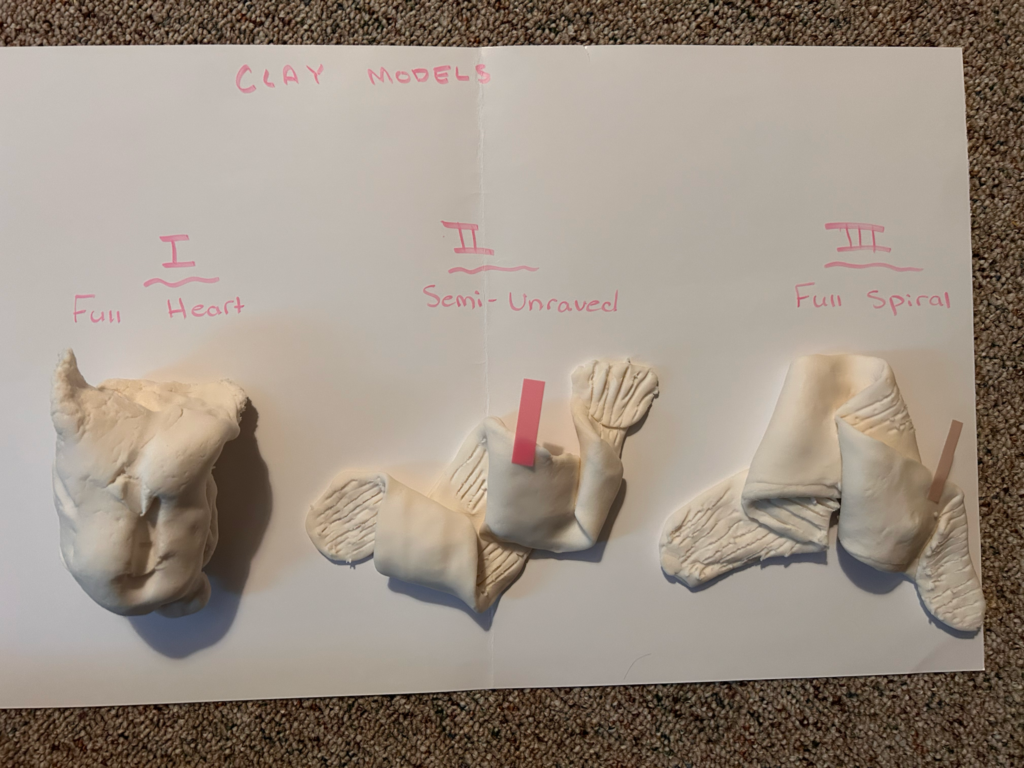
The clay modeling component provided a hands-on method to visualize and better understand this concept. By shaping and partially unraveling the model, the continuous and spiral nature of the myocardium became more apparent. This process reinforced how the heart’s structure contributes to coordinated contraction, pressure generation, and efficient circulation. Overall, this project demonstrates how combining art and science can deepen understanding of complex biological systems and emphasizes the importance of structural organization in cardiovascular function