 Posted by
Adi Michael
Don Larson
Anatomy & Physiology 111x
November 20, 2025
Skeletal Muscles and Sarcopenia
Skeletal muscles are one of the major components of the human body at the microscopic and gross levels, helping us perform our daily activities. Skeletal muscles comprise about 40% of body mass and hold 50-60% of all body proteins. As we age, there is a chance of getting an age-related condition that affects skeletal muscle mass, strength, and function. It is on the rise and could continue to impact many generations to come. This chronic condition is called sarcopenia. A question that came to me while reading on sarcopenia was, is it inevitable with aging? In this review, we will discuss skeletal muscles and how sarcopenia affects them.
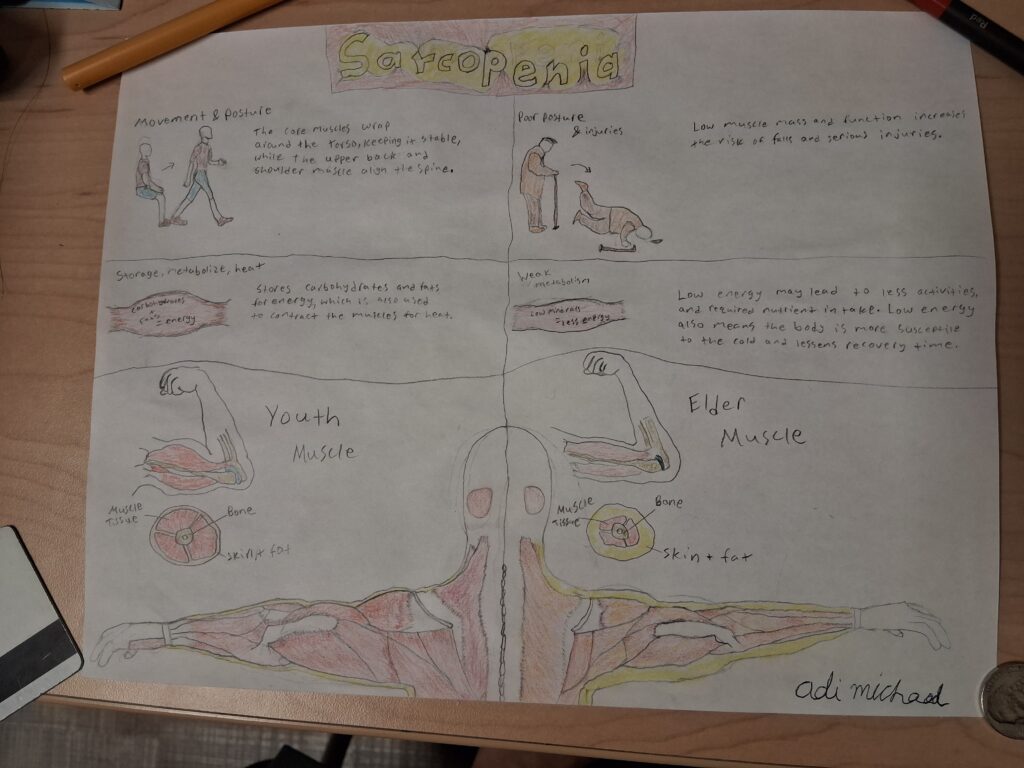
Skeletal muscles work in two ways: mechanically and metabolically (Frontera & Ochala, 2014). Our posture, the ability to move and fight, the protection of internal organs, and the endurance we humans have are derived from our skeletal muscles. They have been known to act as a storage for amino acids, carbohydrates, and other minerals, which help keep our body warm. This type of muscle is also voluntary, meaning that skeletal muscles respond to our conscious will, which allows us to move our bodies. This tissue has been, and continues to be, vital for our dexterity and mobility in human evolution.
The four characteristics that allow skeletal muscles to function are excitability, contractility, extensibility, and elasticity. Excitability is the response to stimuli; contractility is the shortening of a muscle; extensibility is the ability to stretch and lengthen; and elasticity is the recoiling of the muscle. Plasticity also helps remodel muscles after exercise or when an injury occurs. It is similar to a rope, with thousands of myofibrils containing myofilaments that make the sarcomeres, which are units of skeletal muscle (Frontera & Ochala, 2014).
In late adulthood (65+ years of age), there is a higher risk of infections, diseases, conditions, and complications. The number of people aged 60+ in the global population of 2021 was 10% (761 million), but is expected to rise to 17% (1.6 billion) by 2050 (Jian et al., 2025). Sarcopenia can have a ruinous effect on the human body and daily activities. The diagnosis of sarcopenia used to be that if there was low muscle mass and strength, it was sarcopenia. Those with obesity sometimes do not get diagnosed with sarcopenia, often leading to more mishaps and even death (Cruz-Jentoft, 2019). Screening tools are not accurate for diagnosing sarcopenia; instead, tests of muscle mass, strength, and physical performance are used.
The loss of skeletal muscle mass and function disrupts the metabolic homeostasis, which often leads to a compromised immune system, increased falls and accidents, and weak bones. There are no medications to prescribe for sarcopenia, other than vitamins, and continued research on mesenchymal stem cells (Jian et al., 2025). To avoid sarcopenia and many other complications, one must live healthily. Eat nutritious foods, incorporate resistance training and anaerobic exercises, and avoid lying in bed for long periods of time.
Skeletal muscles are dynamic, as with other muscles, but none work like them; they are responsible for moving the human body, maintaining posture and joint stability, generating heat through metabolism, and protecting the organs. Excitability, contractility, extensibility, and elasticity work together to keep the body moving and skeletal muscle functioning. A healthy lifestyle would maintain most skeletal muscles, but it may not be affordable for those in poverty. Sarcopenia may be entirely preventable, but unpredictable events can become the reason for this condition.
Works Cited
Cruz-Jentoft, P. A. J. (2019, June 27). Https://www.sciencedirect.com/science/article/abs/pii/S1047847720300046?via=ihub. Sarcopenia. https://www.med.upenn.edu/pmi/events/https-www-sciencedirect-com-science-article-abs-pii-s1047847720300046-via-3dihub
Jian, Z., Yang, D., Tang, C., Zheng, L., Zhao, W., Zhou, Z., Wang, F., & Peng, X. (2025, September 3). Exercise-activated mesenchymal stem cells: A translational strategy for age-related sarcopenia management – stem cell reviews and reports. SpringerLink. https://link.springer.com/article/10.1007/s12015-025-10969-7
Frontera, W. R., & Ochala, J. (2014a, October 8). Skeletal muscle: A brief review of structure and function – calcified tissue international. SpringerLink. https://link.springer.com/article/10.1007/s00223-014-9915-y#Sec7