STEAM project Abstract: Cody Foulk
Partner: Michi J. Roberts
My Partner did her STEAM project on Growth and Decay where she goes over the various components and key structures of the nervous system,” and “Identify the 4 main structures of the brain and their functions and compares how a healthy brain is deferent then one that is effected from Alzheimer’s. She starts off by going over and explaining the major parts of the Brain along with their function, starting off with the Cerebrum its role is that of higher cognitive functions, examples include judgment, memories and decision making. The Cerebellum is responsible for our motor control and balance and coordination. The Diencephalon regulates sensory pathways and homeostasis. And the Brainstem which is responsible for vital functions such as breathing and heart rate. Then she goes over and explains the structure and purpose of the nervous system, which is made up of the brain, spinal cord and nerves that send signals throughout the body. She then looks into the cause and progression of Alzheimer and how it impacts the brain. Alzheimer’s is typically influenced by age, genetics along with lifestyle factors it is a progressive condition to mean it gets worse over time. It effects the brain’s ability to think, the ability to communicate along with memory and daily function.
Cody Foulk
Michi Roberts STEAM Abstract:
This project focuses on the structural and functional properties and components of the nervous system with an emphasis on Alzheimer’s disease (AD) and how it alters the health of the brain. The paper goes over the primary regions of the brain, the cerebellum, cerebrum, brainstem and lastly the diencephalon and are described in terms of their role for condition, motor control, sensory regulation and automatic regulation. With the addition of the spinal cord and peripheral nerves these structures form the nervous system which takes the role of communication between the body and brain to regulate essential functions such as movement, speech and digestion.
Alzheimer’s disease is a progressive neurodegenerative disorder that impairs judgement, memory, language and social behaviour. Regions within the cerebellum are especially vulnerable along with the hippocampus, amygdala and entorhinal cortex which can lead to disruptions with reward processing, memory and emotion. Neuroimaging reveals subtle volumetric changes and deformations which suggest that Alzheimer’s affects multiple brain systems at once rather than a single system and patterns are known to vary by age.
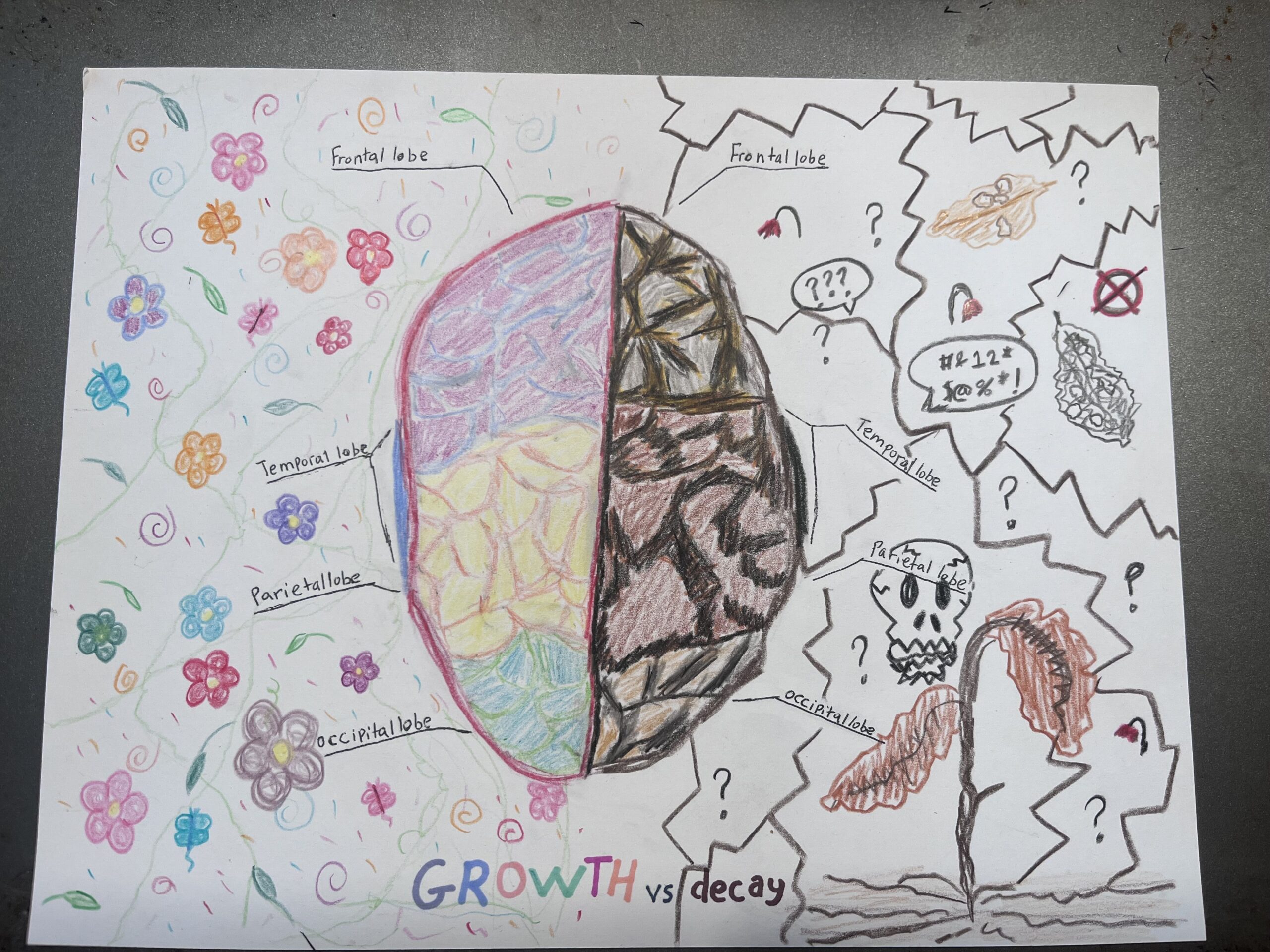
The artwork shown contrasts a healthy brain function to pathological changes from AD, overall this project highlights the importance of early prevention and recognition. It also emphasizes the variation within Alzheimer’s advances in both scientific knowledge but also lets others be more aware and empathetic to those affected by neurodegeneration.
 Posted by

STEAM project Abstract: Cody Foulk
Partner: Michi J. Roberts
My Partner did her STEAM project on Growth and Decay where she goes over the various components and key structures of the nervous system,” and “Identify the 4 main structures of the brain and their functions and compares how a healthy brain is deferent then one that is effected from Alzheimer’s. She starts off by going over and explaining the major parts of the Brain along with their function, starting off with the Cerebrum its role is that of higher cognitive functions, examples include judgment, memories and decision making. The Cerebellum is responsible for our motor control and balance and coordination. The Diencephalon regulates sensory pathways and homeostasis. And the Brainstem which is responsible for vital functions such as breathing and heart rate. Then she goes over and explains the structure and purpose of the nervous system, which is made up of the brain, spinal cord and nerves that send signals throughout the body. She then looks into the cause and progression of Alzheimer and how it impacts the brain. Alzheimer’s is typically influenced by age, genetics along with lifestyle factors it is a progressive condition to mean it gets worse over time. It effects the brain’s ability to think, the ability to communicate along with memory and daily function.
Michi Roberts STEAM Abstract:
This project focuses on the structural and functional properties and components of the nervous system with an emphasis on Alzheimer’s disease (AD) and how it alters the health of the brain. The paper goes over the primary regions of the brain, the cerebellum, cerebrum, brainstem and lastly the diencephalon and are described in terms of their role for condition, motor control, sensory regulation and automatic regulation. With the addition of the spinal cord and peripheral nerves these structures form the nervous system which takes the role of communication between the body and brain to regulate essential functions such as movement, speech and digestion.
Alzheimer’s disease is a progressive neurodegenerative disorder that impairs judgement, memory, language and social behaviour. Regions within the cerebellum are especially vulnerable along with the hippocampus, amygdala and entorhinal cortex which can lead to disruptions with reward processing, memory and emotion. Neuroimaging reveals subtle volumetric changes and deformations which suggest that Alzheimer’s affects multiple brain systems at once rather than a single system and patterns are known to vary by age.
The artwork shown contrasts a healthy brain function to pathological changes from AD, overall this project highlights the importance of early prevention and recognition. It also emphasizes the variation within Alzheimer’s advances in both scientific knowledge but also lets others be more aware and empathetic to those affected by neurodegeneration.