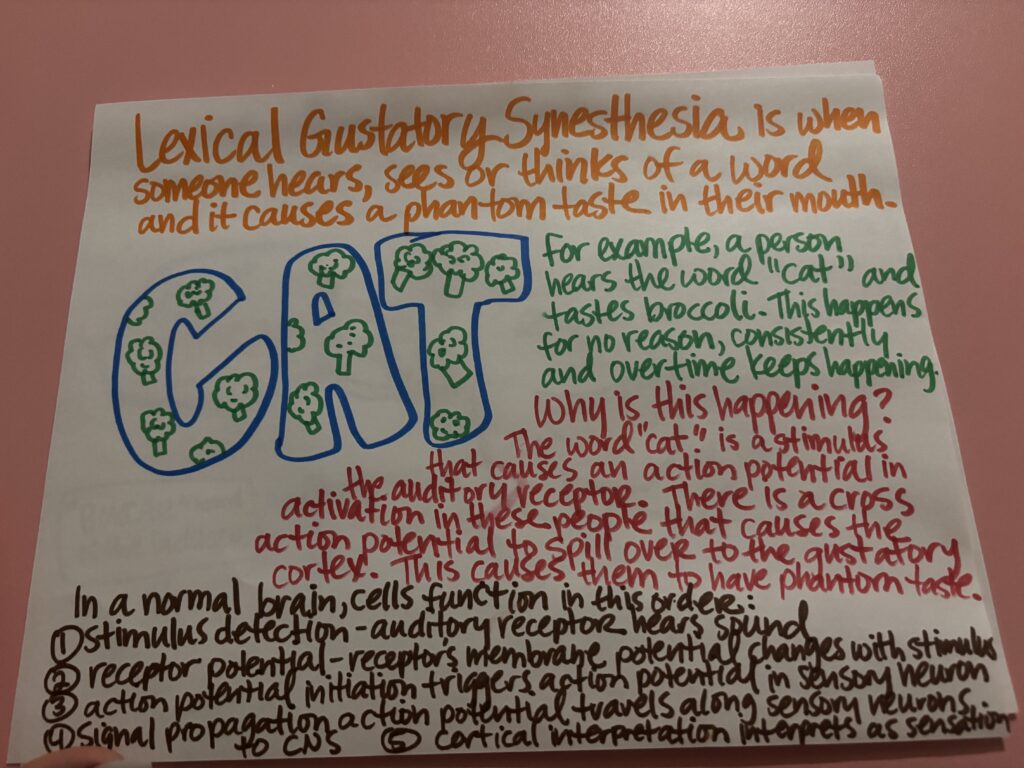
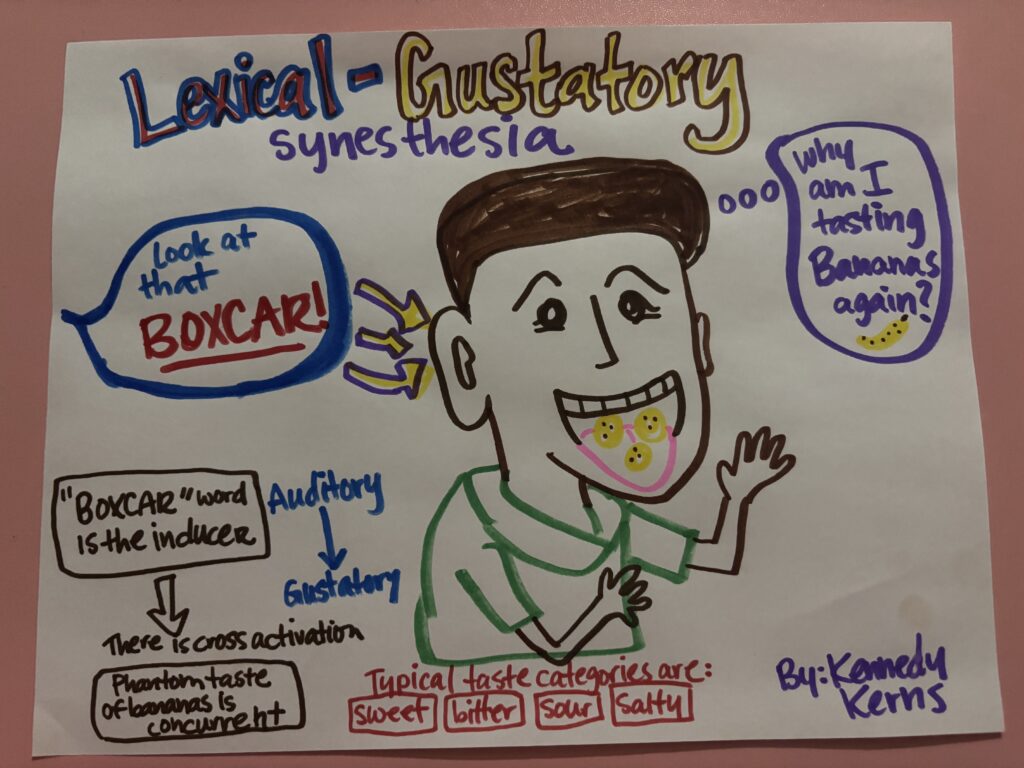
For my STEAM project I chose Lexical Gustatory Synesthesia which is a rare but interesting phenomenon that happens when a person hears a word and experiences a phantom taste in their mouth. This happens due to an abnormal hyper-activation with action potentials between the auditory and gustatory nerves. I showed this through two drawings. The first drawing depicts someone hearing the word “boxcar” and asking himself why he is tasting bananas again. This is to show that there is no reasonable association the person should have with the word “boxcar” and a taste of bananas. If a person hears the word “pickle” and salivates because he knows pickles are sour due to eating them a lot, that is not lexicial gustatory synesthesia. That is a conditioned response. In my second drawing, I drew a bubble letter of the word “CAT” and inside the letters there is broccoli. This represents how a person would hear, see or think the word “cat” and have the taste of broccoli in their mouth. I found this interesting because for the people who have this condition, it can be pleasant or unpleasant, depending on their experience and taste the words provoke for them. I hope this was an easy way to understand this neurological condition.
Kennedy Kerns
This STEAM project illustrates exploration of lexical gustatory synesthesia a rare neurological condition in which hearing, reading, or thinking of a word consistently triggers an unrelated taste sensation. Their work uses two drawings to clearly highlight the difference between true synesthesia and ordinary learned associations. In the first drawing, it shows a person hearing the word “boxcar” and questioning why he tastes bananas again. This pairing has no logical connection, which emphasizes the hallmark of synesthesia automatic involuntary and repeated sensory cross-activation. The project contrasts this with a second example hearing “pickle” and salivating because pickles taste sour explaining that this reaction comes from experience not synesthesia.
In their second drawing it illustrates the word “CAT” with broccoli hidden inside the letters, demonstrating how a person with lexical–gustatory synesthesia might experience a taste simply by seeing or thinking about the word. Kennedy connects these artistic representations to the neuroscience behind the condition, explaining that abnormal hyperactivation between auditory and gustatory pathways causes action potentials from the auditory nerve to trigger taste related areas of the brain, even without stimulation of the tongue.
The project effectively uses visuals and straightforward explanations to show how cross-sensory wiring creates phantom tastes. Kennedy related how these experiences can be pleasant or unpleasant depending on the taste a word evokes and their artwork provides a clear accessible way to understand this unusual neurological condition.
 Posted by

For my STEAM project I chose Lexical Gustatory Synesthesia which is a rare but interesting phenomenon that happens when a person hears a word and experiences a phantom taste in their mouth. This happens due to an abnormal hyper-activation with action potentials between the auditory and gustatory nerves. I showed this through two drawings. The first drawing depicts someone hearing the word “boxcar” and asking himself why he is tasting bananas again. This is to show that there is no reasonable association the person should have with the word “boxcar” and a taste of bananas. If a person hears the word “pickle” and salivates because he knows pickles are sour due to eating them a lot, that is not lexicial gustatory synesthesia. That is a conditioned response. In my second drawing, I drew a bubble letter of the word “CAT” and inside the letters there is broccoli. This represents how a person would hear, see or think the word “cat” and have the taste of broccoli in their mouth. I found this interesting because for the people who have this condition, it can be pleasant or unpleasant, depending on their experience and taste the words provoke for them. I hope this was an easy way to understand this neurological condition.
This STEAM project illustrates exploration of lexical gustatory synesthesia a rare neurological condition in which hearing, reading, or thinking of a word consistently triggers an unrelated taste sensation. Their work uses two drawings to clearly highlight the difference between true synesthesia and ordinary learned associations. In the first drawing, it shows a person hearing the word “boxcar” and questioning why he tastes bananas again. This pairing has no logical connection, which emphasizes the hallmark of synesthesia automatic involuntary and repeated sensory cross-activation. The project contrasts this with a second example hearing “pickle” and salivating because pickles taste sour explaining that this reaction comes from experience not synesthesia.
In their second drawing it illustrates the word “CAT” with broccoli hidden inside the letters, demonstrating how a person with lexical–gustatory synesthesia might experience a taste simply by seeing or thinking about the word. Kennedy connects these artistic representations to the neuroscience behind the condition, explaining that abnormal hyperactivation between auditory and gustatory pathways causes action potentials from the auditory nerve to trigger taste related areas of the brain, even without stimulation of the tongue.
The project effectively uses visuals and straightforward explanations to show how cross-sensory wiring creates phantom tastes. Kennedy related how these experiences can be pleasant or unpleasant depending on the taste a word evokes and their artwork provides a clear accessible way to understand this unusual neurological condition.