 Posted by
Everybody considers swimming as the most complete activity, that’s why I decided to focus my STEAM project on osteoporosis and how swimming can be helpful or useless for bones and for reducing the risk of this disease. I have been swimming for my entire life and I already know all the benefits it gives, but now, after much research, I understand better why I’m doing it.
First of all, bones are made up of 4 cells:
- Osteogenic cells give origin to all the other bone cells, because they are stem cells that can regenerate and differentiate
- Bone lining cells serve to maintain bone matrix and control mineral exchange
- Osteoblasts are cells that build bone by increasing bone mineral density.
- Osteoclasts have the opposite function of the osteoblasts, because they break down bone tissue. Moreover, osteoclasts are responsible for bone resorption, a process that reduces bone density because bone tissue is lost.
Osteoporosis is a disease in which bone resorption (osteoclasts) exceeds bone formation (osteoblasts). Osteoporosis makes the bones porous and fragile, because bone mass decreases even though the bone structure remains normal. Vertebrae and hip bones are the most affected ones, that’s why vertebral fractures and hip fractures are common in people with osteoporosis. Postmanopausal women are affected by it, because the drop in estrogen reduces their protection against bone loss. However, there are other factors that can lead to osteoporosis, for instance smoking, sedentary lifestyle, excessive alcohol consumption or eating food low in calcium and protein. Avoiding all of these activities or trying to reduce them is recommended, and the perfect way of prevention is to do regular weight-bearing physical activity.
However, there are some activities that are not helpful for bones, for example low impact endurance exercise. Low impact exercise uses more of the muscles, decreasing the impact on bones, which means that the osteoblasts are less active than the osteoclasts. In this case, the risk of osteoporosis increases, especially because osteoclasts are stimulated by PTH, a hormone that increases the calcium level in the blood.
Swimming is a low impact activity, for this reason the impact on bones is low and it doesn’t increase bone density. But, studies have shown that it doesn’t completely create a fragile skeleton, because in some ways it is also helpful.
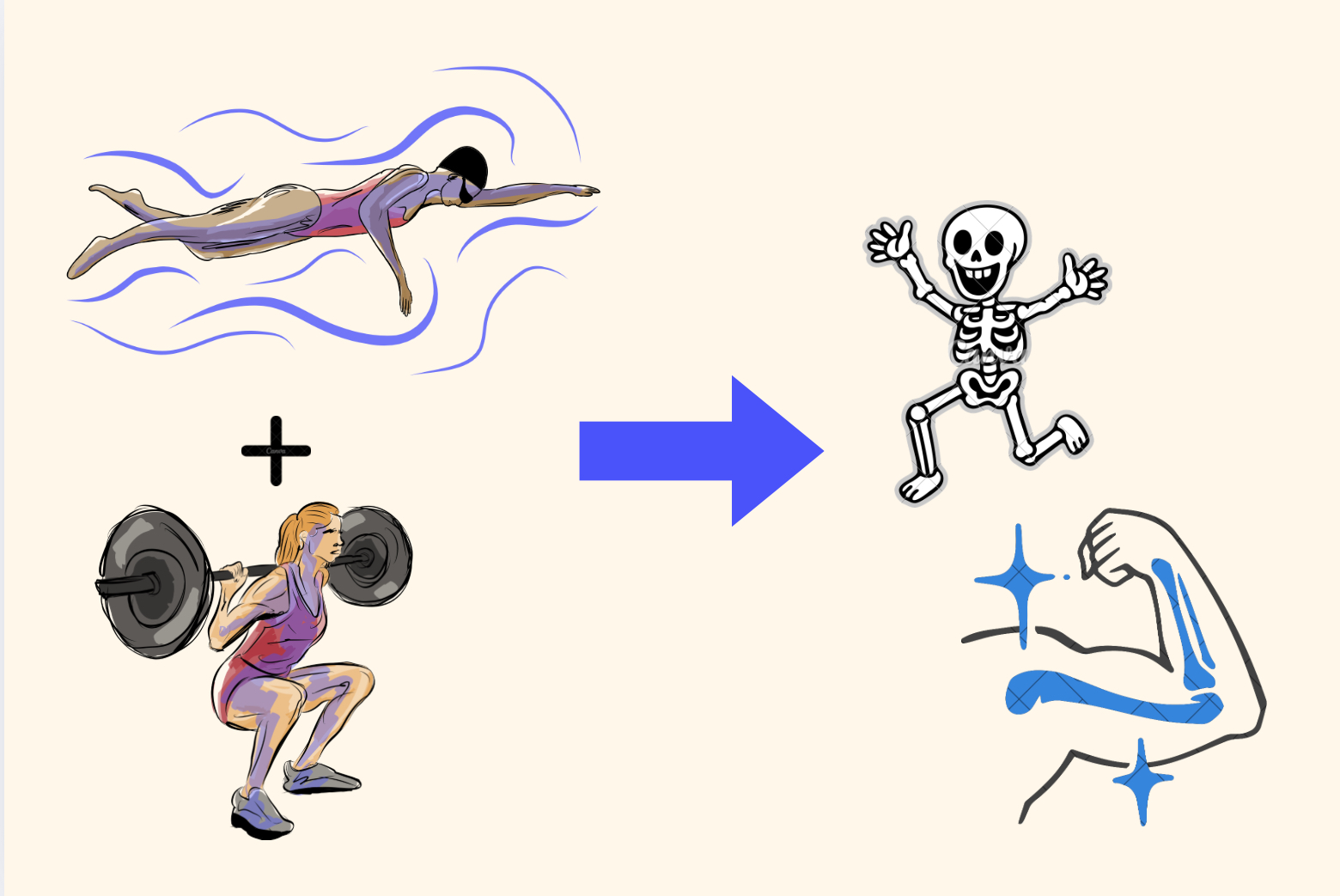
I chose this article named “Does long term swimming participation have a deleterious effect on the adult female skeleton?”, because it actually examines what swimming does to bones. They conducted a study of 87 women around 40 years old and divided them into 2 groups. Several data were considered for each group, the most important being the weekly hours of physical activity. They did that to see if between the two groups there was a difference in bone density, and it was, but it was so minimal that it didn’t give importance to the research. The initial hypothesis was not confirmed, the study shows that swimming doesn’t worsen bone density in adult women and that it can have an indirect protective effect, because it stimulates musculature and coordination. Unfortunately, just swimming is not enough to completely avoid the risk of osteoporosis, but for optimal skeletal health it should be alongside moderate impact activities or strength training, like doing weights. These types of exercises have more effective stimuli to increase bone density.
All of this is also supported in the article “The muscle bone unit in adolescent swimmers”, which compares adolescent swimmers with non-swimming adolescents. The result is the same as the other survey, swimmers have less bone density and a lot of muscles. For this reason it also recommends adding weights to swimming.
Being a swimmer, I’m used to doing both activities, but I wasn’t aware that this combination should be common and necessary for everyone in order to be truly useful to your body and health.