 Posted by
The reason I chose this for my project is because when i was younger I broke my hand and ankle alot and i was always in and out of orthopedic offices and i got a major interest in orthopedic surgery so the bones of the body is one of my most favorite subjects.
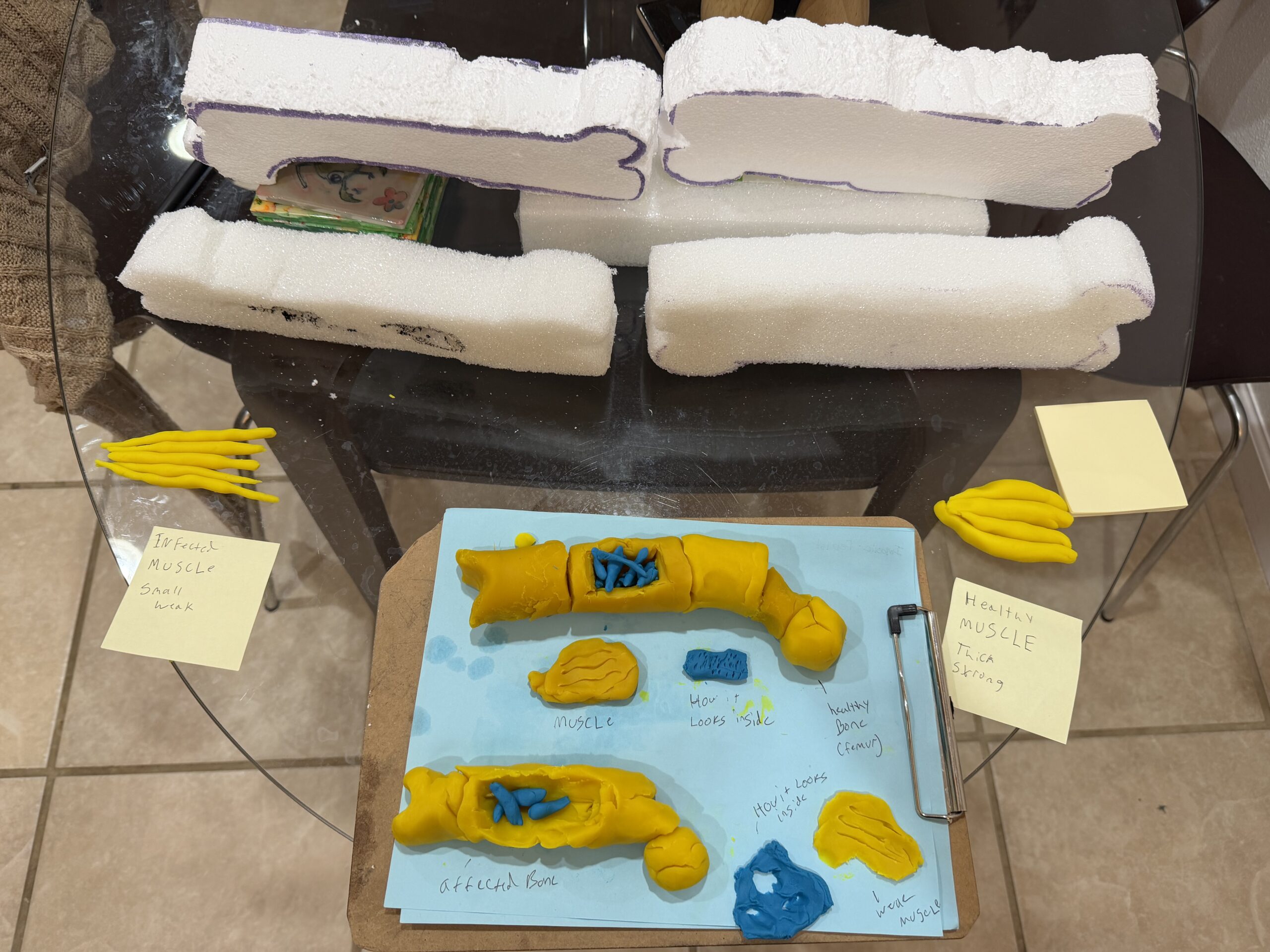
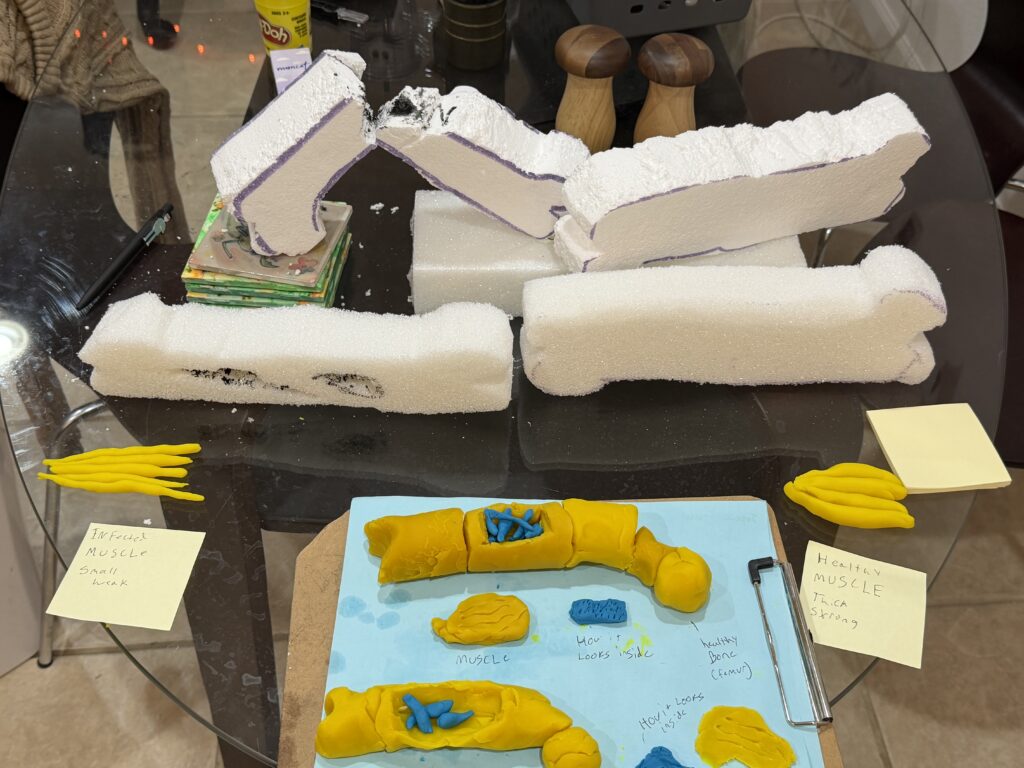
For the model I made a rough draft for the project out of playdough that is super crude and not well put together . Then for the final draft I took some Styrofoam and cut it into the shape of a femur along with took some plastic Styrofoam that looks a lot like the spongy bone in the bones along with recreated the bone to show how the bone looks if you peel off the hard outer layer of the bone. Then I cut the middle out of the Styrofoam bone and inserted some Plastic Styrofoam to show how it would look inside and for the damaged bone I left more out
Then since it’s hard to get the Styrofoam to look like muscle i used a bit of the plastic one colored in to show the striated muscle along with use the playdough to show how normal muscle looks along with how the affected muscle is in size .along with for the non -literal portion i going painted it to look like a peanut brittle cookie due to the other name of the disease to be Brittle bone. (edit i did not do the peanut brittle because i was scared i was gonna mess it up and not have a project to turn in )
I’ll be doing my abstract on Johnathan Dupee’s project. His project examines osteogenesis imperfecta (OI) and its impact on both bone structure and the surrounding muscles. Johnathan’s research, in turn, modeled how OI alters the internal architecture of the bone. Specifically, spongy bone (trabeculae), as well as the implications of this weakness for brittle bones and muscle support, are a consequence of weakened bone. In his project, I learned that OI is a disorder characterized by defects in collagen formation, mineralization, and osteoblast function, and that researchers have identified at least 22 genetic forms of OI, with variable expression directed toward the skeleton. I learned that upper-arm emerging treatments, such as whole-body vibration, are being evaluated as mechanisms to strengthen bones or improve mobility in OI, among others.
The physical model provided a good illustration of the contrast between healthy and affected bone. The use of styrofoam to shape the femur and create spongy bone provided a visualization of how the widened hollowed caverns of OI influence structural integrity. His representation of healthy versus affected muscle, expressed through different textures and thicknesses, provided a useful contrast, showing that when bone is either fragile or underused due to chronic fractures, muscle can also be weakened.
Overall, his project taught me about the biological mechanisms underlying brittle bone disease and provided a hands-on model that clearly and accessibly represented microscopic structural changes.