 Posted by
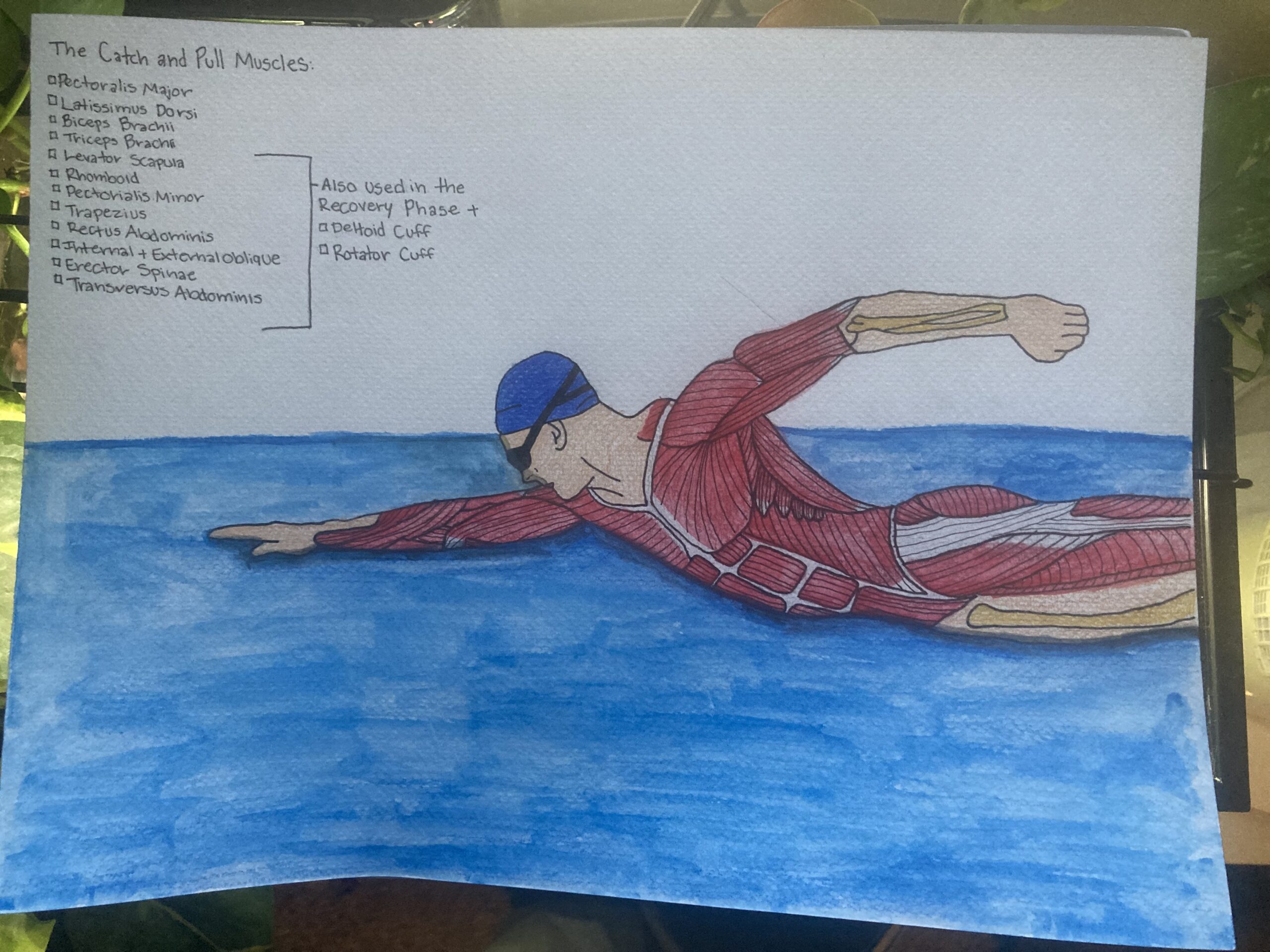
Few athletes rely on their shoulders as intensely as swimmers, where every stroke demands strength, stability, and a great amount of range of motion. While they use their whole body, the arms take up most of the load and propel them forward. The muscles in the shoulder that are used during swimming consist of 14 muscles. These can be separated into 3 categories: the propulsive phase, the recovery phase, and both phases. The propulsive phase is the phase in which the arm is pulling underneath the water. Muscles used in this phase are the pectoralis major, latissimus dorsi, biceps brachii, and triceps brachii (Moore, 2022). The recovery phase is when the arm comes out of the water and over your head before entering the water again. The muscles are the deltoid cuff and rotator cuff. Finally, the muscles that are used in both the propulsive and recovery phase are the levator scapula, rhomboid, pectoralis minor, trapezius (lower and middle), rectus abdominis, internal and external oblique, erector spinae, and transversus abdominis (Moore, 2022). As you can see, there are a lot, but they all play a part in propelling the body forward while swimming.
A study was conducted comparing competitive swimmers and the glenohumeral joints to those who aren’t non-competitive swimmers. The task was to activate the scapular plane while unweighted to assess the humeral position, instantaneous helical axis (IHA), and humeral contract path length (CPL) (Silverson et al., 2025). The results showed that competitive swimmers had a more anterior humeral head position, but no significant difference in the superior/inferior position. Same with the IHA and CPL position, there were no significant differences (Silverson et al., 2025). While it may seem that this study was unsuccessful in finding the results they were looking for, it also suggests that the test may not have detected any differences due to the load it was giving, and should be conducted in a more sport-specific setting.
Another study tested how cutting off blood flow affected muscles in swimmers, or ischemic preconditioning (IPC). They took 3 groups and had one do IPC once before swimming (AIPC), one group did it every day for 7 days (RIPC), and the third had a fake version (SHAM) (Wu et al., 2025). This test was to show if cutting the blood flow briefly helped swimmers recover better after working out. The results showed that the RIPC group improved in performance at 0h-48h post-training and the AIPC at 48h (Wu et al., 2025). What can be concluded from these results is that those who had a brief period of time where blood flow was cut, but did it every day for a week, recovered faster than those who only did it once, before swimming, or with no real pressure at all. This is important because recovery is a key tool for athletes. Swimmers are constantly using their shoulders and fatiguing their muscles. This study has shown that there are more ways to help be more effective in recovery.
Not only is recovery good for the muscles involved, but if overtrained or poor recovery can lead to injury. A common injury among swimmers is swimmer’s shoulder. This is a broad term, but it refers to the concept of pain within the shoulder caused by overuse, poor biomechanics, or excessive training (Swimmers Shoulder, 2025). This pain is often found in the front/side of the shoulder and can be caused by impingement, rotator cuff tear, labral injuries, or neurological impingement. These happen because the soft tissues of the muscle get compressed during movement, but it can also occur because of joint laxity, weakness in the stabilizers, or poor scapular mechanics (Swimmers Shoulder, 2025). There are a few ways to treat swimmer’s shoulder, either with manual therapy, rehabilitation exercises, load management, or in extreme cases, surgical intervention. Manual therapy consists of releases, mobilization, and/or taping. Rehabilitation focuses on mobility in the scapula and rotator cuff. Load management is just adjusting training volumes, technique, and/or removal of equipment. This helps reduce the stress that the shoulder endures while training. Finally, surgery is never on top of anyone’s list, but in some cases, it is the only option once the other are exhausted.
Shoulders are a vital part of everyday life, but for swimmers, it is a lifeline of movement. It must be protected and strengthened to help become faster and stronger.
Citations:
Moore, E. (2022, September 30). What Muscles Do I Use When I Swim? (With images and strokes). Chase the Water. https://chasethewater.com/what-muscles-do-i-use-when-i-swim-with-images-and-strokes/#google_vignette
Silverson, O. A., Saini, G., Glasoe, W. M., Ludewig, P. M., & Staker, J. L. (2025). Comparison of glenohumeral joint kinematics between swimmers clinically classified with multidirectional instability and asymptomatic controls. PLoS ONE, 20(10), 1–16. https://doi.org/10.1371/journal.pone.0335045
Swimmers Shoulder • Peak Physio. (2025, February 25). Peak Physio. https://www.peak-physio.com.au/education/swimmers-shoulder/
Wu, Y., Fan, Z., Wang, Z., Lv, J., & Yang, N. (2025). Effects of Acute and Repeated Ischemic Preconditioning on Recovery from Muscle Fatigue after High-Intensity Swim Training in Male Amateur Swimmers. Journal of Sports Science & Medicine, 24(3), 696–706. https://doi.org/10.52082/jssm.2025.696
Steam Abstract Kaidence Sampsel: Shoulder Muscles in Swimmers
Kaidences topic explores the crucial role of the shoulder muscles for swimmers, as the shoulder contributes to propulsion, recovery and performance overall. Fourteen muscles are used when swimming strokes, both in the propulsive phase, which include muscles such as the pectoralis major,latissimus dorsi, biceps brachii, and the triceps brachii, and muscles in the recovery phase which include the deltoid and rotator cuff. The muscles that are included in both recovery and propulsion include the trapezius, rhomboids, abdominals, and erector spinae. These muscles are the base of stability and power necessary to have efficient strokes in the water as shown by the provided artwork.
Kaidences essay highlights two studies that refine our understanding of swimmer physiology. The first study compares glenohumeral joint kinematics between competitive and non-competitive swimmers, the study found small differences in humeral head positioning but sport specific testing is needed to make the results clearer. The second study looked at ischemic preconditioning (IPC) which is where temporary restriction of blood flow can improve performance, especially when repeated often.
Lastly the paper addressed an injury that is common for competitive swimmers called swimmers shoulder which is caused by overuse, tissue impingement, excessive training, or poor biomechanics. Some treatment options are rehabilitation exercises, manual therapy, load management and if bad enough surgery. Overall this project places a spotlight on the importance of the shoulder for both everyday actions and for swimming, the shoulder requires protection, strengthening and good recovery practices to sustain health and athletic success.