 Posted by
My STEAM project focuses on the skeletal system, specifically the development and function of the vertebral column, by examining the condition spina bifida occulta. This condition is considered a mild mid neural-tube defect that occurs when one or more vertebral arches fail to properly close during fetal development. Although the vertebral arches may appear slightly separated, even a small developmental gap in the lamina can influence the stability of the spine or the protection of the spinal cord.Because vertebrae can play such a central role in the structural support and nervous system protection, spina bifida occulta serves as an ideal condition for connecting classroom concepts we learned such as bone formation, ossification, skeletal development, and protective functions to real world medical challenges.
According to the National Institute of Child Health and Human Development, spina bifida occulta is the least severe form of spina bifida and often goes unnoticed throughout a person’s lifetime. Many individuals experience no symptoms at all, which is why the condition is commonly discovered incidentally through imaging done for unrelated reasons. However, some people may develop subtle symptoms, such as lower back pain, muscle weakness, or even slight altercations in posture or gait. These symptoms highlight what we learned about in class: the vertebral column does far more than provide rigid support. It also houses the spinal cord, absorbs stress during movement, and helps coordinate body mechanics. Even small changes to the vertebral arches can therefore influence how forces travel through the spine or how nerves exit the spinal cord.
The Mayo Clinic explains that although spina bifida occulta usually causes minimal disruption, early identification through imaging such as MRI or prenatal ultrasounds can be important when symptoms present or become worse. They also note that treatment varies depending on the severity. Individuals with mild discomfort may benefit from simple physical therapy, strengthening exercises, and posture correction. Those with more severe cases especially with nerve involvement is significant, surgical intervention may be necessary to protect the spinal cord or even prevent further complications. These treatment options directly relate to our coursework on growth, remodeling, and healing. Since vertebrae develop through fetal bone formation can lead to long term structural differences. Understanding these principles helps explain why some individuals remain asymptomatic while others experience mechanical or even neurological complications.
My peer-reviewed research further shows the understanding of his condition. Yoshida et al. (2021) describe how advances in surgical techniques, imaging, and long-term patient monitoring have significantly improved outcomes for individuals with spina bifida occulta. Their findings emphasize that early detection and personalized care plans can prevent complications and improve quality of life.
My other peer-reviewed research provides deeper insight into how these defects form and how they can be managed. De Reuver et al. (2024) present updated perspective on neural-tube closure defects, highlighting advances in prenatal diagnosis and the increasing role of early surgical management for more severe forms of spina bifida. Their work emphasizes that even subtle failures in vertebral arch can reflect broader developmental patterns within neural tube. While spina bifida occulta is typically mild, understanding its embryological origins helps clinicians identify which patients may benefit from monitoring and which may project by lining the anatomical features of the vertebrae to current medical strategies for addressing closure defects.
For my artistic component, I represented the anatomy nonliterally by shaping two vertebrae like interlocking puzzle pieces; the normal vertebrae shows complete arches that easily lock together and the occulta model contains deliberate gap that prevents the “puzzle” from fully closing. This will show how even small developmental differences can disrupt the structural integrity of the spine.
National Institute of Child Health and Human Development. (n.d.). Spina bifida fact sheet. https://www.nichd.nih.gov/health/topics/factsheets/spinabifida
Mayo Clinic. (n.d.). Spina bifida: Diagnosis and treatment. https://www.mayoclinic.org/diseases-conditions/spina-bifida/diagnosis-treatment/drc-20377865
Yoshida, M., et al. (2021). Current concepts in spina bifida: Pathophysiology, surgical management, and long-term outcomes. Journal of Orthopaedic Surgery and Research, 16(1), 1–9. https://josr-online.biomedcentral.com/articles/10.1186/s13018-021-02285-wde Reuver, S., et al. (2024). New perspectives on spinal closure defects and prenatal management of spina bifida.The Spine Journal, 24(2), 101–110. https://www.sciencedirect.com/science/article/pii/S2210261224001019
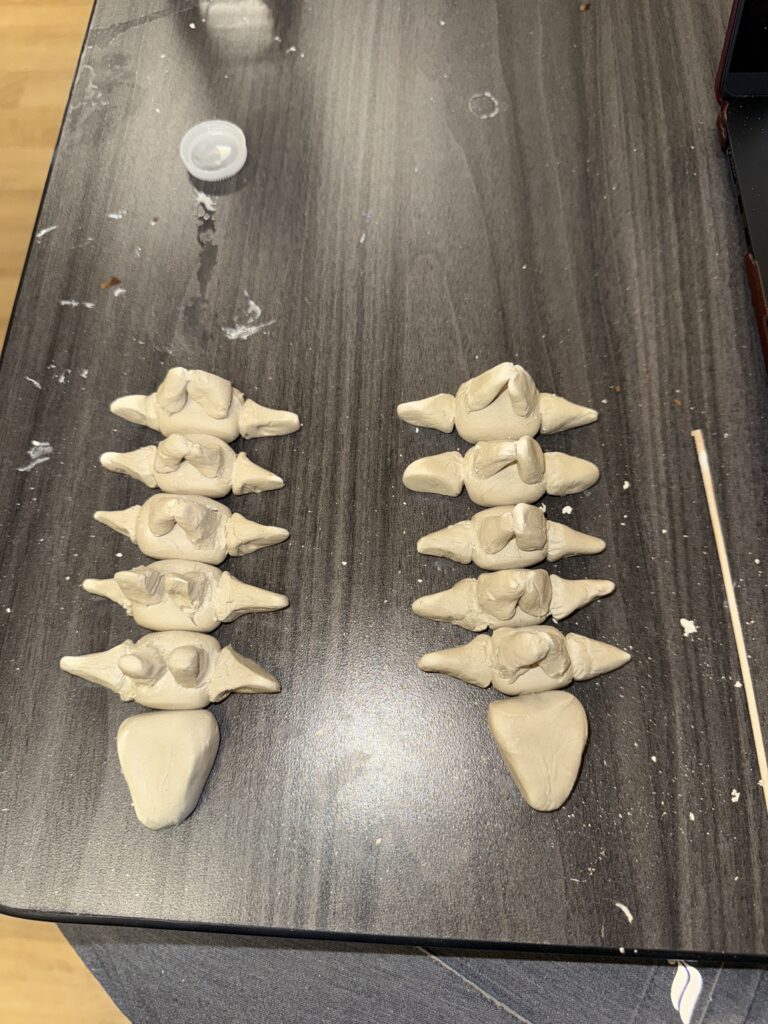
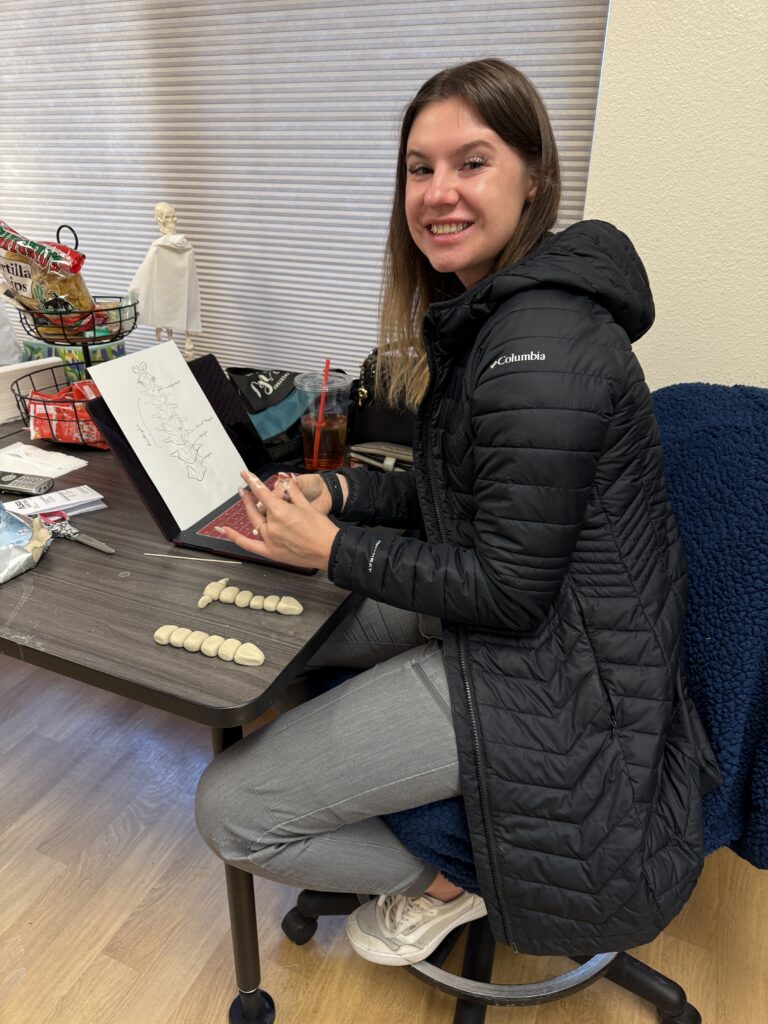
Pam’s STEAM project covers the skeletal system, focusing mainly on the vertebral column, and its development caused by spina bifida occulta. Spina bifida occulta is a mild neural tube defect that occurs when one or more arches in the vertebrae do not close during the early fetal stage of development. Despite the gap barely appearing in the vertebrae, this small gap could eventually cause the instability of the spine and how the spinal cord will be protected from absorbing shock. Spina bifida occulta is considered to be the least severe form of spina bifida and is often unnoticed throughout the individual’s development. However, no symptoms or subtle symptoms will still occur and can be dismissed as normal pains. These subtle symptoms could be lower back pain, muscle weakness, and alterations to gait and posture. Spina bifida occulta is often diagnosed by accident when the individual attends a physician visit for an unrelated reason.
Although spina bifida occulta’s symptoms appear to be mild or subtle, early detection and identification through prenatal ultrasounds and MRI scans will benefit the prevention of the symptoms worsening. The treatment of the condition may also vary depending on the severity of the gap. Those experiencing mild symptoms will benefit from physical therapy, strengthening exercises, and posture correction. Those with more severe cases may require significant surgical intervention in order to protect the spinal cord and prevent further complications. While spina bifida occulta is considered mild, understanding its embryological origins helps physicians detect and identify which treatment benefits the patients by monitoring the development and providing the correct treatment.