
 Posted by
For my STEAM Project, I wrote a short story. On paper, it is about five or six pages. This is a fictional story, and all relationships to real persons, living or dead, is entirely coincidental.
Eliza was 19 when she got the diagnosis. Kuru, a rare and fatal neurological disease. It gave her a year or less. Her mother had cried. Her father had yelled. Eliza just sat, staring out of a nearby window. The doctor was talking, but Eliza couldn’t hear him. When she got home later, it hit her smack in the face, and she cried all night.
They had found out about the disease when Eliza had broken a different glass four days in a row. She had grabbed it, moving to pick it up, when something happened. The first time, she simply dropped it. The next, she twitched, and instead of picking it up, it went flying across the room. Similar things happened twice more before her parents decided to take her to the hospital.
It had taken two weeks before the doctors had decided to test for the disease. They said it was caused by unusual proteins called prions. These were misfolded proteins that caused neuron pathways to shut down and fail. She would lose control over her muscles, lose the ability to speak, and finally go brain dead. It was why she was dropping glasses.
The doctors had wanted to keep her in the hospital to “help her feel better.” She knew that just meant they wanted to do tests on her. Her parents had refused at first, but she had convinced them to bring her to the hospital. She had donated all but one of her belongings the day before she went to the hospital. She only kept her e-reader, because she wanted to lose herself in her books and stories.
When she got to her room, a nurse called to her, saying, “Eliza, come meet your roommate, Carl.”
Eliza walked over calmly, and held her hand out. “My name is Eliza Jane Smith. How do you do, Carl?”
The nurse winced. “He can’t speak honey. He has a similar disease, and he’s in the later stages.”
A frantic grunt left Carl’s mouth, his eyes wide with panic. The nurse wheeled him to his bed, then closed his curtain. “Due to the disease, he is very paranoid. Even if his own family ever visited, he likely wouldn’t recognize them,” the nurse explained.
After that interaction, Eliza watched and waited for someone to visit Carl. Anyone besides the hospital personnel. No one came. Her family brought her cookies and updated her kindle regularly, staying and chatting for hours. The nurses didn’t even stay to talk to Carl, simply feeding him his oatmeal or giving him a bath, then leaving again. By the end of the first week in the hospital, Eliza’d had enough.
She picked up her e-reader, and asked the nurses for a chair. They brought her a metal folding chair and left. Eliza moved over to Carl with the chair and sat down.
“I know you might not understand me, but I still think it’s important that you have someone in your life,” she said quietly. Then, she began reading.
Carl had Creutzfeldt-Jakob disease — she’s heard the nurses discussing it, and done some research of her own. It was similar to Kuru, which explained why Carl was afraid and trembling, even when nothing was happening. She’d seen him at night, shaking and grunting softly under his covers.
She knew he wouldn’t be able to understand much, so she pulled up an old childhood favorite on her e-reader. Ten Apples Up On Top! by Dr. Seuss. She knew it was a kiddie book, but she didn’t care. She wanted Carl to understand what she was trying to do, trying to say without speaking. And he sat quietly, listening until she shut her e-reader and looked at him.
“Did you like it Carl?” she asked softly.
He said nothing, but she saw his head twitch. It seemed like he was trying to nod for her. She smiled, and opened another book.
For the next two months, Eliza spent hours reading and talking to Carl. He never said anything, but she felt she could see the smile in his old, tired eyes. Her days were difficult now, she dropped her utensils when she ate, and she used plastic and paper plates now, as she had broken a few glass dishes.
She wasn’t distracted from the horrors at night, so she cried and trembled. She didn’t know if it was the disease or the quiet sobs that shook her body each night. Sometimes though, she could hear Carl’s bed shaking nuder him as well. She would walk over and tuck him in, hoping it could help, just a bit.
She tried to write sometimes, to get her feelings out on paper, but the words scrambled and scribbled across the page, blurring into unrecognizable lumps. Then, her eyes would tear up, little droplets staining the pages.
By the end of her third month, she couldn’t walk on her own, needing a nurse or a wheelchair to get over and read to Carl. But she read nonetheless, diligently stuttering over the words as her jaw clamped and unclamped of its own free will.
One day, Eliza came back from a short walk — roll, really — to see the room empty, and Carl’s bed made. She rolled to a nearby nursing station and waited for someone to notice her.
“Wh-wh-where’s Carl?” she asked, gesturing to her room.
The nurses glanced to each other, none answering her question. Eliza’s body racked with an involuntary shiver. A nurse brought her back to her room and gave her a paperback.
“Wait here dear. You mother is coming to visit,” said the nurse kindly before disappearing.
Eliza’s mother showed up, ready to sit and chat and brush Eliza’s messy hair. Eliza stopped her before she even sat down.
“Wh-where’s C-C-Carl?” she asked again.
Her mother swallowed nervously, then looked around. After several minutes of silence, her mother finally answered, “He passed while you were out, baby. I’m sorry.”
Eliza burst into tears, shivers from sobs and her damaged neural pathways racked her body till she nearly collapsed.
She learned that Carl had passed due to a heart attack. It had been inevitable, really. With their prion diseases, their brains couldn’t keep up with the needs of their bodies, and eventually, something would have failed. But now it was real for Eliza. She spent the night crying, getting no sleep, wishing to hear Carl shivering in the other bed.
A week later, she went to the funeral. Only hospital staff and her family were there, and it was a very small ceremony. It was the first time she had left the hospital since her diagnosis, but she wished it had never happened.
She watched his frail body get covered first by a coffin lid, then by layers of dirt. She asked to be taken back to her room, because she couldn’t watch anymore.
When she got back to her room, a nurse was waiting with a paper in hand.
“Eliza, I think this is for you. It was on Carl’s nightstand when he passed,” the nurse said, handing Eliza the paper.
Eliza took it, and carefully unfolded it, almost dropping it several times due to her tremors. Once she unfolded it, she nearly burst into tears again. On it were five letters, large and printed. Painstakingly, carefully written letters that were so shaky, she could barely read what they said.
“We think he wrote it in his last couple of days here. It must have been difficult to even make the letters legible,” said the nurse quietly.
Eliza did cry the, but these were quieter than her tears when Carl had died, or at his funeral. An involuntary smirk twitched at her lips, but the disease seemed weaker, invisible in the face of those five letters.
Carl’s last written piece, from only a few days ago.
Her name. Eliza.
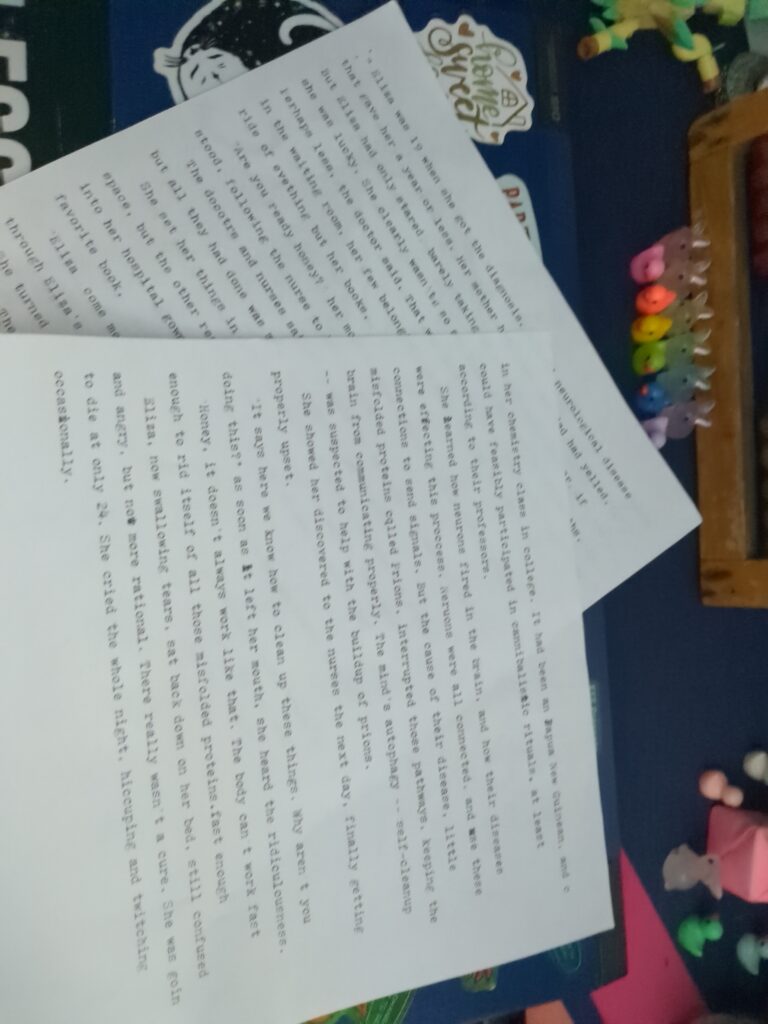
This is the original draft of my paper. I started writing it on my typewriter before realizing it would be easier to read if I just typed it here instead. I hope you enjoyed the story.
CJD, Kuru, and other prion disease are caused by by misfolded proteins called prions. These can be caused naturally, and can be contracted through consumption — or genetically, in some cases. It is thought to be always fatal, although the body has a natural system — autophagy — that could feasibly clean some of the prions up. However, it seems autophagy may “malfunction” in the face of prion buildups (Yao et al.).
Kuru was specifically seen to be caused by cannibalistic practices in Papua New Guinea — around the 1950s. The last recorded case of Kuru was in the year 2002, as it seemed to gradually die off due to limitation of said practices. Kuru has a large incubation period with an acute onset, making it difficult to detect (Gajdusek & Zigas). CJD is also caused by prions, but is not limited to contraction through consumption. It can also be contracted through genetic means (Cyngiser).
Both diseases have similar symptoms, as they are both caused by prions. As the prions interrupt neurons — by sticking to them — a communication breakdown occurs in the brain. This causes signals to go to incorrect places, meaning that muscles will move involuntarily (Fang et al.). In turn, speech, movement, balance, and automatic functions begin to either occur incorrectly or less frequently. While the mind breaks down, understanding of any concepts, basic or complex, would decrease, as well as memory. Some increased paranoia can also be observed with both diseases, causing irrational outbursts or accidental harm (Collinge et al., Mayo Clinic).
Resources:
Collinge, J., Whitfield, J., McKintosh, E., Frosh, A., Mead, S., Hill, A., Brandner, S., Thomas, D., Alpers, M. “A Clinical Study of Kuru Patients With Long Incubation Periods at the End of the Epidemic in Papua New Guinea.” Philosophical Transactions of the Royal Society B Biological Sciences, vol. 363, no. 1510, Oct. 2008, pp. 3725–39. https://doi.org/10.1098/rstb.2008.0068.
Cyngiser, T. “Creutzfeldt-Jakob Disease: A Disease Overview.” American Journal of Electroneurodiagnostic Technology, vol. 48, no. 3, Sept. 2008, pp. 199–208. https://doi.org/10.1080/1086508x.2008.11079680.
Fang, C., Imberdis, T., Garza, M., Wille, H., Harris, D. “A Neuronal Culture System to Detect Prion Synaptotoxicity.” PLoS Pathogens, vol. 12, no. 5, May 2016, p. e1005623. https://doi.org/10.1371/journal.ppat.1005623.
Gajdusek, D., Zigas, V. “Kuru.” The American Journal of Medicine, vol. 26, no. 3, Mar. 1959, pp. 442–69. https://doi.org/10.1016/0002-9343(59)90251-7.
Imran, M., Mahmood, S. “An Overview of Animal Prion Diseases.” Virology Journal, vol. 8, no. 1, Nov. 2011, p. 493. https://doi.org/10.1186/1743-422x-8-493.
Yao, H., Zhao, D., Khan, S., Yang, L. “Role of Autophagy in Prion Protein-induced Neurodegenerative Diseases.” Acta Biochimica Et Biophysica Sinica, vol. 45, no. 6, Mar. 2013, pp. 494–502. https://doi.org/10.1093/abbs/gmt022.
—. “Creutzfeldt-Jakob Disease – Symptoms and Causes – Mayo Clinic.” Mayo Clinic, 28 Jan. 2023, www.mayoclinic.org/diseases-conditions/creutzfeldt-jakob-disease/symptoms-causes/syc-20371226.
Lola Guritz wrote a short story about a young woman named Eliza who is diagnosed with a fatal neurodegenerative disorder and given less than a year to live. Though the story is fictional the disease she writes about is very real. Kuru, a neurological disorder that causes the body to produce unusual proteins known as prions. Prions, misfolded proteins that cause neuron pathways to shut down and fail, lead to cellular death. Kuru strikes the main character of the story quickly and causes rapid neurologic damage and nerve degeneration. Eliza’s disease causes her to lose control over her muscles, lose the ability to speak, and finally go brain dead.
In the story, knowing that the disease would reduce Eliza to a hospital bed, her family takes her to the hospital for monitoring and observation. During her stay in the hospital, Eliza is placed in a room with a man named Carl who also has a neurodegenerative disease caused by prions. Carl’s disease is called Creutzfeldt-Jakob disease (CJD), which is known as mad cow disease in bovines (Betts et al, 2022, p. 482). Carl is farther along in his degeneration and Eliza ends up reading to him to ease his loneliness and to pass the long hospital hours.
Carl dies and Eliza is left with the harsh reality that she soon will succumb to her disease. Diseases like kuru and CJD can be contracted through consumption or are inherited genetically. Kuru and CJD have similar symptoms, both caused by prions that interrupt neurons by sticking to them causing a communication breakdown in the brain. Neuropathway signals get crossed and cause misfiring of muscles. The final stage of both disorders attacks the brain and leaves the patient immobile and unable to speak. Both diseases are always fatal.
References:
Betts, J. G., Desaix, P., Johnson, E., Johnson, J. E., Korol, O., Kruse, D., Poe, B., Wise, J. A., Womble, M., & Young, K. A. (2022). Anatomy and Physiology (2nd ed.). OpenStax, Rice University, p. 482.