
 Posted by
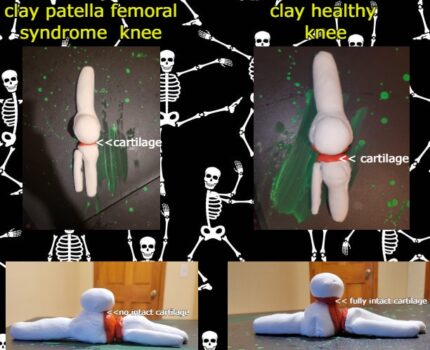
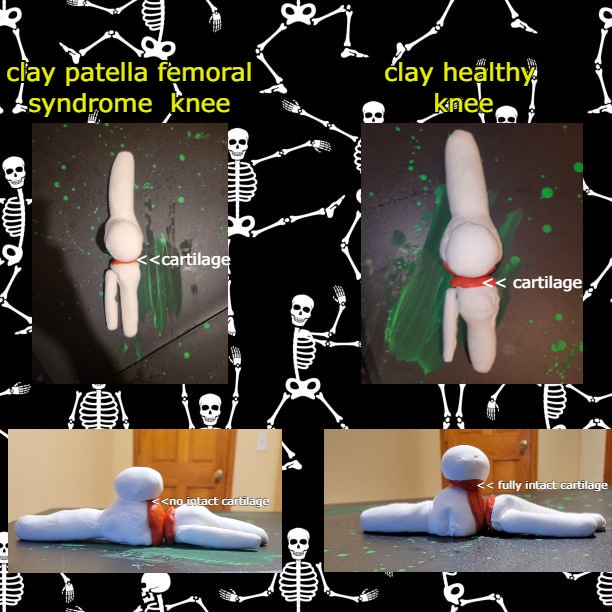
By creating clay models of a healthy knee and a knee affected by patellofemoral pain syndrome offers a visual aide and a hands on view of how patella femoral syndrome affects the normal functions of the bones specifically support, protection, and movement The patella, femur, and tibia work together to create the knee joint. As you see with me modeling two different knees one being healthy and the other being affected by patella femoral syndrome, you see the functional differences.
The model of a healthy knee, patella sits perfectly within the trochlear groove of the femur, representing a proper patellar tracking. The placement is vital for support, as the patella helps disperse force during weight bearing activities However, the model of the knee with patella femoral syndrome shows a patella positioned slightly laterally, demonstrating the maltracking described by Fick et al. (2021). Their study found that individuals with patella femoral syndrome show different patellofemoral kinematics, including multi-plane maltracking in the sagittal, coronal, and axial planes. The knee struggles with weight distribution because misalignment leads to uneven load sharing across bones. The model makes this concept clearer by showing how a shifted patella disrupts the balance and stability of the entire joint structure.
The second function represented in the clay models is movement. A healthy knee sculpture, the patella acts as a smooth gliding lever for your quadriceps tendon, enhancing mechanical efficiency during extension and flexion. To show the PFPS knee, I sculpted the patella with a slightly tilted orientation, symbolizing how maltracking can impair the lever arm. Coelho et al. (2021) found that individuals with patella femoral syndrome perform worse on balance tasks, such as the anterior reach of the Y-Balance Test, even though proprioception may remain intact. Which suggests that weakened movement is due to a change in mechanics rather than loss of sensation. The model shows a deviation in patella motion altering normal joint mechanics, which leads to difficulty squatting, going up and down stairs, and running.
The third function depicted in the clay representation is protection. However with a healthy knee, the patella protects the femoral trochlea by absorbing forces across a broad area. My healthy model shows a wide, congruent contact surface between the patella and the femur. In contrast, the PFPS clay knee has a noticeably reduced contact area. This reflects Fick et al.’s (2021) findings that maltracking decreases patellofemoral contact area and increases localized pressure on cartilage and bone. With stress concentrated in smaller regions, the knee becomes vulnerable to pain, cartilage wear, and long-term damage. The model shows how the damage is visible with how a change in alignment can lead to significant structural damage.
In conclusion, using clay art to model both a healthy knee and a PFPS affected knee provides an effective way to understand how PFPS compromises the bone functions of support, movement, and protection. The visual differences between correct and Incorrect patella alignment widens the understanding of biomechanical findings from Coelho et al. (2021) and Fick et al. (2021).
References
Coelho, V. K., Gomes, B. S. Q., Lopes, T. J. A., Corrêa, L. A., Telles, G. F., & Nogueira, L. A. C. (2021). Knee proprioceptive function and physical performance of patients with patellofemoral pain: A matched case-control study. Knee, 33, 49–57. https://doi.org/10.1016/j.knee.2021.08.031
Fick, C. N., Jiménez-Silva, R., Sheehan, F. T., & Grant, C. (2021). Patellofemoral kinematics in patellofemoral pain syndrome: The influence of demographic factors. Journal of Biomechanics, 130, 110819. https://doi.org/10.1016/j.jbiomech.2021.110819
Abstract :
Each clay sculpture represents the bones of a human knee and the cartilage in that region. The cartilage in each of these structures, as well as the positioning of the patella, however, are different. In the clay sculpture on the right, a healthy human knee is represented. The clay sculpture on the left represents a knee with Patellofemoral Pain Syndrome. This syndrome involves a misaligned patella, causing load bearing to be uneven for the knee. In a healthy knee, the patella can smoothly glide and aids in flexion and extension. In a knee with Patellofemoral Pain Syndrome, the misalignment of the patella can hinder movements and make activities such as squatting, running, and going up the stairs more difficult. A healthy knee offers a wide, congruent contact area between the patella and femur. A healthy knee has a normal amount of wear and tear. However, the knee with Patellofemoral Pain Syndrome shows less contact area. The same amount of pressure put onto a smaller contact area results in more wearing down of cartilage, more damage, and ultimately more pain. Overall, a knee with Patellofemoral Pain Syndrome is misaligned, hinders ease of movement, decreases overall protection, and can be painful.