 Posted by

Water is one of the most abundant molecules in the human body. Its structure as well as its abundance are why water is such an important molecule in bodily functions. By examining water’s tendency to hydrogen bond because of its polarity, its physical properties can be identified. Some properties that arise from water’s structure are a high heat capacity and heat of vaporization, and the presence of a dipole caused by polarity (Larson, 2025). These features are critical to maintaining body temperature and extracellular environment temperatures during cellular reactions, as well as dissolving salts and certain macromolecules as a solvent.
On the atomic scale, water is formed from 2 covalent bonds between two hydrogen atoms and one oxygen atom. Figure 1. Geometry Optimized Molecular Structure of Water using WebMO Software.
The red sphere symbolizes oxygen, while the two smaller white spheres are hydrogen. Evidently, the oxygen atom is much larger than the hydrogen atom, which means it has more protons and therefore more pull on electrons than the hydrogen atom, which only has one proton. This property of oxygen, having a greater “pull” on electrons than hydrogen, is known as electronegativity. A very electronegative atom will create an uneven sharing of electrons in a covalent bond as the electrons drift closer to the electronegative atom and further away from the less electronegative atom. Since electrons carry charge, an uneven distribution across a molecule will create partial positive and negative charges in certain areas of the molecule. Figure 2. Partial Charges on the Atoms in a Water Molecule (WebMO).
The partial charges calculated by the software WebMO state that an oxygen atom in water has a partial charge of -0.87 and the hydrogens have a partial charge of +0.43. Water, as a gross substance, will have a massive amount of these molecules in proximity. Because of this, the slightly charged regions of water will be electrically attracted to each other. Through analyzing the structure of water in its liquid form electronically, it was determined that each water molecule can form around 3.4 hydrogen bonds per molecule (Kumar et al., 2007). More bonding between molecules raises a substance’s specific heat capacity and heat of vaporization because a more attractive interaction between molecules increases the energy required to sever those interactions. Since water is capable of forming many hydrogen bonds per molecule, water as a gross substance is extremely resistant to changes in temperature. Since water is around 60-80% of the volume in living cells, it is important for water to be able to handle changes in temperature due to chemical reactions occurring within the cell. Water’s high heat capacity allows for a consistent cellular environment, which is essential for the proper functioning of proteins, lipids, and other cellular components. On a larger scale, water’s high heat of vaporization is why sweating is an effective means of cooling the body; since water absorbs so much heat before turning into water vapor, it can carry excess heat away from the body (Larson, 2025).
When an atom is asymmetrical (like water) and has partial charges caused by an electronegative atom, creating an unequal distribution of electrons, the molecule is known as polar. The saying “like dissolves like” is often tossed around, which stems from the tendency of substances that share similar properties to be miscible with each other. Mostly non-polar molecules like lipids are not miscible with water or other polar molecules because there are no formal or partial charges on their long hydrocarbon chains. Water, being a polar molecule, makes it an effective solvent for ionic and other polar molenocules—which includes important macromolecules like proteins and nucleic acids (Larson, 2025). Since water is so abundant in the body, most reactions will occur in the presence of water, which means most compounds in the body will be water-soluble. Compounds like salts, such as sodium chloride (NaCl), disassociate in water because of the partial charges on water’s atoms. All salts are ionic compounds, which means they are bonded together through an ionic bond. Ionic bonds involve the donation and reception of electrons between two atoms. This complete transfer of an electron creates full charges (positive or negative) on each of the atoms involved in bonding. The partial charges on water will react with the full charges on salt molecules and disassociate them into solution. It is this process that creates the ions (such as Na+ or K+) that the body requires for chemical signalling in the body (Larson, 2025). A very interesting phenomenon that occurs when water is close to non-polar surfaces is the increased organization of molecules. Typically, water molecules are disorganized, and hydrogen bonds are shifting between molecules. Research done by Scatena et al. in their report “Water at Hydrophobic Surfaces: Weak Hydrogen Bonding and Strong Orientation Effects” found that water surrounded by other water or water vapor vibrates at lower frequencies in the infrared region, but vibrates at higher frequencies when near non-polar substances. Lower vibrational frequencies are suggestive of water molecules that are strongly hydrogen-bonded to each other. Higher vibrational frequencies are suggestive of decreased or non-existent hydrogen bonding between water molecules. This means water molecules that are closer to non-polar molecules (which tend to repel charged molecules) will have less of an opportunity to hydrogen bond. What is interesting about this is that even though there is little to no interaction between the water molecules and the non-polar interface, the lack of hydrogen bonding actually forces the water molecules into a more organized state when they are near the hydrophobic substance, when compared to the disorganization when they are surrounded by other water molecules. Based on the article from Scatena et al., this process of water becoming more organized at a non-polar interface is not fully understood because the behavior is hard to quantify. What is understood, however, is the importance of water at non-polar interfaces because its behavior plays roles in processes such as “[p]rotein folding, membrane formation, [&] micellar assembly” (Scatena et al., 2001).
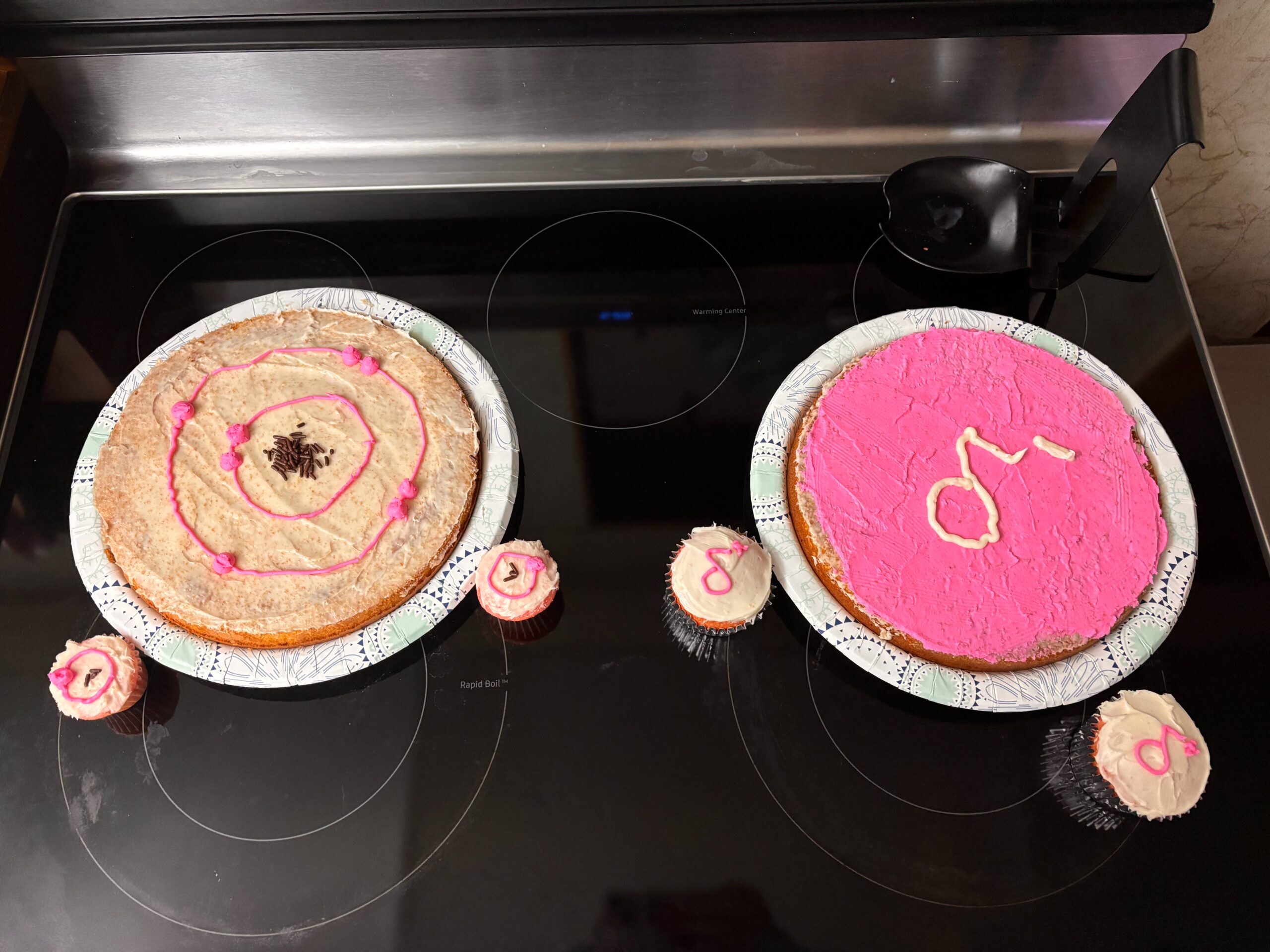
Water can seem like such a simple molecule on a surface level, but evidently, the electrochemical properties of water give it a lot more complexity and importance than is initially realized—to the point where researchers have not yet figured out how water interacts with gross amounts of nonpolar molecules. My STEAM project visualizes the difference in size between the atoms that form water and their relative partial charges; water’s polarity is a driving factor in its physical properties that make it so useful in the body. Even though hydrogen is small, it carries a large partial charge because of the high electronegativity of oxygen. This is pictured in my STEAM project, as the partial charges of hydrogen are larger than the actual atom, while the relative size of oxygen to it’s partial charge stays generally the same. I hope that the difference in sizes of the mini cupcakes to the normal cupcakes does a good job visualizing how oxygen contains both positive and negative partial charges, which is the driving force behind all of its behavior in the body discussed above.
References
Betts, J. G., Young, K. A., Wise, J. A., Johnson, E., Poe, B., Kruse, D. H., … DeSaix, P. (2022). 2.2 Chemical Bonds. In Anatomy and Physiology 2e. OpenStax. https://openstax.org/books/anatomy-and-physiology-2e/pages/2-2-chemical-bonds.
Kumar, R., Schmidt, J. R., & Skinner, J. L. (2007). Hydrogen bonding definitions and dynamics in liquid water. Journal of Chemical Physics, 126(20), Article 204107. https://doi.org/10.1063/1.2742385.
Larson, D. (2025). Unit 1 Chemistry [PowerPoint slides]. Canvas at the University of Alaska Fairbanks.
Larson, D. (2025). Unit 2 Macromolecules and Cells [PowerPoint slides]. Canvas at the University of Alaska Fairbanks.
Scatena, L. F., Brown, M. G., & Richmond, G. L. (2001). Water at hydrophobic surfaces: Weak hydrogen bonding and strong orientation effects. Science, 292(5518), 908–912. https://doi.org/10.1126/science.1059514. WebMO LLC. (2024). WebMO [Web-based application]. https://www.webmo.net.
I loved the refresh on water molecules! Not only is water one of the most abundant molecules in the body but one of the most important structures in the body. It was really cool how the cupcakes represented the positive and negative charges in oxygen. In this project I saw the differences in comparison by size, content, and relative partial charges.
I also saw how water is a polar solvent molecule which is important in dissolving macromolecules and nucleic acids. I learned that since water is the most effective solvent in the body especially for ionic molecules such as salt, due to the partial charges on water’s atoms. This process is called disassociation. A part that I found interesting was the study done by “Water at Hydrophobic Surfaces: Weak Hydrogen Bonding and Strong Orientation Effects” in how water surrounding itself generates vibrations in lower frequencies through infrared region. This causes the water molecules to be more organized since it interacts or bonds less with hydrogen bonds.