 Posted by
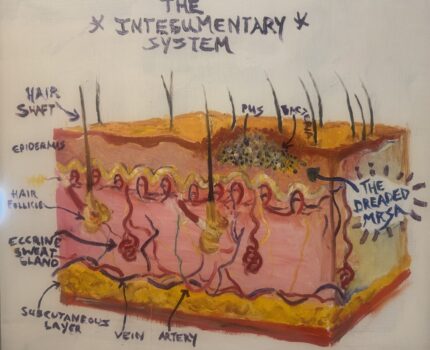
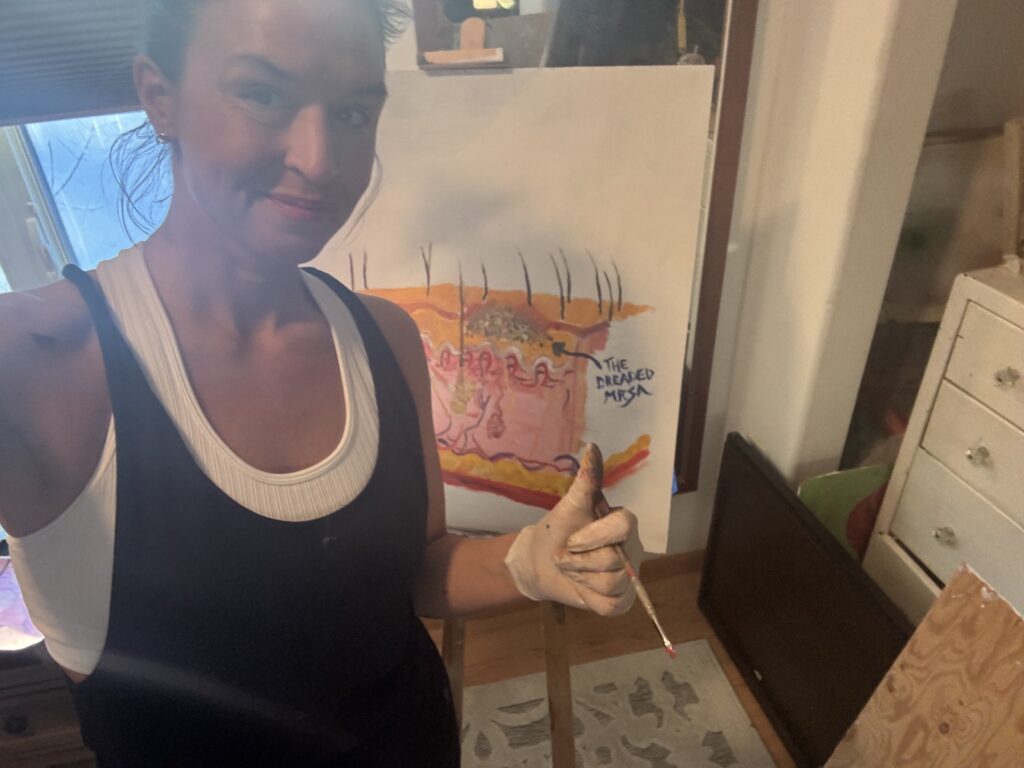
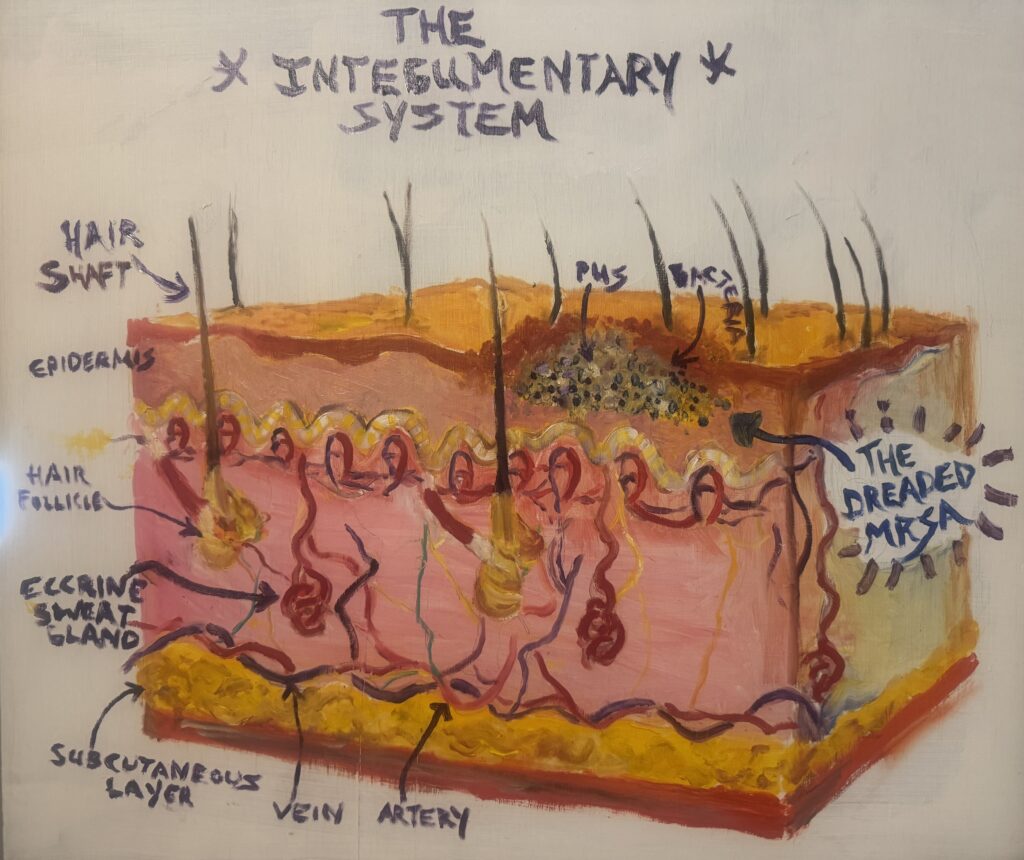
Methicillin-resistant Staphylococcus aureus, more commonly known as MRSA, was my immediate thought when I first heard of the STEAM project. Unfortunately, it not only satisfied the required criteria, but I also happen to have firsthand experience with this awful condition.
As my chosen objective was Describe the functions of the integumentary, I feel it is important to start by explaining what the integumentary system encompasses. The integumentary system is a vital part of the human body, and comes in the form of hair, nails, glands, and most importantly, skin. This system is essential for temperature regulation, allowing our bodies to maintain a healthy temperature. It also contains nerve endings that give us sensations. Without sensation we wouldn’t be able to feel pain, pressure, touch,etc. We excrete waste in the form of sweat, through the integumentry system and it also synthesizes Vitamin D. Most importantly, especially when covering the bacteria known as MRSA, the integumentry system plays an important role in protection. Skin serves as our armor, protecting our organs and the rest of our interior body parts from countless harms. The danger can come from viruses, bacteria, physical injury, chemicals, the sun, etc. and our skin acts as the first line of defense.
MRSA is an incredibly contagious bacteria that often finds its way into the human body where there is a weak spot in our skin such as a cut, scrape, pimple. It can appear in the form of abscesses, blisters, boils and is extremely dangerous as it is resistant to regular antibiotics that should be able to kill it, such as penicillin. Although it can reveal itself as a skin lesion, it can easily spread throughout the body into bones, blood, organs, and joints which can prove fatal if not properly treated in a timely manner. MRSA most frequently colonizes itself in a person’s nasal passage. Statistically speaking, 28-32% of the U.S population has MRSA in their nares(Turner,et al 2025), although it can remain dormant for life.
MRSA is ever adapting, unpredictable, and versatile which makes it so hard for doctors to attack. There are new trials that show promise on being effective destroyers of this bacterial infection, but it is so hard as there are so many strains, and more being discovered every day. The most commonly used drug, that has proven a certain degree of effectiveness throughout the last few decades is Vancomycin. Vancomycin is a glycopeptide antibiotic, that is most effective when administered intravenously. Intravenous administration allows it to enter the bloodstream unlike its oral option. Another antibiotic known for its ability to treat MRSA is Linezolid. This option also can be administered orally or intravenously, depending on the severity of infection but also carries serious side effects. Although vaccines would be a great defense, there has been no success in that department, to date.
Another frightening issue, specific to MRSA is that the risk of infection is extremely high as anything that comes in contact with one’s skin can serve as a formite. In other words, MRSA doesn’t discriminate on its method of transfer. It is commonly found in hospital settings as it loves open wounds, weakened bodies, and invasive procedures. Another reason it is easy to acquire in such a setting is its ability to survive on any surface for an extended amount of time if the object/area is not thoroughly disinfected. It is an interesting fact that hospital-acquired MRSA infections (in the US) are caused by specific strains, PFGE USA100 or USA200 whereas those found in the community are found to be created from USA300 or USA400 strains (Hassoun, et al 2017). These strains and others can be identified through molecular typing methods such as pulsed field gel electrophoresis. As it doesn’t discriminate on its method of transfer, MRSA also doesn’t attack any specific demographic. It can be found in the young and old, and any race though it does have a higher prevalence amongst drug users, prisoners, healthcare professionals, athletes and the military.
I was one of the high-risk people, many years ago and learned the hard way how brutal this infection can be. I spent a large portion of my life being addicted to methamphetamines and would go through phases where I would obsess over zits that weren’t even there. I would spend hours picking at my face. Throughout my active addiction, I had a terrible Staph infection once and years later found myself with a MRSA infection, both times were in my face. Although some details have become foggy, certain details, I will remember for the rest of my life. The night before I got MRSA, I locked myself in a bathroom and was digging at a zit under my eye, close to my nose. About an hour into picking, my face started swelling so much that my one eye was too puffy to see out of. A friend told me to go to sleep and it would be better in the morning. When I woke up the next day, my face was elevated like I had been sleeping on multiple pillows. I looked in the mirror, and half of my face had doubled in size. I spent the next three days in the hospital, with nurses constantly removing pus filled pads from my face. Fortunately, that part of my life is long in the past, but once someone gets MRSA, it will always be in their body.
REFERENCES
Turner, N. A., Sharma-Kuinkel, B. K., Maskarinec, S. A., Eichenberger, E. M., Shah, P. P.,
Carugati, M., Holland, T. L., & Fowler, V. G., Jr (2019). Methicillin-resistant Staphylococcus
aureus: an overview of basic and clinical research. Nature reviews. Microbiology, 17(4),
203–218. https://doi.org/10.1038/s41579-018-0147-4
Parsons, J.B., Mourad, A., Conlon, B.P. et al. Methicillin-resistant and
susceptible Staphylococcus aureus: tolerance, immune evasion and treatment. Nat Rev
Microbiol (2025). https://doi.org/10.1038/s41579-025-01226-2
Hassoun, A., Linden, P. K., & Friedman, B. (2017). Incidence, prevalence, and management
of MRSA bacteremia across patient populations-a review of recent developments in MRSA
management and treatment. Critical care (London, England), 21(1), 211.
https://doi.org/10.1186/s13054-017-1801-3