 Posted by
Human Vs. Egg-Laying Mammal Reproductive Systems:
Mammalian reproductive systems exhibit significant diversity across evolutionary lineages, particularly when comparing placental mammals such as humans to egg-laying mammals, or monotremes, such as the platypus and echidna. While both groups share core mammalian features—such as internal fertilization and lactation—the structure, function, and physiological regulation of reproduction differ markedly. Drawing on recent systems-level physiological insights (Ivell & Anand-Ivell, 2021) and evolutionary anatomy (Kielan-Jaworowska, 2004), this essay explores the contrasting reproductive strategies and systems of humans and monotremes.
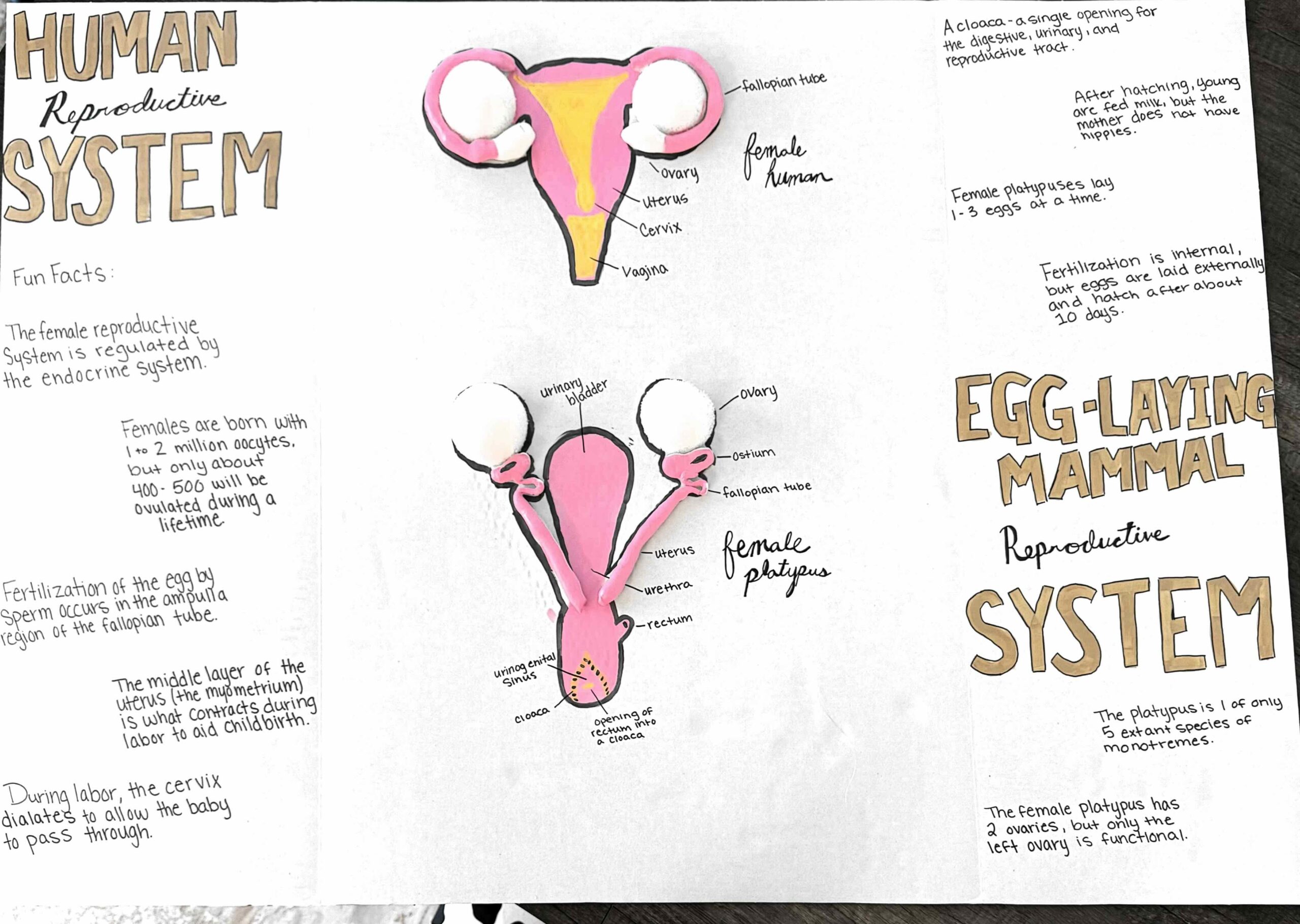
The human reproductive system, as a representative of placental mammals (eutherians), is highly specialized for internal gestation and live birth. The female reproductive tract includes paired ovaries, fallopian tubes, a uterus, and a vagina. After ovulation and fertilization in the fallopian tube, the embryo implants into the uterine wall, where it is nourished via the placenta. This organ enables gas exchange, waste removal, and nutrient delivery between mother and fetus. The hormonal regulation of human reproduction is dynamic and tightly coordinated, involving pulsatile secretion of gonadotropin-releasing hormone (GnRH), luteinizing hormone (LH), and follicle-stimulating hormone (FSH), which control ovulation and sex steroid production (Ivell & Anand-Ivell, 2021). Feedback loops involving the hypothalamic-pituitary-gonadal axis are central to maintaining reproductive cycles and fertility.
In contrast, monotremes—the most primitive living mammals—retain several reproductive features characteristic of reptiles. Monotreme females lay leathery-shelled eggs after internal fertilization. Only the left ovary is functional in the platypus, and the reproductive tract opens into a single cloaca, a shared passage for urine, feces, and reproductive materials. After a brief gestation, monotremes lay eggs that are incubated outside the body. Hatching occurs after about 10 days, and the altricial young rely on maternal milk secreted through skin openings, as monotremes lack nipples (Kielan-Jaworowska, 2004). This primitive form of lactation supports the underdeveloped offspring until they can feed independently.
A significant difference between these two systems lies in developmental strategy. Placental mammals invest heavily in internal gestation, with the uterus and placenta supporting extensive fetal development prior to birth. This allows for the birth of relatively mature and viable offspring. In contrast, monotremes invest less in internal development; the embryo completes much of its growth outside the mother’s body, protected by an eggshell. This shift reflects different reproductive trade-offs in evolutionary history. Monotremes, though mammals, exhibit a mix of mammalian and reptilian reproductive features, suggesting an early divergence from the therian lineage that gave rise to marsupials and placental mammals (Kielan-Jaworowska, 2004).
Modern physiological research also highlights the complex regulation of reproduction in placental mammals. Ivell and Anand-Ivell (2021) argue that mammalian reproduction is governed by dynamic, system-wide signaling networks rather than isolated hormonal events. In humans, hormonal pulses and feedback mechanisms are integrated with metabolic, neural, and environmental signals, enabling precise control over fertility, menstrual cycles, and pregnancy. This complexity contrasts with the simpler reproductive control systems of monotremes, which rely more heavily on fixed seasonal cues and less on hormonal feedback cycles.
In conclusion, while humans and monotremes share core mammalian reproductive traits such as internal fertilization and lactation, their systems diverge significantly in anatomical structure, physiological regulation, and developmental strategy. Humans rely on a highly integrated, hormonally regulated system that supports long gestation and live birth, while monotremes retain egg-laying and cloacal anatomy more similar to their reptilian ancestors. These differences underscore both the adaptability and evolutionary history of mammalian reproduction.
Citations:
https://doc.rero.ch/record/16173/files/PAL_E3377.pdf?utm_e
Textbook
Lecture notes
https://www.frontiersin.org/journals/physiology/articles/10.3389/fphys.2021.650550/full