 Posted by
Crohn’s disease (CD) is an incurable type of autoimmune disease, specifically an inflammatory bowel disease, that can only be managed. Both genetics and the environment play a role in the microbiome, which is important in the prognosis of CD. Genetically, mutations can impair the immune response to microbes by epithelial and dendritic cells, which are the innate immune cells found in the bloodstream and gut. The diet, antibiotic exposure, and infections can induce CD (M.T. Henke et al., 2019).
It’s important to discuss the hygiene hypothesis, as studies have observed that there is a negative correlation between infectious disease frequency and increase of allergic and autoimmune diseases. There is not enough evidence to determine causation based on this correlation alone, and many researchers disagree with the hypothesis. Because infectious disease frequency is difficult to quantify, this can be measured socio-economically. Factors can include the quality of drinking water, the cold chain, and the use of antibiotics and vaccines. One supportive piece of evidence is that allergic and autoimmune diseases are more common in families with more children than in families with only one child. This suggests that larger families contain a larger microbiome which allows for greater resistance to diseases such as CD (Bach, J-F., 2021).
To understand CD on a molecular level, we must examine the gut microbes. Trillions of microbes live in the human intestine, which allows homeostasis with the immune system. Interactions between the two are compromised when the gut microbe composition changes. These changes may be due to factors such as diet and inflammatory conditions. To understand the gut microbiota of patients with Crohn’s disease, one study used fecal sampling on patients with specific carbohydrate diets (SCD) vs a low residue diet (LRD). Inflammatory bowel disease (IBD) symptoms were closely monitored and a high-density DNA microarray PhyloChip assessed gut microbiota composition. It was found that there was less gut microbiome complexity in IBD patients than healthy individuals. And interestingly, IBD patients had a greater abundance of Bacteriodes fragilis (B. fragilis). Additionally, there was increased microbial diversity in patients who received the SCD, while those receiving the LRD diet had reduced microbial diversity (Walters SS et al., 2014).
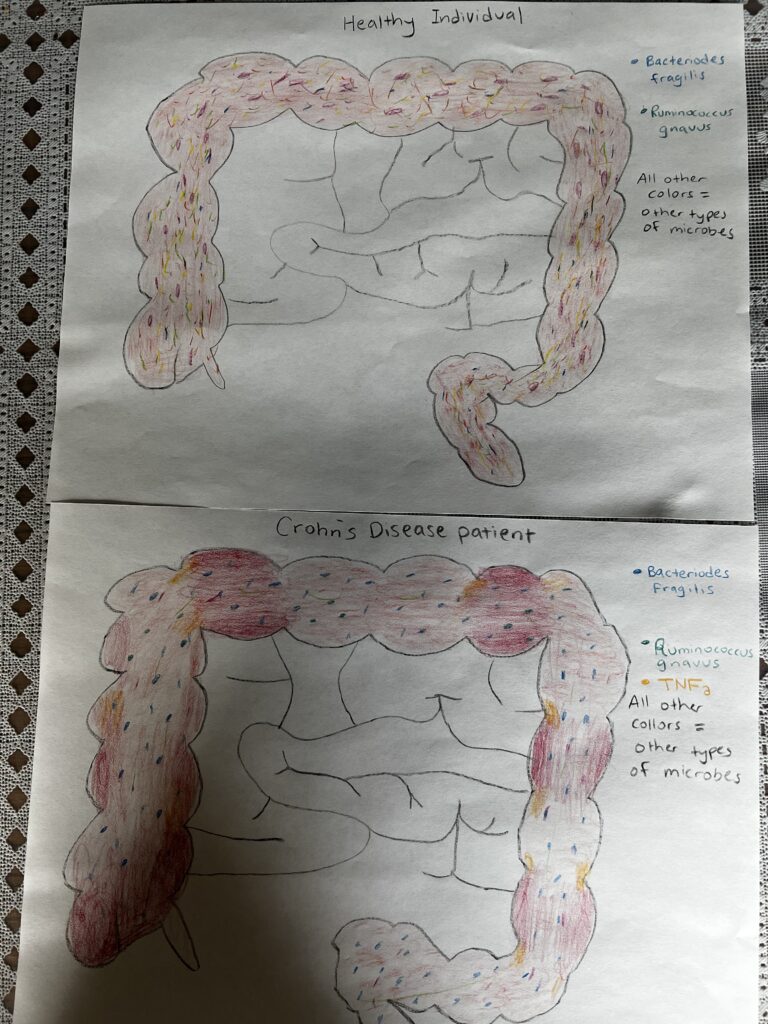
Although these results are telling, additionally research produces results that suggest further complexity with gut microbes involved with Crohn’s disease. Ruminococcus gnavus (R. gnavus), a prevalent gut microbe has been associated with Crohn’s disease, according to multiple studies. R. gnavus is a gram-positive bacterium that is resistant to antibiotics, and has been found more abundantly in CD patients. R. gnavus creates and releases a complex inflammatory glucorhamnan polysaccharide. This molecule induces inflammatory cytokine, tumor necrosis factor alpha (TNFa), secretion by dendritic cells. In fact, CD symptoms are managed by using antibodies against TNFa. The molecular mechanism described provides a direct relationship between R. gnavus and Crohn’s disease. Adoption of a Western diet has been linked with the increase of CD worldwide, further suggesting an environmental factor in its onset. Overall, various factors influence the gut microbiome in patients with CD, leading to an imbalance that is not seen in healthy individuals (M.T. Henke et al., 2019).
Bach, J.-F. (2025). Revisiting the hygiene hypothesis in the context of autoimmunity. Frontiers. https://www.frontiersin.org/journals/immunology/articles/10.3389/fimmu.2020.615192/full
M.T. Henke, D.J. Kenny, C.D. Cassilly, H. Vlamakis, R.J. Xavier, & J. Clardy. (2019). Ruminococcus gnavus, a member of the human gut microbiome associated with Crohn’s disease, produces an inflammatory polysaccharide, Proc. Natl. Acad. Sci. U.S.A. 116 (26) 12672-12677, https://doi.org/10.1073/pnas.1904099116.
Walters SS, Quiros A, Rolston M, Grishina I, Li J, Fenton A, DeSantis TZ, Thai A, Andersen GL, Papathakis P, Nieves R, Prindiville T, Dandekar S. (2014). Analysis of Gut Microbiome and Diet Modification in Patients with Crohn’s Disease. SOJ Microbiol Infect Dis. 2014;2(3):1-13. doi: 10.15226/sojmid/2/3/00122. Epub PMID: 29756026; PMCID: PMC5944867.
Crohn’s disease is an inflammatory bowel disease that, rather than having a cure, can only be managed. This journal discusses the hygiene hypothesis and the problems associated with the hypothesis, including lack of evidence. Infectious diseases are hard to quantify and need to be examined through different lenses, including a socio-economical one. This article also discusses Crohn’s disease on a molecular level, specifically examining microbiomes in the “gut.” Usually in a healthy individual the digestive system is in homeostasis with microbes that line the intestine, however that can change when the combination of the digestive microbiome changes. Analysis is conducted with sampling fecal matter and determining what factors contribute to Crohn’s disease.